
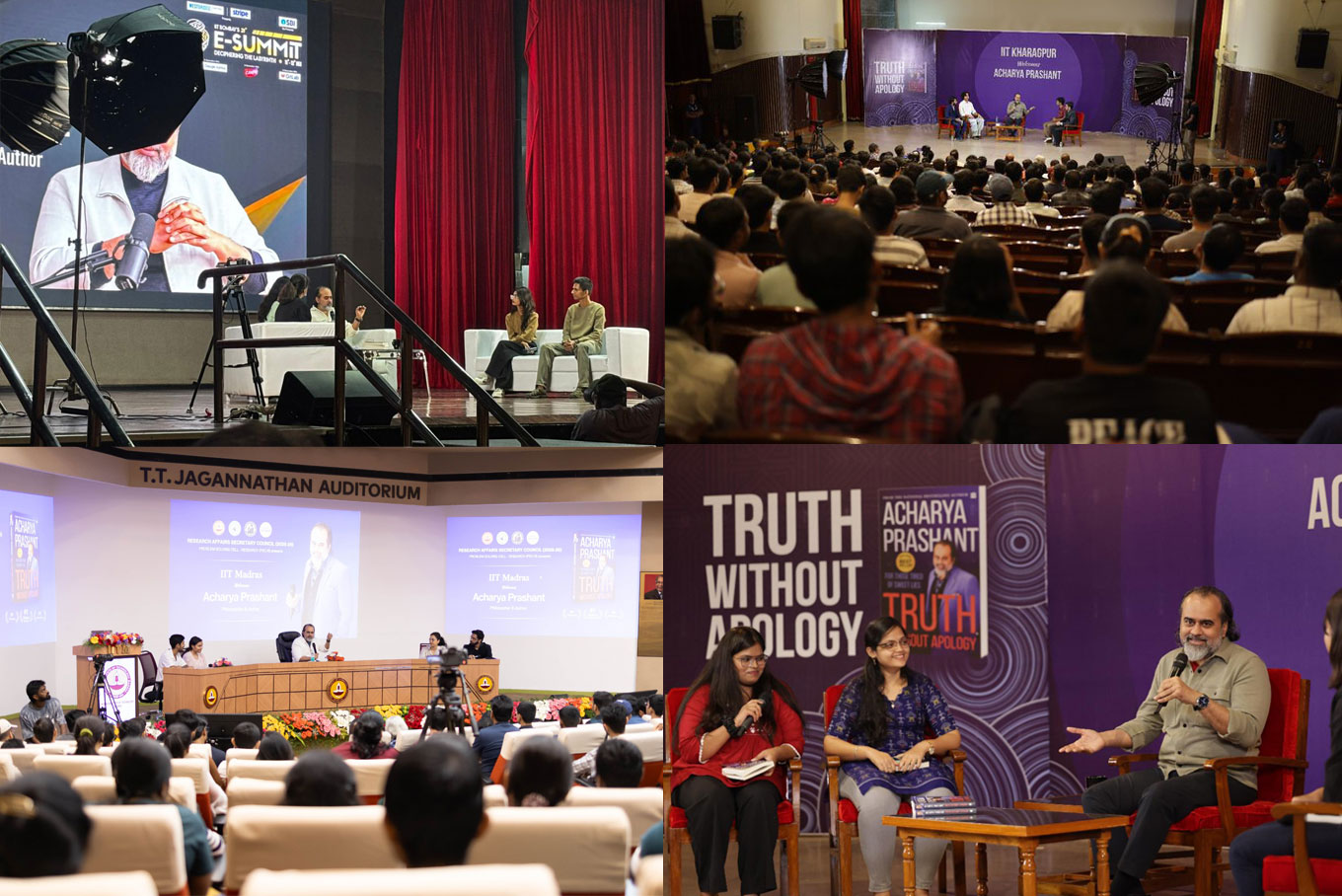
Acharya Prashant’s recent philosophy talks at four esteemed IIT campuses – Hyderabad, Kharagpur, Madras, and Bombay – highlight a burgeoning trend in India’s top educational institutions. Over two months, his engaging sessions attracted packed audiences, fostered lively debates, and inspired students to linger long after the events concluded, reflecting a heightened desire for personal insight and philosophical understanding to accompany academic rigor.
Philosophy lectures on engineering campuses are nothing new. What is new is a 1500-seat auditorium filling up half an hour before the event begins, students lining staircases and aisles, and conversations that refuse to end – stretching six or seven hours because no one wants to walk away.
Between October and December, Acharya Prashant addressed packed gatherings at IIT Hyderabad, IIT Kharagpur, IIT Madras, and IIT Bombay in rapid succession. Each event ran well beyond schedule. In more than one instance, formal sessions dissolved into late-night, informal dialogues on lawns and outside guest houses. Whatever one’s interpretation, this was far from a routine guest lecture circuit.
IIT Hyderabad: Probing Deeper (October 1)
At IIT Hyderabad on 1st October, the session was hosted under the prestigious Extra Mural Lectures (EML) series. Structured as a panel discussion followed by open dialogue, it saw active participation from the institute’s Director, Dr. Murthy, along with faculty and students. Questions ranged from scientific thinking and technology to stress, purpose, and the restless modern mind. When climate change entered the discussion, Acharya Prashant shifted the focus inward: carbon metrics and melting glaciers, he suggested, are incomplete conversations if we refuse to examine the endless human desires that fuel them. It was not the usual environmental narrative – and that seemed to be the point.
IIT Kharagpur: Fear Unpacked (November 1)
A month later, IIT Kharagpur’s Netaji Auditorium overflowed before the session even began. After a formal welcome by the deans, the conversation centered on fear – not as abstraction, but as the hidden architect of career choices, relationships, and life trajectories. “When it comes to major decisions, it is not love that guides us,” he said. “A fearful and insecure mind cannot love.” The same systems that generate insecurity, he argued, quietly define our idea of safety – leading us to pursue ambitions we have never truly examined. On understanding, his assertion was direct: “Understanding cannot be inherited. Everyone has to see for themselves.”
What followed was unscripted. Hundreds of students surrounded him after the formal close, walking with him across the campus lawns. Three additional hours of dialogue unfolded on clarity, freedom, and inner strength. The next day, the Student Council invited him again for a concluding interaction. Total engagement over two days approached seven hours.
IIT Madras: World Philosophy Day (November 20)
The IIT Madras session on 20th November – World Philosophy Day – mirrored this pattern. The hall was filled before time. Introduced by the Dean of Students, the discussion moved across ethical living, climate anxiety, identity, expectation, and action. Yet repeatedly, the emphasis returned to psychological self-inquiry rather than external reform. Conversations continued late into the night outside the Bose–Einstein Guest House.
IIT Bombay: E-Summit Spotlight (December 10)
At IIT Bombay on 10th December, during the 21st E-Summit – Asia’s largest student-run entrepreneurial festival – the context shifted but the intensity did not. Alongside industry leaders and policymakers stood a philosopher. The Convocation Hall was full before the session began. For over three hours, students raised questions about ambition, relationships, overthinking, startup pressures, and definitions of success. Acharya Prashant consistently redirected attention to conditioning and self-awareness. Success measured purely by accumulation, he argued, is inherently fragile. On gender, he suggested progress lies not only in equality but in making gender progressively irrelevant as a defining category. On freedom, he cautioned that assuming oneself to be free – without examining psychological conditioning – deepens confusion rather than dissolving it.
Again, the formal conclusion did not conclude the event. Students lingered.
The recurring pattern is unmistakable: sessions end, students stay. The questions persist.
Some observers may attribute this to personality. Yet repeated invitations from premier technical institutions indicate something deeper. Engineering students are not short on ambition or career orientation. What appears to resonate is the recognition that technical competence without inner clarity is incomplete – that questions of self-knowledge and purpose are not distractions from serious work, but prerequisites for it.
If reports are accurate, more institutions – within India and beyond – are preparing to host similar dialogues. Philosophy, it seems, still commands attention. Particularly among those trained to engineer the external world, there is a growing appetite to examine the internal one.