
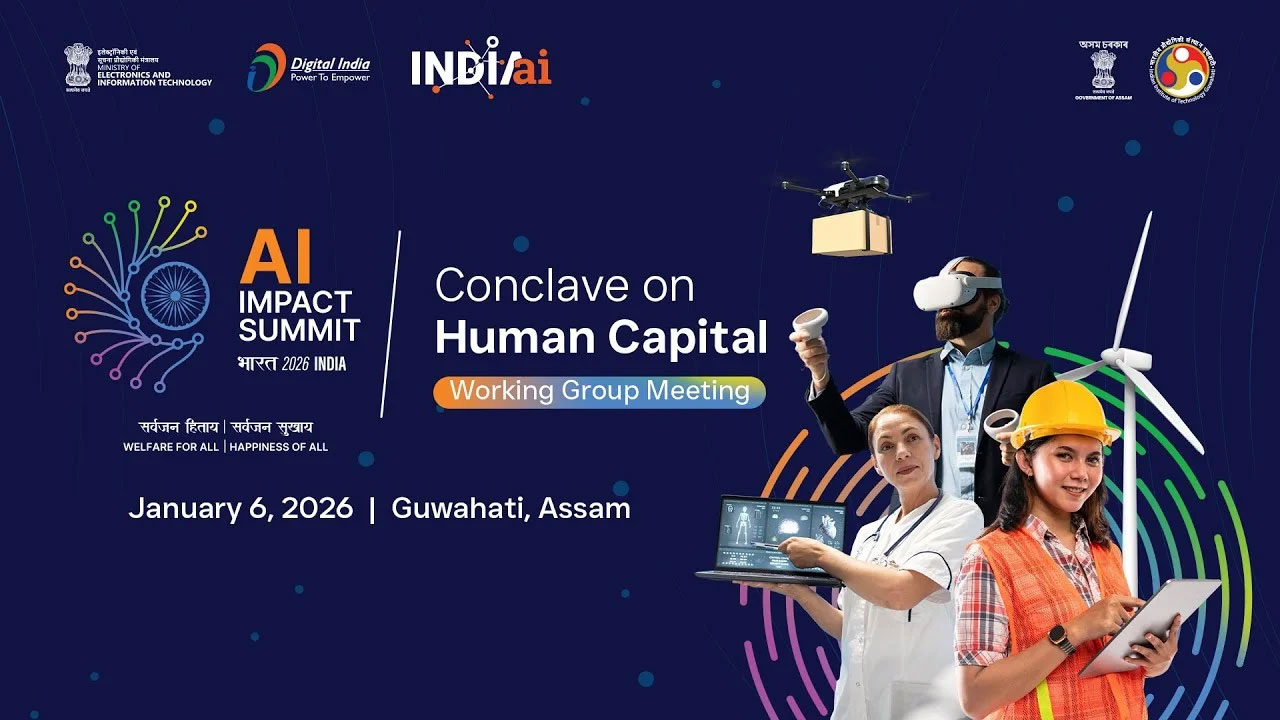
The Ministry of Electronics and Information Technology (MeitY), the IndiaAI Mission, the Government of Assam, and IIT Guwahati jointly hosted a two‑day Human Capital Working Group Meeting on January 5–6, 2026, at the IIT Guwahati campus. The meeting brought together senior policymakers, academic leaders, industry experts, and practitioners to advance national deliberations on education reform, workforce transition, and inclusive, human‑centric AI adoption. Chaired by Prof. T. G. Sitharam, the convening serves as a key thematic precursor to the India AI Impact Summit 2026, scheduled for February 15–20, 2026, in New Delhi, and is expected to shape major policy outcomes and institutional strategies for India’s AI‑driven future.
The opening session set the tone for the discussions, with addresses from Shri Syedain Abbasi, Special Chief Secretary, Government of Assam; Shri K. S. Gopinath Narayan, Principal Secretary (IT), Government of Assam; Prof. T. G. Sitharam, Chair of the Human Capital Working Group; Prof. Devendra Jalihal, Director, IIT Guwahati; and Ms. Shikha Dahiya, Joint Director, IndiaAI, MeitY. Speakers underscored the centrality of human capital in India’s AI journey, calling for a shift from narrow skilling models to holistic, lifelong learning ecosystems that integrate technical competence with adaptability, judgment, and social resilience.
Anchoring AI in Human Capital
Welcome the participants, Prof. Devendra Jalihal highlighted IIT Guwahati’s role as a convening platform where policymakers, academia, industry, and students come together to co‑design future‑ready human capital for the age of AI. He emphasized the institute’s commitment to operating at the intersection of technology, education, and social impact, noting that strong student engagement reflects the growing interest in inclusive AI ecosystems and socially responsible innovation.
Ms. Shikha Dahiya outlined the vision for the India AI Impact Summit 2026, stressing its focus on human capital, democratization of AI resources, and inclusive, responsible AI adoption for the Global South. She highlighted the IndiaAI Mission’s multi‑pronged strategy, including scaling indigenous compute capacity, curating sovereign datasets and models, and expanding nationwide AI skilling and capacity‑building. She noted that the outcomes from the Guwahati Working Group would directly feed into both national policy discussions and the global debates at the upcoming Summit.
Inclusive, People‑Centric AI Transitions
Prof. T. G. Sitharam articulated the overarching philosophy of the Working Group: the transition to an AI‑enabled economy must be inclusive, people‑centric, and grounded in dignity, not just efficiency. He called for moving beyond fragmented, one‑time skilling efforts toward continuous, adaptive learning ecosystems that prioritize human‑centred capabilities – such as critical thinking, judgment, and ethical reasoning – alongside technical proficiencies. He underscored that technological progress should enhance resilience, opportunity, and quality of life, rather than merely reducing labor costs.
Shri K. S. Gopinath Narayan highlighted that AI is not just another productivity tool but a transformative force reshaping how economies and societies function. He warned that without deliberate policy design, automation‑led shifts could deepen regional and sectoral inequalities. He stressed the importance of “human augmentation over automation,” advocating for AI‑driven micro‑skilling, continuous learning, and AI literacy as core public capabilities.
Shri Syedain Abbasi observed that while AI hype recalls past technology cycles, the current moment is qualitatively different because AI increasingly behaves as an autonomous agent, making decisions independently of direct human oversight. He cautioned that the concentration of AI capabilities among a few global players could threaten India’s traditional IT and outsourcing‑led employment model. He called for indigenous compute infrastructure, robust public–private collaboration, and differentiated skilling pathways tailored to different education levels and occupations.
The inaugural session concluded with a vote of thanks by Shri Ashwani Kumar, Director, IT Department, Government of Assam, who acknowledged the Human Capital Working Group’s thought leadership and praised IIT Guwahati for providing a rigorous academic platform that links research, policy, and on‑ground implementation. He also expressed gratitude to the IndiaAI Mission for its sustained support in advancing India’s national AI agenda.
Keynote: Democratizing Competency in the Age of AI
Day 1 featured a keynote address by Prof. Gautam Barua, Former Director, IIT Guwahati, on “Democratizing Competency in the Age of AI.” Prof. Barua examined the shift from traditional education systems – designed to produce isolated experts – to models that can scale human augmentation through domain‑specific AI tools. He emphasized the need for sovereign AI systems aligned with Indian sectors such as healthcare, agriculture, and governance, which can raise the baseline capability of millions of workers while ensuring social protection for those displaced by automation.
He argued that democratizing AI‑enabled competency does not mean replacing humans but equipping them with AI‑driven assistants that enhance productivity, decision‑quality, and safety. To that end, he called for investments in regionally representative data, explainable AI tools, and robust evaluation frameworks that track not only technical performance but also social outcomes such as equity, employability, and resilience.
Panels on Gender‑Responsive AI and Education Reform
A panel on “Gender‑Responsive Strategies for the AI Transition” examined the differential impact of AI on women in the workforce. The session highlighted risks such as automation of entry‑level service and data‑entry roles, potential widening of wage gaps, data and algorithmic bias, and unequal access to AI skilling opportunities. Moderated by Ms. Arpitha Desai, the panel brought together experts from government, industry, and research, including Ms. Tulika Pandey (MeitY), Mr. Sanjay Kukreja (eClerx AI), Ms. Urmi Tat (Salesforce), Dr. Tanu M. Goyal (ICRIER), Prof. Dhruba Kumar Bhattacharyya (Tezpur University), and Prof. Ratnajit Bhattacharjee (IIT Guwahati).
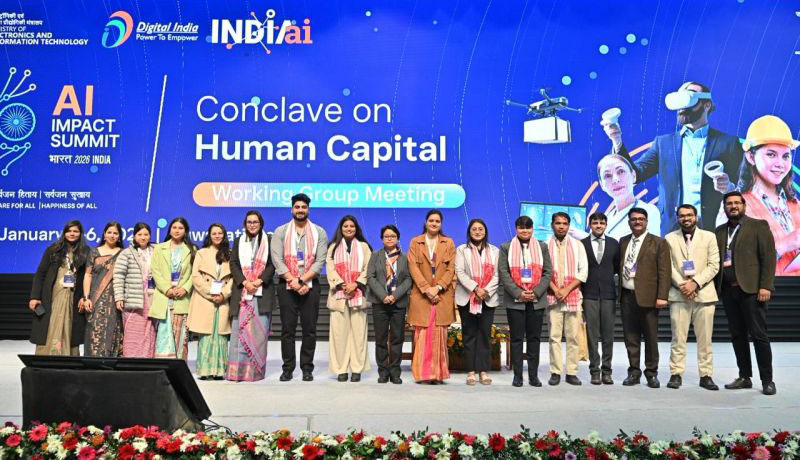
The discussion underscored the need for gender‑responsive AI policy: inclusive design, transparent and explainable algorithms, adoption‑linked reskilling, and ecosystem‑driven interventions such as mentorship, childcare support, and flexible work‑adjacent training. Participants emphasized that without deliberate action, AI‑driven automation could exacerbate existing gender disparities rather than close them.
Later, a panel on “Redefining Education for the Cognitive Age” explored how AI is reshaping pedagogy, learning objectives, and assessment systems. Moderated by Mr. Subhodeep Jash, the session featured educators, ed‑tech founders, and industry leaders such as Mr. Venkatesh Reddy Mallapu Reddy (ConveGenius), Mr. Siddhant Sachdeva (Rocket Learning), Mr. Parminder Singh Kakria (Kyndryl), Prof. Anupam Basu (NIT Durgapur), and Prof. Shyamanta Hazarika (IIT Guwahati).
Panellists advocated for a move away from rote‑based instruction towards cognitive, process‑oriented learning that nurtures creativity, collaboration, and critical thinking. They highlighted AI’s role in personalizing learning pathways, automating administrative tasks, and providing real‑time feedback, while cautioning that AI tools must be community‑tested, context‑sensitive, and human‑centric. They called for tighter alignment between curricula and evolving industry needs, treating adaptability, lifelong learning, and digital literacy as core competencies.
Looking Ahead: From Guwahati to New Delhi
The Working Group Meeting will continue into Day 2 with focused sessions on education reform, workforce transition, lifelong learning systems, and gender‑responsive AI strategies. The deliberations are expected to culminate in a consolidated set of recommendations for national policy, providing a robust evidence base for the India AI Impact Summit 2026. Positioned as a thematic precursor to that summit, the Guwahati convening reinforces India’s commitment to building inclusive, human‑centric AI ecosystems under the IndiaAI Mission, aligning regional insights with national priorities for Viksit Bharat 2047.
Through this multi‑stakeholder dialogue, India is laying the foundation for an AI‑ready workforce that is not only technically skilled but also socially conscious, adaptable, and resilient – ensuring that the benefits of AI are shared equitably across regions, sectors, and genders.