

The Delhi government has entered a six‑month collaboration with IIT Madras to study whether photocatalytic “smog‑eating” coatings on roads, pavements, and other city infrastructure can meaningfully reduce key air pollutants such as nitrogen dioxide (NO₂) and volatile organic compounds (VOCs). The project, led by Professor Somnath C Roy of IIT Madras, will begin with lab‑based smog simulations followed by field trials in Delhi, aiming to assess whether such coatings can become a scalable, science‑driven tool in the Capital’s fight against air pollution.
The Delhi government is exploring a novel, science‑driven approach to tackle the Capital’s persistent air‑pollution problem, teaming up with the Indian Institute of Technology (IIT) Madras to test “smog‑eating” photocatalytic coatings on roads, pavements, and other public surfaces. The six‑month collaboration, formalised on March 13, seeks to evaluate whether coatings based on titanium dioxide (TiO₂) can break down harmful air pollutants under real‑world conditions, offering a possible complementary strategy to existing emission‑control measures.
The project is funded by the Delhi government and led by Professor Somnath C Roy of IIT Madras, who will first conduct controlled laboratory experiments before moving to field trials in Delhi. The exact locations for these trials have not yet been finalised; Professor Roy said preliminary lab results will inform recommendations, after which the government will decide where pilot installations may be carried out. Environment Minister Manjinder Singh Sirsa emphasized that the aim is to identify the “best, long‑lasting, and affordable ways” to apply smog‑eating coatings on roads, buildings, and other city infrastructure, particularly if evidence shows they can reduce NO₂ and other pollutants.
Central to the experiment is the creation of an artificial smog chamber that replicates Delhi’s heavily polluted air. The team plans to use real‑world data on traffic patterns, pollution levels, and nitrogen oxide (NOx) concentrations collected from government monitoring stations and public displays to build a controlled environment inside the laboratory. “We will create smog in our laboratory,” Roy explained, “using actual data from Delhi. Then we will test how long it takes for smog‑eating surfaces to bring pollutant levels down to safer ranges.”
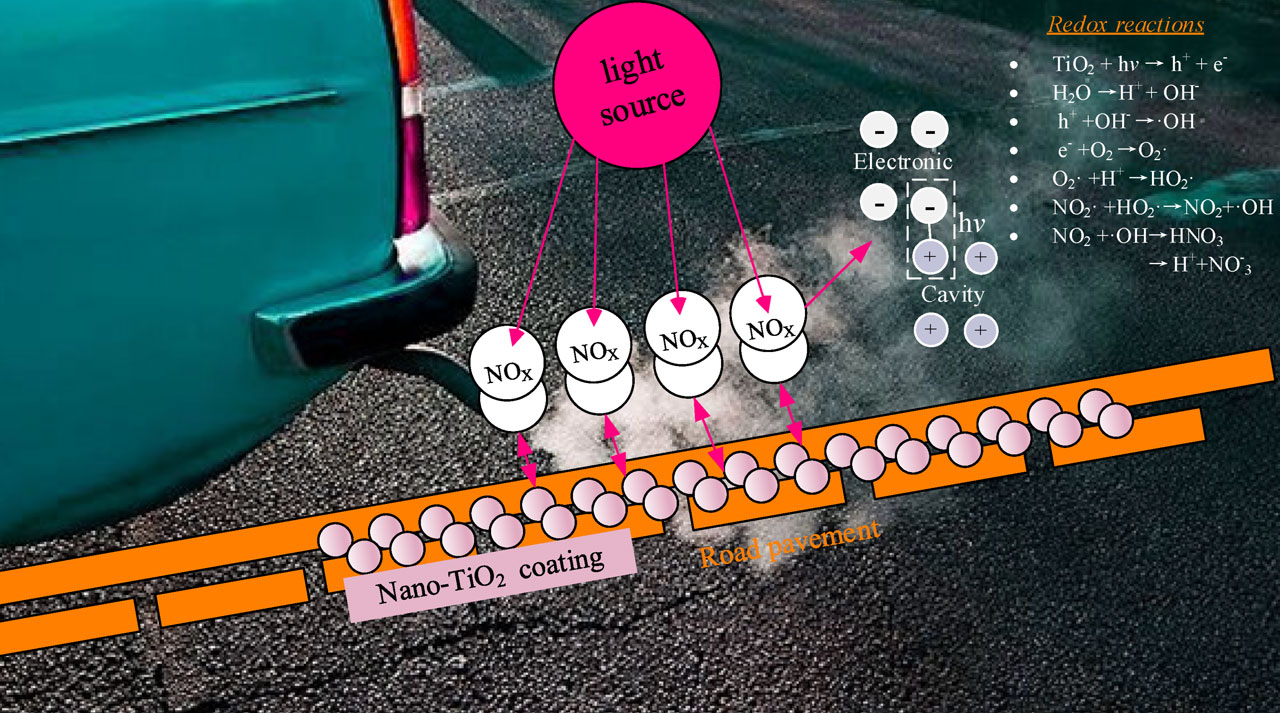
At the heart of the coatings being tested is titanium dioxide (TiO₂), a photocatalytic material that activates under light. When sunlight falls on TiO₂, it generates electrons that rise to the surface and react with pollutants such as NO₂ and certain VOCs, breaking them down into relatively harmless substances like nitrogen and oxygen. “The process is similar to how solar panels work,” Roy said, “but instead of generating electricity, TiO₂ uses sunlight to drive chemical reactions that dismantle pollutants. Sunlight alone cannot break these molecules; the photocatalyst is essential.”
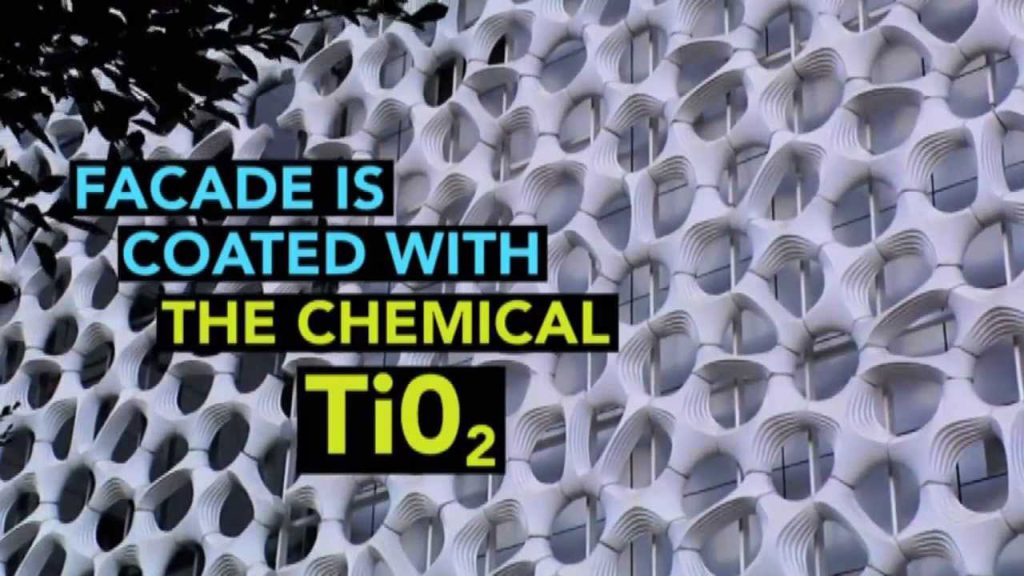
The project will experiment with multiple deployment modes for TiO₂. These include mixing the material into concrete and asphalt, applying it as a surface coating, and developing panels that can be mounted on rooftops or streetlights, much like solar panels. “These panels could directly interact with ambient air,” Roy said, adding that, if deployed at scale – especially in high‑emission zones such as busy intersections or industrial corridors – they could generate a measurable, background reduction in pollution over time.
Importantly, the technology is not envisioned as a standalone solution. “This will be a continuous background process,” Roy stressed. “It will not replace other pollution‑control measures such as emission standards, vehicular regulations, or waste‑burning bans. It will work alongside them.” The government has framed the project as part of a broader push for innovative, scalable, and evidence‑based tools to complement existing policy actions.
In the lab, the team will expose TiO₂‑based surfaces to different lighting conditions – full sunlight, reduced sunlight, and even low‑intensity street lighting – to understand how performance varies under Delhi’s fluctuating conditions. This is critical because dense smog can severely reduce sunlight intensity, potentially slowing the photocatalytic reaction. “During peak smog, sunlight intensity drops significantly, so that is part of what we will test,” Roy noted. He also highlighted a key difference between the lab and the real world: in a closed chamber, pollutants can be forced into contact with the coated surface, but outdoors, constantly moving air distributes and renews them, altering the kinetics of the process.
Wind, in particular, will be a key variable in later stages. “Wind does not affect the material itself,” he said, “but it carries pollutants away and brings new ones in, so the interaction is always changing. We will need to quantify how that affects the overall cleaning efficiency.”
There are also practical challenges posed by Delhi’s dusty environment. Dust can settle on photocatalytic surfaces, blocking both light and direct contact with pollutants, thereby reducing efficiency. “Dust can block both light and pollutant access,” Roy explained, “so periodic cleaning – perhaps once a month – will likely be necessary.” On the positive side, TiO₂ itself is chemically stable, non‑toxic, and commercially available at relatively low cost, similar to common construction materials like sand. “It does not significantly increase construction costs if used sensibly,” he said.
Before costs can be estimated more precisely, the study will focus on optimising the concentration of TiO₂ in concrete, asphalt, and coatings. “We first need to determine how much TiO₂ is required to achieve effective pollutant breakdown without compromising structural or surface properties,” Roy said. “Once we find that optimal concentration, we can calculate the true economic impact.”
The Delhi government sees the research as part of a long‑term, technology‑intensive strategy to keep pace with the Capital’s rapid urbanisation and population growth. Environment Minister Sirsa pointed out that Delhi’s expansion – driven in part by urban sprawl from surrounding regions – has intensified the need for innovative solutions that can operate alongside economic growth rather than through blanket restrictions. Under the leadership of Chief Minister Rekha Gupta, the government has publicly committed to cleaner air for residents, with the TiO₂ project exemplifying its attempt to harness scientific collaboration instead of relying solely on regulatory bans.
If the laboratory trials yield promising results and the field tests in Delhi confirm the technology’s effectiveness and durability, such smog‑eating surfaces could gradually be integrated into new road construction, building facades, and public infrastructure. Over time, they could contribute to a persistent, low‑intensity “cleaning” effect on the city’s air, helping to chip away at chronic NO₂ and VOC levels without disrupting daily life.
Ultimately, the IIT Madras–Delhi government study aims to convert a complex, sprawling urban pollution problem into a measurable, manageable scientific challenge – one that starts inside a smog chamber, but whose outcomes could one day shape the surfaces of an entire metropolis.