

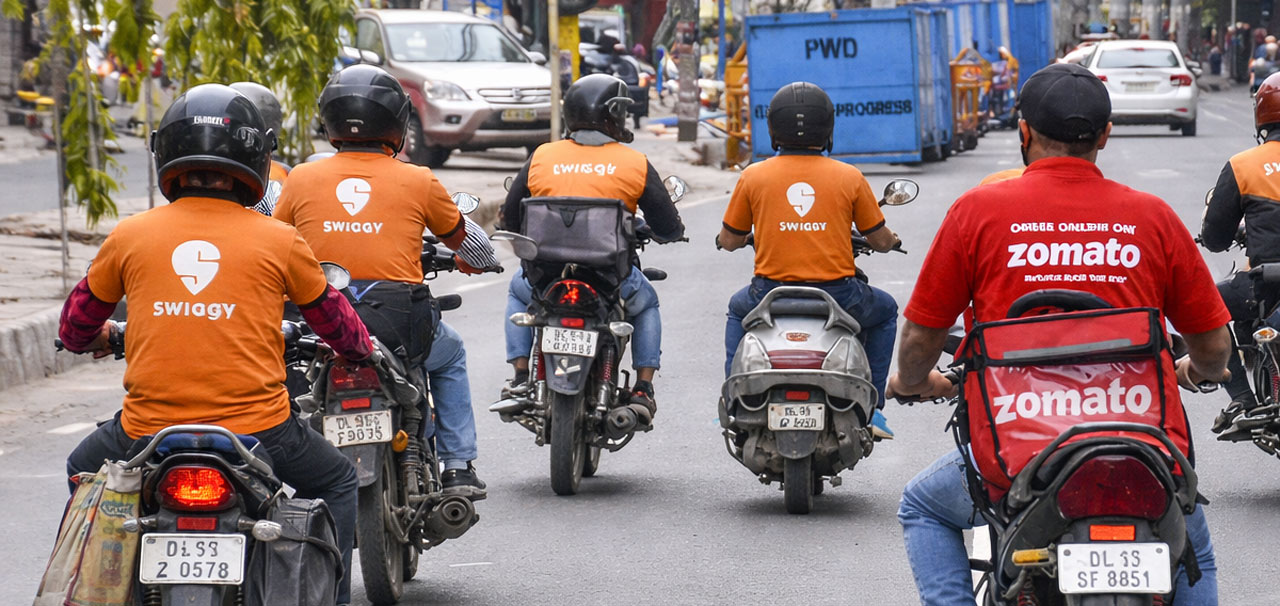
Labour oversupply, fragmented workforces, and algorithmic control enable gig platforms to absorb strikes quietly, revealing a growing power imbalance between app‑based companies, their workers, and India’s evolving labour laws. Even when delivery partners stage city‑wide protests, platforms can maintain service levels without overt confrontation, underscoring how structural advantages shield companies from accountability.
When gig delivery workers called for strikes across Indian cities on New Year’s Eve, the disruption turned out to be short‑lived. Orders kept rolling in, deliveries stayed on track, and platforms avoided any visible clash with the workforce. Labour researchers say this outcome was not accidental but a reflection of the deeper architecture of India’s gig economy.
“The biggest reason the strike failed on December 31 was labour oversupply and fragmentation,” says Dr. Anjana Karumathil, Associate Professor of Practice at IIM Kozhikode and a specialist in India’s gig economy. “Even if one group of workers stops working, there are always others available who don’t share the same agenda. That fragments collective action and weakens its impact.”
Platform leaders often frame this resilience as proof of fairness. Zomato founder Deepinder Goyal, for instance, has argued that gig work is flexible, voluntary, and largely a side‑income stream. In this view, a system that consistently attracts and retains workers cannot be fundamentally unjust. Yet experts like Karumathil push back on that narrative.
“India’s labour laws have only just begun to recognise gig workers, and even then they are not classified as employees,” she explains. Under the Code on Social Security, 2020, gig and platform workers are eligible for social‑security registration through the e‑Shram portal, but they remain excluded from core protections such as minimum wages, fixed working hours, and the right to collective bargaining. “The platform still controls demand, allocates tasks, decides pay, and enforces discipline through opaque algorithms, without being held to the same accountability that applies to formal employers,” she says.
This imbalance also explains why gig‑worker strikes can be neutralised so quietly. Platforms rarely need to fire anyone or call in the police. Oversupply ensures there are always fresh workers to step in, while algorithmic tools – such as incentives, surge pricing, and selective deactivations – manage labour supply in real time. Workers who log off or participate in strikes risk losing income or being deactivated without warning. “At least 60–70% of blue‑collar gig workers have faced deactivation at some point, often with little or no explanation,” Karumathil observes.
Debates around earnings further complicate the picture. Platforms frequently cite average monthly payouts of roughly ₹20,000–22,000 and emphasise the freedom to log in or out as evidence of fairness. But researchers highlight intense income volatility. “Flexibility only works when there is predictable access to work, transparent pay structures, and the ability to exit without penalty,” Karumathil says. “When earnings fluctuate wildly, social security is absent, and bargaining power is weak, what looks like flexibility is actually precarity.”
From a legal standpoint, more incremental reforms may be realistic. Siddharth Chandrashekhar, Advocate & Counsel at the Bombay High Court, notes that the Code on Social Security formally recognises gig and platform workers and mandates that aggregators contribute to a fund providing benefits like health cover and pensions via the e‑Shram scheme. “Without reclassifying gig workers as traditional employees, the law can still introduce minimum safeguards – baseline earnings principles, safety standards, and protection against arbitrary deactivation,” he says. Such measures, he argues, could reduce uncertainty while preserving the inherent flexibility that platforms and workers both value.
Recent worker demands – such as fixed monthly salaries, permanent employment, and full benefits – are understandable, Chandrashekhar adds, but they often conflict with the task‑based, project‑driven nature of gig work. A more pragmatic middle path, he suggests, lies in guaranteed minimum earnings, occupational safety norms, and structured dispute‑resolution mechanisms.
Platforms have unquestionably expanded access to work in an economy where nearly 90% of jobs remain informal. However, as Karumathil stresses, “Scale alone cannot justify business models that shift all risk onto workers.” Until enforceable safeguards are put in place, platforms will continue to absorb worker resistance quietly, efficiently, and by design.