

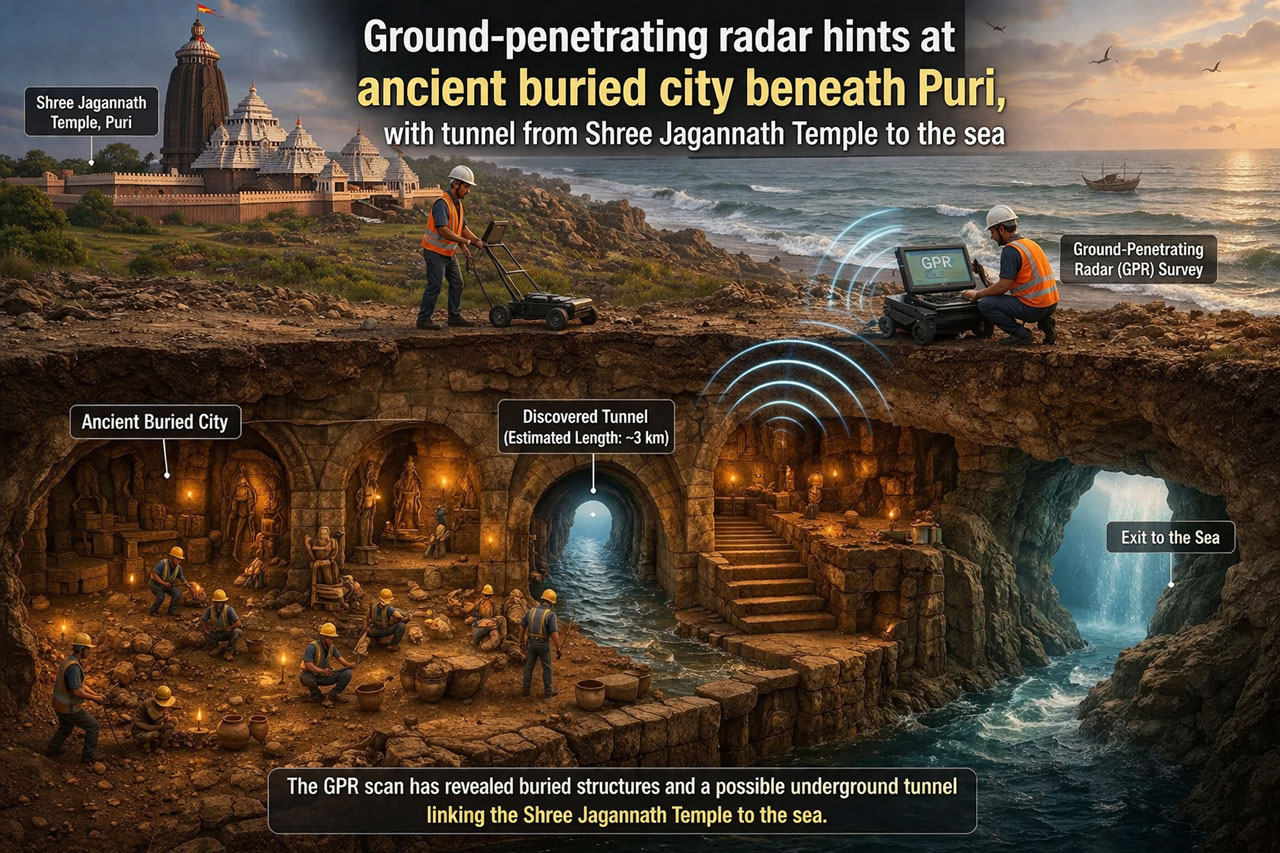
A Ground Penetrating Radar (GPR) survey in Puri has revealed possible evidence of an ancient city buried beneath the holy town, including a suspected underground tunnel linking the Shree Jagannath Temple to the sea. The findings, emerging from the Srimandir Parikrama Project area, point to widespread historical remains extending well beyond the temple complex.
A Ground Penetrating Radar (GPR) survey in Puri has uncovered possible traces of an ancient buried city beneath the coastal town, along with a suspected subterranean tunnel connecting the Shree Jagannath Temple to the sea. The scans, carried out under the Srimandir Parikrama Project, follow earlier discoveries of artefacts such as lion sculptures from the Ganga dynasty during excavation work. These and subsequent findings suggest that historical structures and habitation may stretch across a large area beneath Puri, not just around the temple precincts.
Experts identified structural remains across 21.6 square metres and flagged 43 potential heritage sites, located at places such as Emar Math, Nrusingha Temple, Budhi Maa Temple, and along the road leading to the Jagannath Temple. Underground layers also contained pottery, metal objects, and everyday domestic items, indicating long‑standing human settlement. Archaeologists have recommended controlled, scientific excavation and robust preservation measures to protect the buried heritage.
Earlier, heavy machinery damaged two Ganga‑dynasty lion sculptures during digging conducted without prior GPR mapping, triggering public controversy. The Archaeological Survey of India later confirmed that the sculptures and a 30‑foot‑long wall belonged to the Ganga period and uncovered a 7.6‑metre‑by‑3‑metre chamber, where researchers speculate golden idols may once have been worshipped.
The Jagannath Temple administration commissioned the GPR survey at a cost of ₹40 lakh, executed by IIT Gandhinagar through OBCC. Initially, the administration claimed not to have received the report, while IIT Gandhinagar maintained it had already submitted the data. Advocate Dillip Baral then obtained the GPR findings through an RTI application and has called for immediate scientific excavation and conservation of the suspected ancient city.