
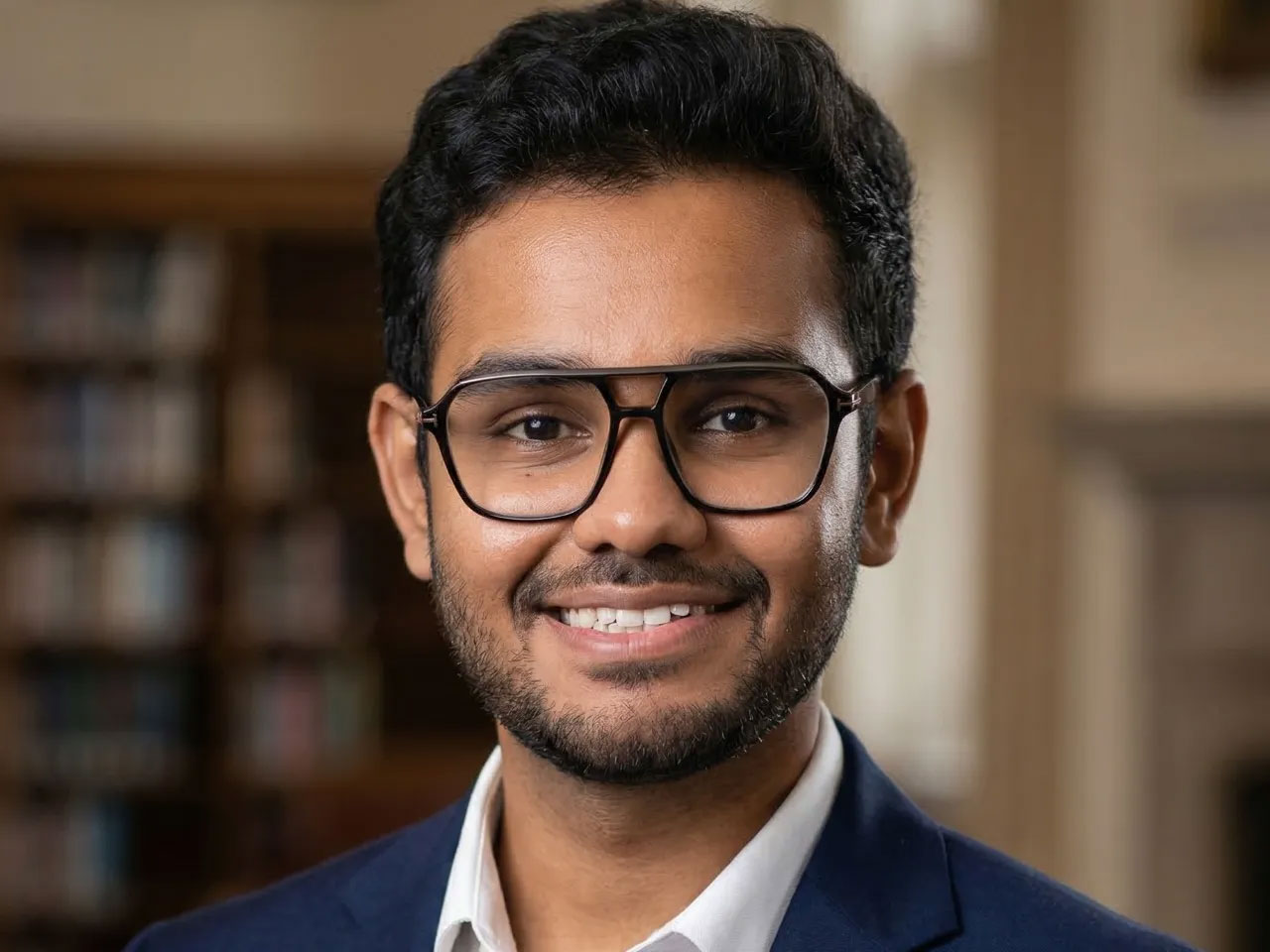
Seemandhar Jain’s NERFIFY automates NeRF code from papers, slashing weeks of work to minutes – accepted at CVPR 2026, hailed by Google and media.
From research paper to working code in minutes
What if an AI system could read a scientific research paper and automatically produce working, shareable code in minutes – a task that typically takes trained researchers weeks of manual effort? That is exactly what Seemandhar Jain, a Computer Science PhD student at the University of California, San Diego, has created. His project, called NERFIFY, has been accepted at CVPR 2026, the world’s most prestigious computer vision conference, and is already attracting attention from Google researchers and major U.S. newspapers.
In simple terms, NERFIFY reads a Neural Radiance Fields (NeRF) research paper and then generates fully functional, executable code that reproduces the proposed method. The system dramatically shortens the gap between theoretical description and practical implementation, turning a process that once took weeks into one that now completes in minutes.
Focusing on Neural Radiance Fields
NERFIFY specifically targets Neural Radiance Fields (NeRFs), a class of AI techniques that reconstruct realistic 3D scenes from ordinary 2D photographs. NeRFs have broad applications in virtual reality, autonomous driving, e‑commerce, and digital heritage preservation, where accurate 3D models from 2D images provide critical value.
Despite the rapid growth of the NeRF subfield, a major bottleneck remains: most research papers do not release code. When code is unavailable, researchers and practitioners must manually reimplement the described methods, a process that is time‑consuming, error‑prone, and often inconsistent. NERFIFY directly addresses this reproducibility gap by automatically translating the paper’s ideas into working code.
How NERFIFY actually works
NERFIFY does not rely on a single monolithic AI model. Instead, it operates as a team of specialised AI “agents”, each responsible for a distinct stage in the pipeline. One agent first reads and interprets the paper, extracting key equations, architectural details, and implementation hints. Another agent tracks down missing components – such as cited baselines or datasets – by tracing references and external documentation.
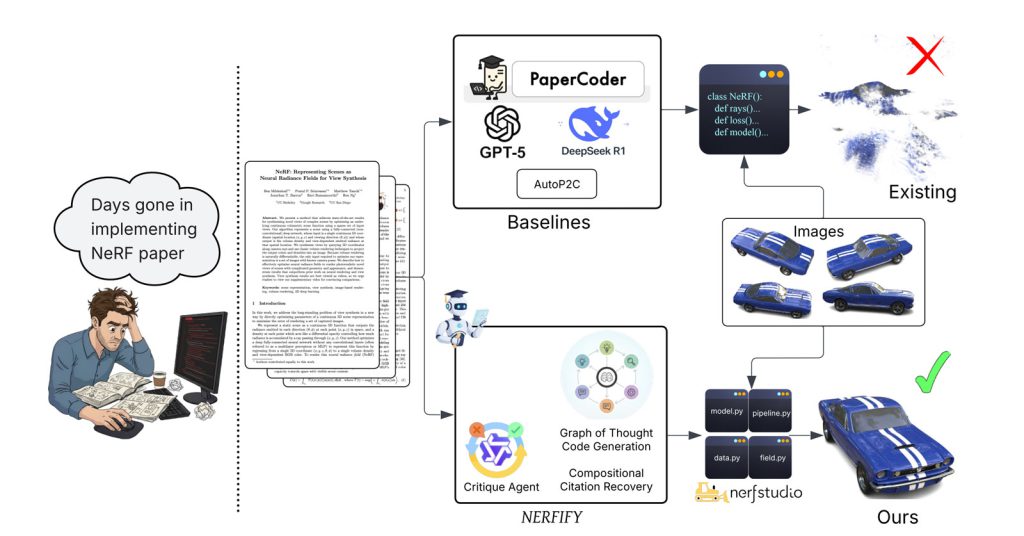
A third agent writes the core implementation code, integrating frameworks and libraries commonly used in NeRF research, while a fourth agent visually verifies the output, comparing rendered 3D scenes against the figures and descriptions in the paper. Each agent uses tailored tools and validation checks, ensuring that the final code is not only syntactically correct but also functionally and visually faithful to the original work.
Beyond ChatGPT‑style question‑answering
One key difference between NERFIFY and frontier language models like ChatGPT is the setup and goal. While ChatGPT excels at answering questions and generating text, it generally fails to produce compile‑ready, accurate NeRF code for specialised research tasks. In contrast, NERFIFY achieves a full success rate on tested papers, matching the visual quality and functional correctness of expert human implementations.
Prof. Manmohan Chandraker, Jain’s doctoral advisor and co‑author, explains the distinction clearly: “Frontier models are really good at giving answers to questions. But NERFIFY is basically a team of AI researchers working together.” Each agent deploys specialised tools – such as code‑generation templates, dependency resolvers, and renderer‑based validators – ensuring that the system behaves less like a casual assistant and more like a disciplined, multi‑step workflow.
Democratizing access to cutting‑edge research
The implications of NERFIFY extend well beyond NeRFs. If AI can reliably convert published research into executable code, then a university lab in Nairobi, a startup in Indore, or a small‑town research group can reproduce and build on work from top institutions like Stanford or MIT without needing the same size of infrastructure or team.
Jain views this capability as a step toward democratising science itself, by lowering the technical and resource barriers to reproducing and extending state‑of‑the‑art methods. Rather than being locked out of recent advances due to unavailable code, smaller teams can now focus on validation, modification, and innovation instead of reinventing the wheel.
At the same time, Prof. Chandraker stresses the need for responsible AI use in research. He emphasises that outputs must remain verifiable, transparent, and aligned with scientific merit, with guardrails to prevent plagiarism or unchecked automation. The team is exploring ways to log provenance, highlight deviations from the original paper, and support human‑in‑the‑loop review so that the system aids, rather than replaces, scientific scrutiny.
From Indore to the global AI stage
Jain’s journey from Indore to the global AI spotlight reflects a strong academic foundation and sustained curiosity. After graduating from IIT Indore, he pursued a Master’s degree at the University of Illinois at Urbana‑Champaign, followed by industry roles at Google and Salesforce, where he gained hands‑on experience with large‑scale machine‑learning systems.
He later joined UC San Diego as a PhD student and was named a Siebel Scholar, an award that recognises outstanding academic achievement and leadership potential. Under Prof. Chandraker’s guidance, his research focuses on multi‑agent AI systems for automated scientific discovery, and NERFIFY serves as a concrete embodiment of that vision.
By combining ideas from multi‑agent systems, automated code generation, and domain‑specific validation, Jain has created a system that not only accelerates implementation but also reshapes expectations about how AI can support scientific research. If technologies like NERFIFY become widely adopted, they could transform the way the research community develops, shares, and builds upon new methods – one research paper and one generated codebase at a time.
Disclaimer
The information in this article is based on available public sources and official statements as of the time of publication. While we aim for accuracy, we do not guarantee completeness or correctness. We advise readers to verify key details from official sources before making any decisions. The website (iitiimsamvaad.com) is not liable for any loss or damage arising from the use of this content. The authors are also not responsible for any such loss or damage.