
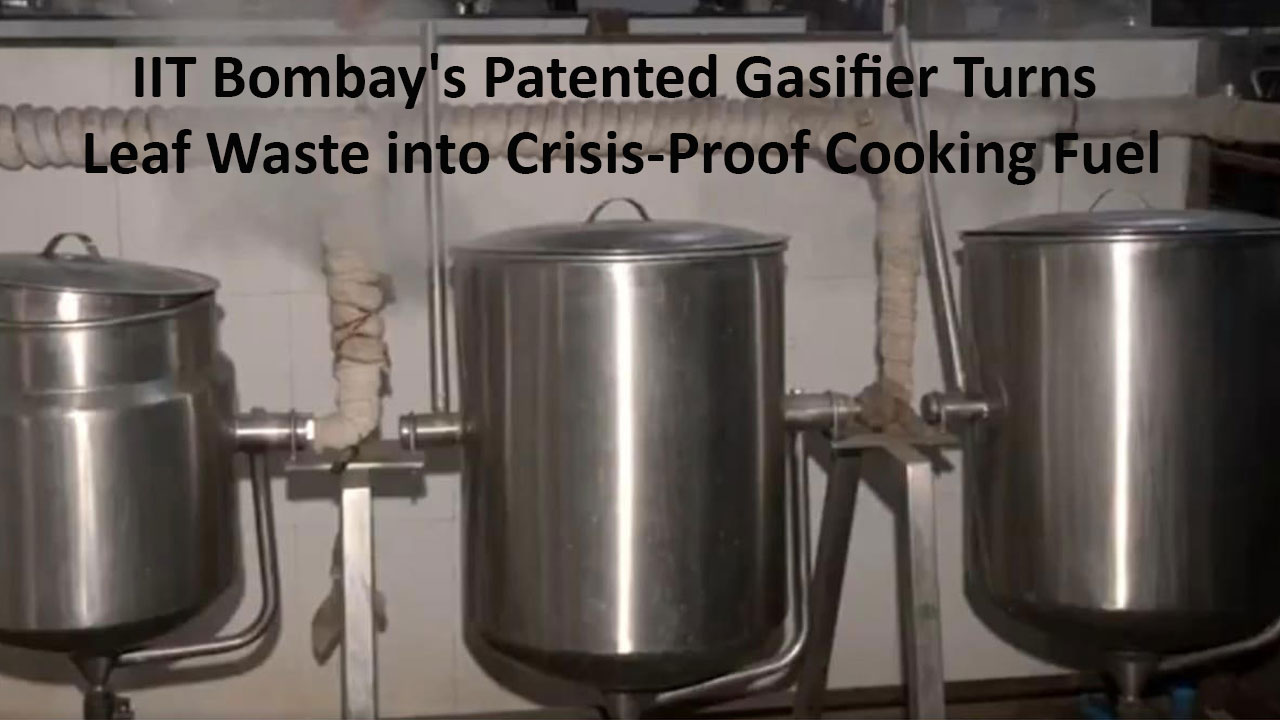
IIT Bombay’s Patented Gasifier Turns Leaf Waste into Crisis-Proof Cooking Fuel. IIT Bombay‘s decade-long biomass gasification innovation converts campus leaves to syngas, shielding canteens from LPG shortages with 40% savings and low emissions.
Amid rising fuel prices and the looming threat of LPG shortages, the Indian Institute of Technology (IIT) Bombay has found a home‑grown, sustainable solution right on its own campus. Using patented biomass gasification technology, the institute has successfully converted fallen dry leaves or leaf waste into a reliable cooking fuel, ensuring that its kitchens can keep functioning even during a gas crisis.
The innovation, shared in a post on the official social media handle of IIT Bombay, is the result of more than a decade of research that began in 2014 under Professor Sanjay Mahajani of the Department of Chemical Engineering. The project was born out of a simple but pressing challenge: how to manage the large amounts of dry leaf waste generated on the green campus.
“The campus has very good green cover, and disposing of all that leaf waste was becoming a problem,” Mahajani said. “So we started working on dry‑waste conversion and came up with a gasifier that could turn this waste into usable energy.”
The idea was not to build a new energy source from scratch, but to repurpose an existing one: the leaves that fell from trees every season. Under the Indian Institute of Technology Bombay model, operators collect, dry, and feed these leaves into a custom-designed gasifier, where they partially combust them under controlled conditions to produce producer gas.
From leaf waste to gasifier
The journey from a pile of dry leaves to a functional gasification system was neither quick nor easy. Early trials saw heavy smoke, technical hiccups, and resistance from kitchen staff, who initially hesitated to trust a new, unfamiliar technology in their daily operations. A major technical hurdle was the formation of clinkers – solid residues that accumulated and clogged conventional gasification systems, reducing efficiency and scaring early users.
Despite these setbacks, the team persisted, experimenting with different feedstocks, air‑flow settings, and reactor configurations. By 2016, they had developed a patented gasifier that significantly reduced clinker formation, making the system cleaner, safer, and more efficient for everyday use.
Joining hands with energy experts
In 2017, Professor Sandeep Kumar from the Department of Energy Science and Engineering joined the project to work on an improved burner capable of safely harnessing the producer gas for cooking. The institute’s Living Lab initiative – a platform that allows real‑time, on‑campus testing of new technologies- provided the perfect environment for trial and refinement.
After a year of continuous testing, user feedback, and iterative improvements, the team successfully deployed the gasification system in the staff canteen in 2024. Today, the canteen kitchens operate with 30% to 40% less LPG, achieving a thermal efficiency of around 60% while emitting very low pollutants.
Environmental and economic impact
The environmental benefits are substantial. The system cuts approximately eight tonnes of carbon‑dioxide emissions annually from the campus. More importantly, it converts a waste stream into a valuable resource, avoiding the need to burn or landfill dry leaf matter.
On the economic side, the post highlights that the institute plans to install larger units in hostel messes, where cooking volumes are much higher. If implemented at scale, the technology could reduce LPG consumption by up to 50 lakh rupees annually and cut hundreds of tonnes of carbon emissions, all while keeping food operations running smoothly, even if LPG supply is disrupted.
“The system is highly flexible and can use different types of dry waste, including non‑recyclable materials,” Professor Sandeep Kumar explains. “We have designed both the gasifier and the burner in‑house, and the goal is to expand this beyond campuses – to industries and large‑scale cooking operations – so that more institutions can reduce their dependence on LPG and rely on a cleaner, cost‑effective alternative energy source.”
A campus‑wide waste‑to‑energy ecosystem
This leaf‑to‑fuel project is only one part of a broader sustainability strategy unfolding at IIT Bombay. The institute also operates a biomethanation plant set up in 2019 with support from alumni of the 1990 batch. The plant processes about two tonnes of wet kitchen waste daily, turning it into biogas that can be used for energy generation.
Together, the biomethanation plant for wet waste and the biomass gasifier for dry leaf waste form a comprehensive waste‑to‑energy ecosystem on campus. The dual approach not only diverts several tonnes of organic waste from landfills every year but also contributes to energy self‑reliance, lower emissions, and reduced dependence on commercial fuel imports.
For IIT Bombay, the transformation of fallen leaves into cooking fuel is a powerful example of how research, innovation, and on‑campus experimentation can produce practical solutions to real‑world energy and environmental challenges – right where the problem starts.
Disclaimer
The information in this article is based on available public sources and official statements as of the time of publication. While we aim for accuracy, we do not guarantee completeness or correctness. Readers are advised to verify key details from official sources before making any decisions. The website (iitiimsamvaad.com) and its authors are not liable for any loss or damage arising from the use of this content.