

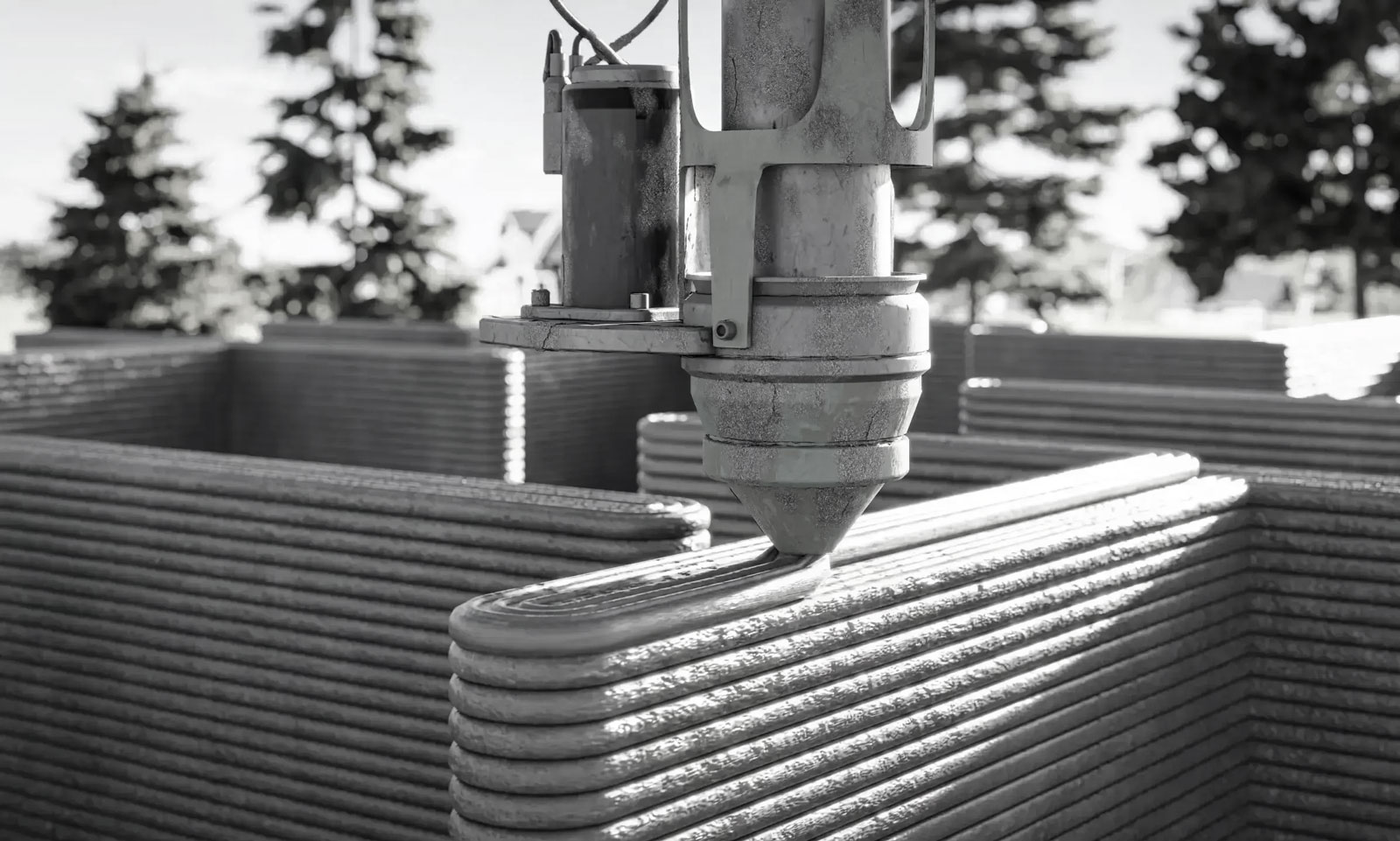
IIT Guwahati researchers validate full-scale 3D-printed concrete walls using ductile materials and modular steel, paving way for seismic-safe robotic construction.
3D‑printed walls put to the seismic test
Researchers at the Indian Institute of Technology (IIT), Guwahati, have developed and experimentally validated a design framework for earthquake resistant 3D printed walls. Their work addresses a key gap in the global adoption of 3D‑printed concrete construction, especially in seismically vulnerable regions where conventional building codes demand strict safety performance.
Construction‑sector interest in 3D printing continues to grow worldwide because the technology reduces labour and material use and allows for complex, customised shapes. However, despite several successful 3D‑printed building projects, such structures still see limited use in earthquake‑prone zones, largely due to uncertainties about how full‑scale printed walls behave under repeated seismic shaking.
Filling the seismic‑design gap
Dr. Biranchi Panda, Assistant Professor in the Department of Mechanical Engineering at IIT Guwahati, explains that one major barrier is the lack of standardised methods for reinforcing 3D‑printed concrete walls in line with current building codes. “Currently, there are no standard procedures for adding steel reinforcement to 3D‑printed walls that comply with earthquake‑safety regulations,” he said.
To address this, his team designed, built, and tested three full‑scale 3D‑printed walls under simulated seismic loads. The experiments, supported by advanced computer simulations, provide one of the first direct validations of how such walls perform under realistic earthquake conditions.
Three walls, three levels of resilience
The first test wall used plain printable mortar (3DPM) – a standard 3D‑printing mix without special ductility. The second wall employed strain‑hardening ductile concrete (3DPC‑CF), a specially formulated concrete that can undergo significant bending and form many fine cracks instead of sudden, catastrophic failure. This ductile concrete supported the wall’s load even after visible damage began.
The third wall combined the same ductile concrete (3DPC‑CF) with a modular steel reinforcement framework (3DPC‑CFR). The team embedded the steel reinforcement in a way that fits within the 3D‑printing workflow, avoiding disruption to the layer‑by‑layer deposition process while still meeting Indian and international earthquake‑safety standards.
“Our modular reinforcement system can be placed inside the wall during printing, so it does not interfere with construction speed or geometry,” Dr. Panda said. “This integration allows engineers to design 3D‑printed walls that are both constructible and safe under seismic demands.”
Full‑scale tests and simulations
The researchers subjected the walls to large‑scale cyclic loading experiments, mimicking the back‑and‑forth motion of earthquakes. They also ran detailed numerical simulations to model how the walls deform, crack, and redistribute forces under repeated shaking. The combined experimental and computational results showed that the ductile concrete plus modular steel reinforcement significantly improved the walls’ strength, ductility, and energy‑dissipation capacity.
“In this study, we have experimentally validated, at full‑scale, the enhanced seismic performance of 3D‑printed walls achieved through material ductility and modular reinforcement,” Dr. Panda said. “Our numerical models also helped us optimise the wall design and predict the cyclic behaviour of full‑scale structural systems.”
From walls to full‑scale buildings
To test the real‑world applicability of the framework, the team built a 3D‑printed model of a single‑storey house and analysed its overall structural behaviour. The results closely matched the predicted performance, confirming that the proposed design approach can scale to complete buildings.
The team also highlighted additional benefits of 3D‑printing technology, including reduced concrete and formwork use, tighter material control, and less on‑site waste. As the scale of 3D‑printed construction grows and the technology matures, these advantages can translate into significant cost savings and construction efficiency, especially in disaster‑prone or remote areas.
Future directions and standards
Dr. Panda said the developed framework has broader implications beyond housing. Engineers can adapt the approach to analyse and design other 3D‑printed structures exposed to earthquakes and other extreme loads, such as bridges, retaining walls, and protective shelters.
“We now plan to extend this work to multi‑storey buildings, study resistance to other hazards like impact and blast loading, and contribute to future design standards for structural 3D printing,” he added. “Our goal is to make robotic and digital construction not only faster and cheaper, but also demonstrably safer in high‑risk environments.”
By combining ductile concrete, modular steel reinforcement, and full‑scale experimental validation, the IIT Guwahati research opens a practical pathway toward earthquake‑resilient, 3D‑printed infrastructure that can meet modern safety codes and real‑world demands.
Disclaimer
The information in this article is based on available public sources and official statements as of the time of publication. While we aim for accuracy, we do not guarantee completeness or correctness. We advise readers to verify key details from official sources before making any decisions. The website (iitiimsamvaad.com) is not liable for any loss or damage arising from the use of this content. The authors are also not responsible for any such loss or damage.