

Supreme Court orders dissociation from academics behind controversial judiciary chapter, prompting IIT-Gandhinagar to scrutinize Michel Danino’s position.
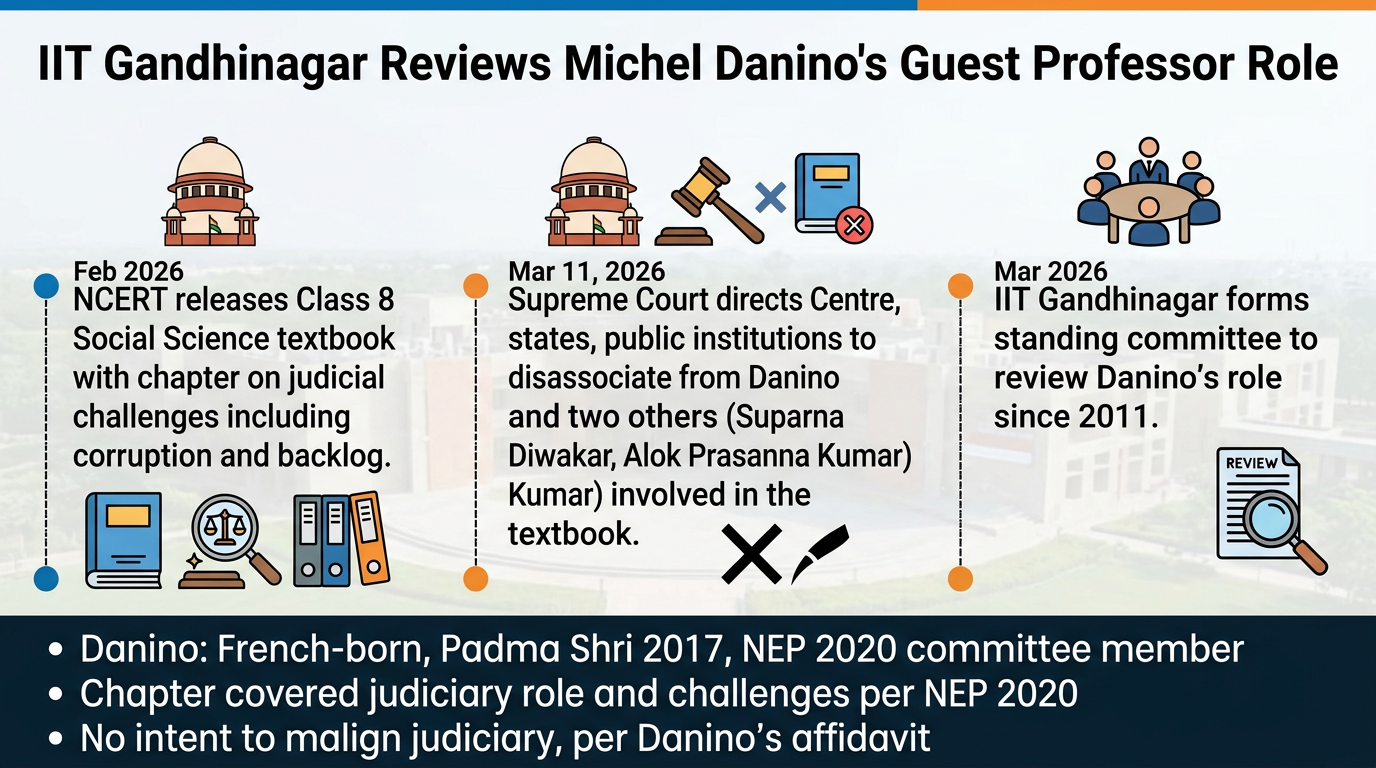
The Supreme Court’s deepening probe into a withdrawn NCERT textbook chapter on judicial corruption has rippled into academia, with IIT Gandhinagar announcing a review of historian Michel Danino’s long-standing guest professorship. This follows the court’s explicit directive for governments and public institutions to cut ties with Danino and two other experts linked to the contentious content.
Trigger: The NCERT Textbook Controversy
The saga erupted late last month when the Supreme Court took suo motu notice of a Class 8 social science textbook chapter alleging corruption in the judiciary. Deeming the references “offending,” a bench led by Chief Justice Surya Kant ordered an immediate ban on circulation and seizures of the book. NCERT complied swiftly, pulling the textbook and issuing an apology for an “error in judgement.”
Yet the court pressed on, escalating from content removal to accountability. On Wednesday, it targeted the drafting trio: Michel Danino, who chaired the social science curricular group; Suparna Diwakar; and Alok Prasanna Kumar. “We have no reason to doubt they lack informed knowledge of the Indian judiciary or deliberately misrepresented facts to tarnish its image before Class 8 students,” the bench stated starkly.
The order barred them from any curriculum roles, questioning their fitness to shape textbooks for the nation’s youth. No responses came from Danino, Diwakar, or Kumar despite outreach attempts.
IIT Gandhinagar’s Response
IIT Gandhinagar, where Michel Danino has served as guest professor since 2011, moved quickly. A senior official confirmed: “A standing committee will examine Danino’s appointment per the Supreme Court’s directions, and a decision will follow.” This marks the controversy’s extension from textbooks to institutional affiliations, testing how public institutes balance academic freedom with judicial mandates.
Who Are the Academics Involved?
Michel Danino, a French-born Indian citizen and 2017 Padma Shri recipient for literature and education, brings heft to education circles. He’s contributed to the National Education Policy 2020’s curriculum framework and authored works on ancient India. His NCERT role amplified his influence.
Alok Prasanna Kumar co-founded the Vidhi Centre for Legal Policy, a think tank advising on legal reforms. Suparna Diwakar, an educator, sits on the board of the School of Inspired Leadership. Their collective expertise made the chapter’s content especially contentious.
Court’s Rationale and Broader Implications
The bench emphasized protecting young minds: “There’s no reason these individuals should associate in any manner with school curricula or textbook finalization.” This rare intervention underscores the judiciary’s vigilance over educational narratives portraying it negatively, amid ongoing NCERT revisions criticized as ideologically driven.
Critics see the chapter’s withdrawal as part of larger textbook tweaks, but the court framed it as a safeguard against misinformation. The directive now pressures institutions nationwide to audit ties with the named experts, potentially chilling academic collaborations.
Ripple Effects on Academia
For IIT Gandhinagar, the review tests its autonomy. Danino’s 15-year tenure involved teaching and research, aligning with the institute’s interdisciplinary ethos. Termination could spark debates on due process versus compliance, especially sans formal charges.
Nationally, it signals courts’ readiness to influence staffing in public bodies. Similar scrutiny might hit other affiliates. As proceedings continue, the case blends education policy, free speech, and institutional governance – watching eyes await IIT’s committee verdict and potential appeals.
This episode highlights tensions in India’s evolving education landscape, where history, ideology, and judiciary intersect.
Disclaimer
The information in this article is based on available public sources and official statements as of the time of publication. While we aim for accuracy, we do not guarantee completeness or correctness. We advise readers to verify key details from official sources before making any decisions. The website (iitiimsamvaad.com) is not liable for any loss or damage arising from the use of this content. The authors are also not responsible for any such loss or damage.