
An IIT Madras CREST analysis finds India now hosts 2.5 lakh start‑ups, with sharp growth in funded ventures, women founders, and innovation beyond major metro cities.
India’s Start‑up Ecosystem Reaches 2.5 Lakh Firms
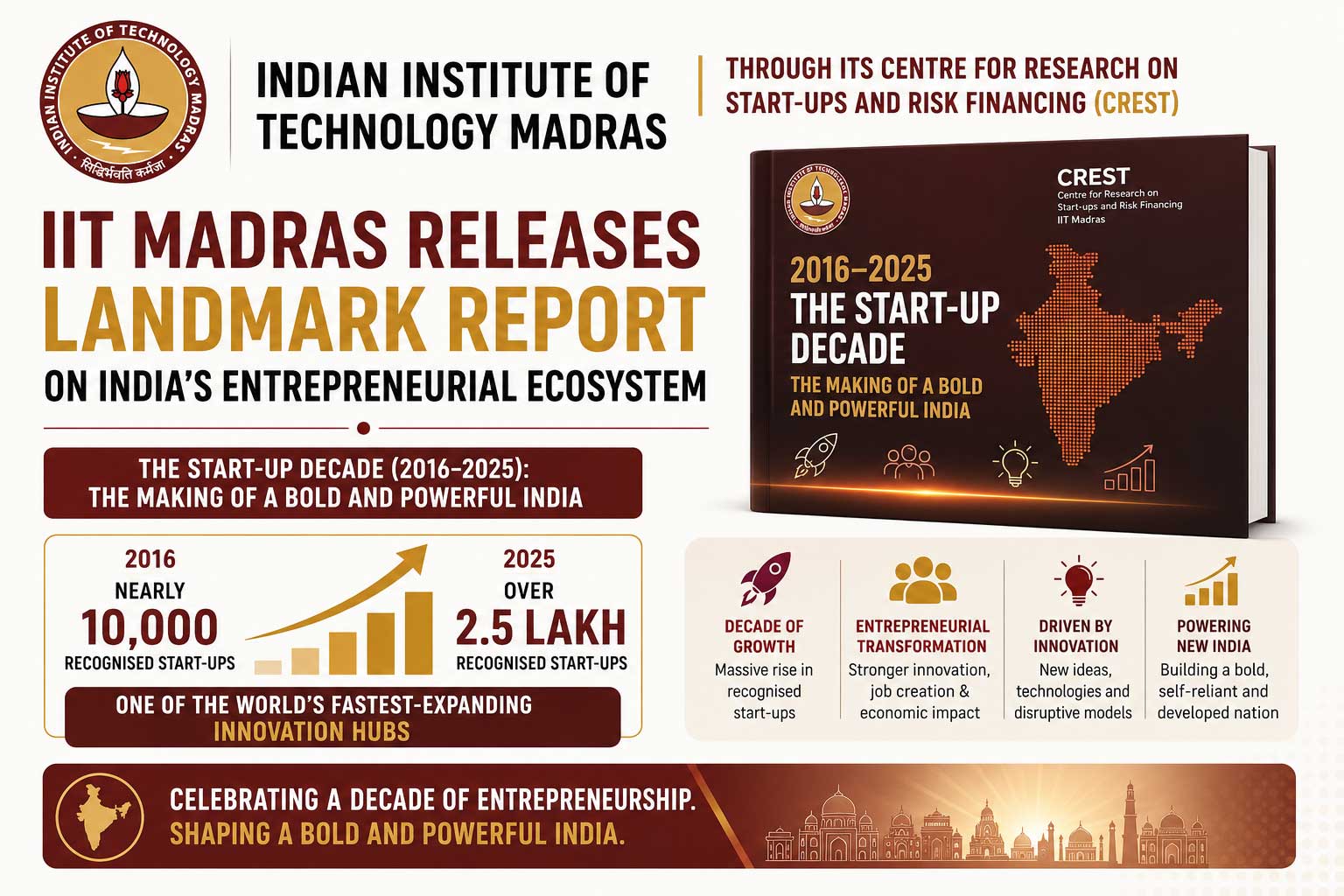
The Indian Institute of Technology Madras (IIT Madras), through its Centre for Research on Start‑ups and Risk Financing (CREST), has released a landmark report on the state of India’s entrepreneurial ecosystem. The study, titled “2016–2025: The Start‑up Decade – The Making of a Bold and Powerful India,” shows that India’s recognised start‑up base has grown from nearly 10,000 in 2016 to over 2.5 lakh by 2025, making it one of the world’s fastest‑expanding innovation hubs.
The data reveal that India’s start‑up story is no longer confined to a handful of high‑profile unicorns but now reflects a broad‑based entrepreneurial surge across sectors, business models, and geographies. The report documents how policy support, digital infrastructure, and easier access to capital have helped move India from a largely services‑driven economy to an innovation‑driven growth model.
Funded Start‑ups and Investment Momentum
The CREST analysis highlights a sharp rise in funded ventures, underlining growing investor confidence in Indian entrepreneurs. The number of funded start‑ups climbed from around 2,000 in 2016 to roughly 75,000 by 2025, indicating a seven‑fold expansion in venture‑capital and growth‑equity activity.
The report attributes this growth to several factors, including the launch and scaling of government‑backed schemes such as the Start‑up India initiative, improved banking and credit‑support frameworks, and the emergence of early‑stage investors, accelerators, and corporate‑venture units. Investors are now actively backing deep‑tech, healthtech, edtech, agritech, and climate‑tech ventures, signalling a shift from purely consumer‑internet bets to more diverse, technology‑driven portfolios.
Key Structural Drivers of Growth
Led by Professor A. Thillai Rajan, the report identifies key structural drivers that have powered the ecosystem’s expansion. One major trend is the rise in women‑led start‑ups and women founders, with a steadily growing share of female entrepreneurs across sectors such as health, education, sustainability, and retail‑technology.
Another driver is the geographic spread of innovation beyond the major metros of Bengaluru, Mumbai, Delhi‑NCR, and Hyderabad. Tier‑2 and tier‑3 cities, states such as Gujarat, Tamil Nadu, Kerala, and Punjab, and regions like the North‑East and Jammu & Kashmir are now seeing vibrant start‑up activity, often supported by local incubators and state‑government initiatives.
The report also notes the expanding role of incubators, research‑centric universities, and banking institutions in nurturing early‑stage ventures, as well as the growing number of start‑ups formally recognised by the Department for Promotion of Industry and Internal Trade (DPIIT), which has strengthened access to benefits and networks.
Launch Event at IIT Madras
The organisers unveiled the report during The Confluence Symposium on Start‑ups and Innovation at IIT Madras, a flagship platform that brings together entrepreneurs, investors, policymakers, and academics. Srini Raju, a prominent industry leader and investor, launched the study alongside Sudatta Mandal, who highlighted the importance of resilience, collaboration, and long‑term vision in building a robust entrepreneurial ecosystem.
At the symposium, experts observed that India’s start‑up growth reflects a structural shift toward innovation‑led economic development, supported by policy reforms, digital‑public‑infrastructure, and an expanding pool of venture capital. Panellists noted that Indian entrepreneurs are increasingly tackling complex, mission‑critical challenges in areas such as healthcare, education, climate, and infrastructure, while also building scalable export‑oriented solutions.
Outlook for India’s Innovation‑Led Economy
The CREST report concludes that India is now firmly positioned as a global leader in start‑up creation, with a strong pipeline of new ventures, rising funding depth, and broadening regional and demographic participation. The authors project that, with sustained policy support, continued investment into early‑stage risk finance, and deeper industry–academia linkages, India’s innovation economy will maintain momentum into the next decade.
By capturing the journey from around 10,000 start‑ups in 2016 to 2.5 lakh firms by 2025, the IIT Madras study offers policymakers and ecosystem builders a data‑driven roadmap for nurturing the next wave of Indian start‑ups—especially in deep‑tech, social‑impact, and sustainability‑focused domains that will shape the country’s long‑term competitiveness.
Disclaimer
The information in this article is based on available public sources and official statements as of the time of publication. While we aim for accuracy, we do not guarantee completeness or correctness. We advise readers to verify key details from official sources before making any decisions. The website (iitiimsamvaad.com) is not liable for any loss or damage arising from the use of this content. The authors are also not responsible for any such loss or damage.