

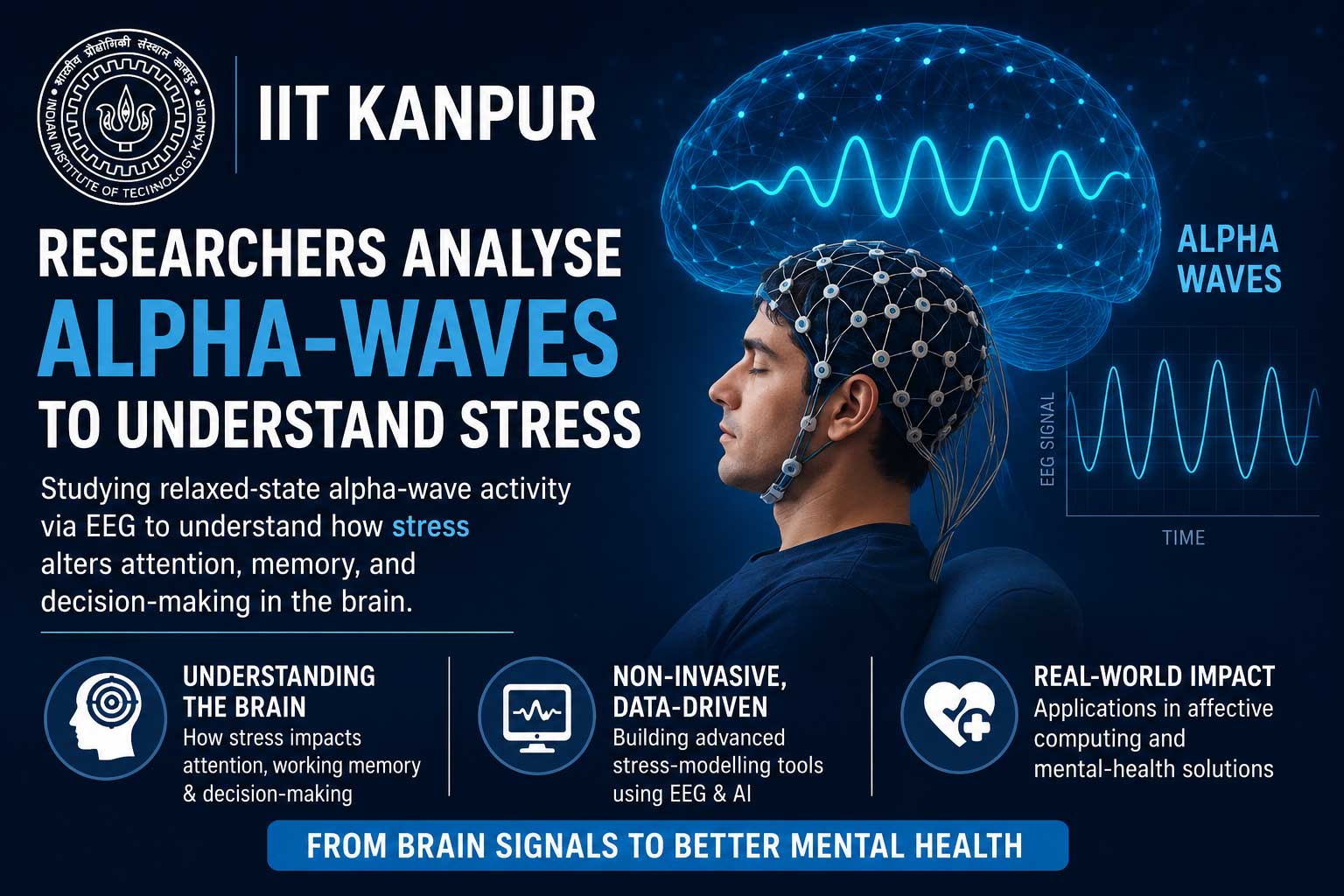
Researchers at IIT‑Kanpur are analysing relaxed‑state alpha‑wave activity recorded via EEG to understand how stress alters attention, working memory, and decision‑making in the human brain, and to build non‑invasive, data‑driven stress‑modelling tools for affective computing and mental‑health applications.
Probing the ‘Relaxed’ Brain Under Stress
A team at the Indian Institute of Technology (IIT), Kanpur is examining alpha waves in the brain – oscillations that dominate when a person is awake and in a relaxed state – to decode how stress influences core cognitive functions such as attention, working memory, and risk‑reward analysis. The project, led by Tushar Sandhan, Associate Professor in the Department of Electrical Engineering, aims to map how different individuals respond to stress and how stress modulates cognition in measurable brain‑signal terms.
The team is using non‑invasive electroencephalogram (EEG) recordings to build automated models of multiple stress dimensions. They correlate these EEG signals with subjective stress indicators such as feelings of loss of control, helplessness, and anxiety, which are outlined in the Diagnostic and Statistical Manual of Mental Disorders (DSM‑5). Their goal is to translate subtle changes in alpha‑wave patterns into objective markers of stress intensity and cognitive impact.
Alpha Waves and the Calm, Relaxed Mind
Alpha waves, first identified about a century ago, typically appear when a person is awake but relaxed, often with eyes closed. They are linked to calmness, meditative states, and reduced external sensory input, and form one of the most visible signatures on clinical EEG systems.
Recent studies, including one published in IEEE Xplore in October 2025, have shown that exposing stressed individuals to binaural beats in the alpha frequency band (8–12 Hertz) can significantly boost alpha‑wave activity and lower perceived stress levels. A binaural beat is an auditory illusion that the brain generates when different frequencies are delivered separately to each ear, and the difference between them falls within the alpha range. The IIT‑Kanpur researchers are building on such findings to explore how external stimuli and internal stress states jointly shape alpha‑wave dynamics.
Frontal Alpha Asymmetry as a Stress Biomarker
Sandhan’s team is focusing on alpha‑wave activity in the frontal lobe, a region critical for judgment, self‑perception, and decision‑making. They are specifically investigating frontal alpha asymmetry – a biomarker that reflects an imbalance in alpha‑wave power between the left and right frontal hemispheres of the brain.
In several psychiatric and neurological conditions, including depression, such asymmetry can become strongly biased, with higher alpha power in one hemisphere compared with the other. Sandhan explains that prior research has linked greater left‑frontal alpha power to reduced left‑frontal activity, which in turn correlates with weaker approach motivation – the tendency to engage with rewards versus withdrawing from threats. By tracking changes in frontal alpha asymmetry under stress, the IIT‑Kanpur group aims to quantify shifts between “approach” and “withdrawal” behavioural tendencies in real time.
The researchers are collecting data using a custom‑assembled bioamplifier with soft, flexible silicon electrodes connected to a 3D‑printed ergonomic EEG headband, allowing comfortable, long‑duration recordings. They are also monitoring cardiac activity with a smartwatch to cross‑check autonomic‑nervous‑system responses to stressors.
Linking EEG Signals to Emotion and Decision‑Making
Earlier, Sandhan and his colleagues proposed an algorithm called DAAFNet to analyse EEG signals and classify emotional states. Their work feeds into the field of affective computing – an interdisciplinary domain that blends artificial intelligence, psychology, and cognitive science to design systems capable of recognising and interpreting human emotions.
Such systems can power advanced human–computer interfaces (HCI) and brain–computer interfaces (BCI), which aim to bridge the gap between human intent and machine action. Potential applications range from adaptive educational technologies and assistive devices for people with motor impairments, to mental‑health diagnostics and real‑time stress‑monitoring tools. By refining their stress‑sensitive alpha‑wave models, the IIT‑Kanpur team hopes to make these interfaces more responsive and personalised.
Gaps in Alpha‑Wave Research
Despite over a century of research on alpha waves, experts say the data on their role as a biomarker remain incomplete. Vaibhav Tripathi, Assistant Professor in the Cognitive and Brain Sciences Department at IIT Gandhinagar, notes that alpha waves are the most prominent oscillations visible on EEG when a person closes their eyes, but their functional meaning is still debated.
Different brain waves – alpha, beta, and gamma – can relate to a variety of cognitive functions and physiological responses, including stress, and their patterns vary across individuals depending on mental state, traits, and daily context. “Your mental state changes through the day and even day to day,” Tripathi says. “Stress is a variable phenomenon, and we need an objective, measurable framework for it to capture state‑level fluctuations in alpha waves across time.”
Need for Long‑Term Data
Tripathi’s own lab studies alpha‑wave signatures in people with attention‑deficit/hyperactivity disorder (ADHD) and major depressive disorder, where distinct patterns of alpha asymmetry and oscillation have surfaced. He emphasises that researchers must still clarify whether alpha waves primarily reflect state properties (momentary mental conditions) or trait properties (long‑term predispositions such as chronic stress or depressive tendencies).
For the IIT‑Kanpur stress‑cognition programme, these open questions translate into a call for large‑scale, longitudinal EEG studies that track the same individuals over days or weeks, under different stress levels and behavioural tasks. Such data would help anchor alpha‑wave findings in robust, quantifiable metrics and move the field closer to clinically useful tools for early stress detection and cognitive‑health monitoring.
Disclaimer
The information in this article is based on available public sources and official statements as of the time of publication. While we aim for accuracy, we do not guarantee completeness or correctness. We advise readers to verify key details from official sources before making any decisions. The website (iitiimsamvaad.com) is not liable for any loss or damage arising from the use of this content. The authors are also not responsible for any such loss or damage.