
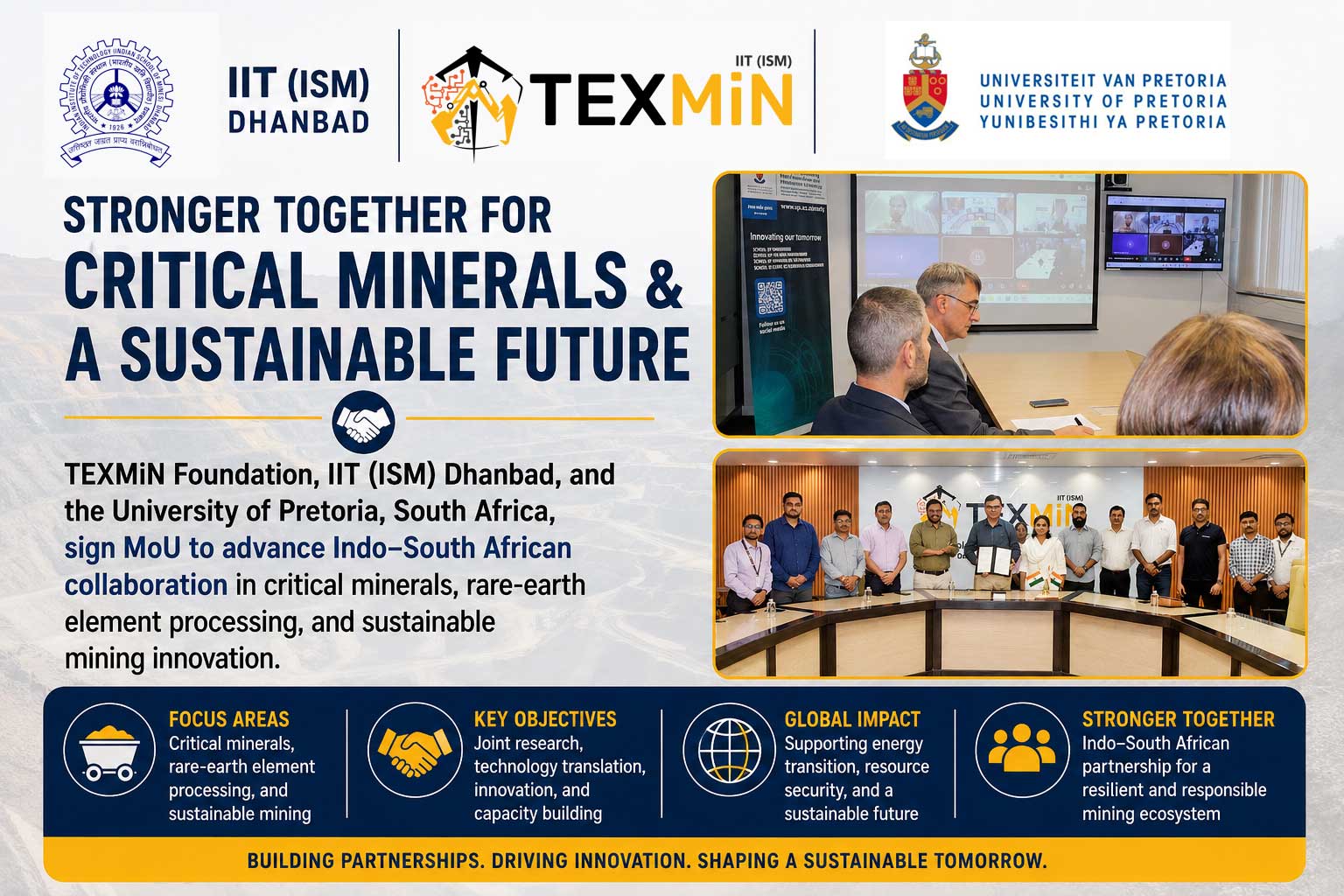
The TEXMiN Foundation, IIT (ISM) Dhanbad, and the University of Pretoria, South Africa, have signed a Memorandum of Understanding to deepen Indo–South African collaboration in critical minerals, rare‑earth element processing, and sustainable mining innovation, with a focus on joint research, technology translation, and global energy‑transition priorities.
Strengthening Indo–South Africa Critical Minerals Ties
TEXMiN Foundation, IIT (Indian School of Mines) Dhanbad, and the University of Pretoria, South Africa, have signed a Memorandum of Understanding (MoU) to strengthen cooperation in critical minerals, rare‑earth element processing, and sustainable mining innovation. The agreement was signed on May 15 in New Delhi and aims to establish a structured platform for joint research, technology development, and academic exchange across the mining value chain.
The collaboration combines TEXMiN’s technology‑translation and innovation capabilities with the University of Pretoria’s academic strengths in mining, metallurgy, and engineering sciences. By linking these pools of expertise, the partners aim to address shared challenges in mineral security, environmental sustainability, and technology‑driven resource development.
Focus on Joint Research and Innovation
Under the MoU, the institutions will launch research programmes covering critical mineral targeting, advanced geophysical methods, and digital subsurface analytics to improve the efficiency and accuracy of mineral exploration. They will also work on mineral‑processing innovations, recycling systems, and extraction technologies for materials such as lithium, graphite, cobalt, nickel, manganese, aluminium, copper, rare‑earth elements, and battery‑grade compounds.
Both sides will develop joint assets, including shared datasets, software tools, and experimental platforms, and will grant each other access to key research infrastructure and laboratories. The partnership will also support translational innovation initiatives aligned with global energy‑transition priorities, such as cleaner processing routes, low‑impact mining methods, and circular‑economy approaches for metal‑rich waste streams.
Centres of Excellence and Talent Development
The MoU includes provisions for future Centre of Excellence‑led initiatives to expand research, skilling, and technology‑translation efforts in critical‑minerals and sustainable‑mining domains. These centres will act as hubs for interdisciplinary research, policy engagement, and technology pilot programmes, drawing on expertise from academia, industry, and public‑sector stakeholders.
The collaboration will also feature student and researcher exchange programmes, internships, and joint training and certification modules for early‑career scientists and engineers. The partners plan to organise executive‑level upskilling programmes and short‑term technical training sessions tailored to industry professionals working in mining, metallurgy, and battery‑materials sectors. Such capacity‑building efforts aim to nurture a globally connected talent pool that can support responsible resource development and advanced technology adoption in both India and South Africa.
Startup Incubation and Industry‑Linked Projects
The TEXMiN–IIT (ISM) Dhanbad–University of Pretoria partnership will support start‑up incubation, workshops, and seminars to accelerate innovation in the critical‑minerals ecosystem. The institutions will jointly pitch industry‑linked projects and co‑design use‑inspired research, with an emphasis on commercialisation and technology transfer.
They may also align selected projects with India’s National Critical Mineral Mission framework, ensuring that their work responds to national priorities in securing strategic minerals, building domestic supply‑chain resilience, and advancing downstream technologies such as batteries and advanced materials. The collaboration will encourage industry‑academia linkages through joint field trials, pilot plants, and technology‑demonstration programmes in both countries.
High‑Level Engagement
The signing ceremony gathered senior officials and academic leaders from India and South Africa. Representatives included Mrs. Banu Prakash, Deputy High Commissioner at the Indian Embassy in South Africa, and Shri Shyam Chand, First Secretary, Indian Embassy, highlighting the strategic importance of the partnership for bilateral science and technology cooperation.
From the University of Pretoria, attendees included Prof. Wynand Steyn, Dean, Faculty of Engineering, Built Environment & Information Technology; Prof. Natasha Naude, Head of the Department of Metallurgy; Prof. Tinus Otto, from the Department of Mining Engineering; and Dr. Vinod Kurup, also from the Department of Metallurgy.
Strategic Vision
Prof. Sukumar Mishra, Director, IIT (ISM) Dhanbad, and Chairman, Hub Governing Board, TEXMiN Foundation, said the partnership reflects the growing importance of international cooperation in securing the future of critical minerals and sustainable mining technologies. “By bringing together complementary expertise from India and South Africa, we aim to create meaningful research outcomes, technology‑led solutions, and knowledge‑sharing platforms that can support industrial transformation and responsible resource development,” he said.
Prof. Dheeraj Kumar, Deputy Director, IIT (ISM) Dhanbad, and Project Director, TEXMiN, added that the collaboration will help build a globally connected innovation ecosystem for the mining and minerals sector by combining research, technology translation, and talent development.
Prof. Wynand Steyn, Dean, Faculty of Engineering, Built Environment & Information Technology, University of Pretoria, said the partnership offers a significant opportunity to strengthen academic and research ties between South Africa and India in critical minerals and sustainable mining, and to jointly address global‑scale resource and environmental challenges.
Disclaimer
The information in this article is based on available public sources and official statements as of the time of publication. While we aim for accuracy, we do not guarantee completeness or correctness. We advise readers to verify key details from official sources before making any decisions. The website (iitiimsamvaad.com) is not liable for any loss or damage arising from the use of this content. The authors are also not responsible for any such loss or damage.