
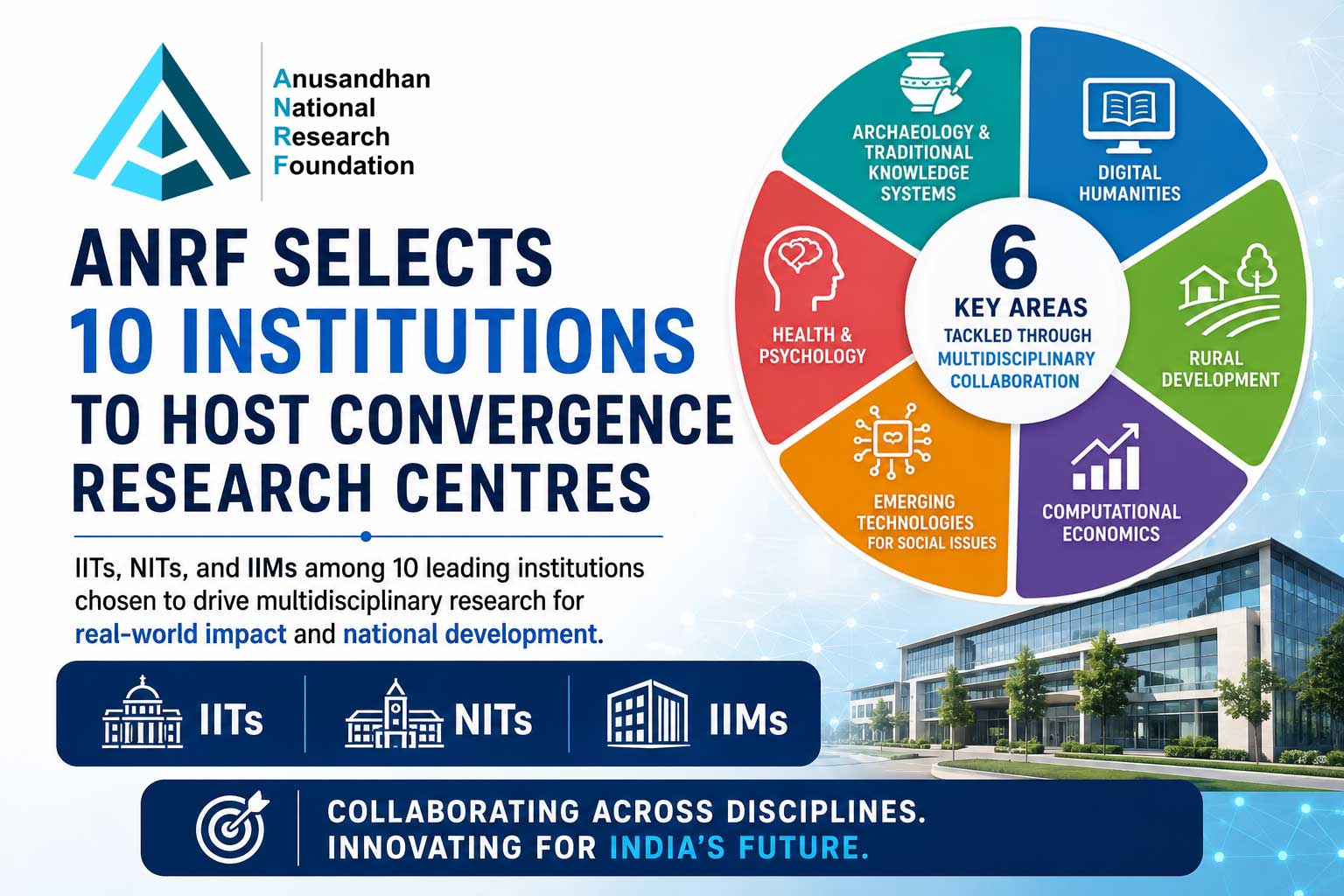
ANRF has selected 10 institutions, including IITs, NITs, and IIMs, to host Convergence Research Centres tackling archaeology, AI, rural development, digital humanities, and sustainable livelihoods through multidisciplinary collaboration.
ANRF Launches Convergence Research Centres of Excellence
The Anusandhan National Research Foundation (ANRF), established under the Department of Science & Technology (DST), has announced 10 new Convergence Research Centres of Excellence (CoE) across India. ANRF oversees the national research‑funding framework and aims to strengthen university and industry‑linked R&D through strategic, problem‑driven programmes.
The Convergence Research Centres of Excellence programme will create multidisciplinary research hubs that integrate scientific and technological expertise with social, cultural, and economic insights. The selected centres will work on themes such as archaeology and traditional knowledge systems, artificial intelligence, labour‑market dynamics, rural livelihoods, digital humanities, language research, and sustainable industrial practices.
National Response and Multi‑Institutional Collaboration
ANRF received 945 proposals from institutions nationwide, underscoring strong engagement from the academic and research community. The foundation will now fund 10 centres, each led by a host institution and supported by a network of collaborators. Principal investigators and co‑investigators will come from nearly 20 partnering organisations, including state universities, central universities, IITs, NITs, colleges, private universities, and public‑funded R&D institutes.
The programme explicitly promotes convergence research, where experts from different disciplines jointly design and implement projects to address real‑world problems that cannot be solved within a single field. By linking natural sciences, engineering, social sciences, and humanities, the centres also aim to generate holistic solutions for India’s development challenges.
Selected Centres and Their Focus Areas
Several IITs, NITs, and an IIM appear among the selected centres, reflecting a broad disciplinary footprint across archaeology, AI, rural development, and digital humanities.
Archaeology and Traditional Knowledge Systems
- Indian Institute of Technology (IIT) Gandhinagar will host the Centre for Human–Climate Interactions and Environmental Histories (CHIEH). The centre will study how past societies adapted to climate and environmental change, using archaeological and historical data to inform present‑day resilience strategies.
- National Institute of Advanced Studies (NIAS) will lead the Centre of Excellence in Archaeomaterials, Archaeometallurgy, Earth Sciences & Conservation Research. The project will also examine ancient materials and metallurgical practices and explore conservation‑oriented approaches rooted in traditional knowledge.
- Indian Institute of Technology (IIT) Madras will set up SAṂYoga – Centre for Sanskrit AI, Music and Yoga, which blends AI, cultural heritage, and cognitive practices. The centre will explore computational applications for Sanskrit texts, musical traditions, and yoga‑based interventions.
Digital Humanities
- National Institute of Technology (NIT) Agartala will launch the AI‑assisted Digital Curation and Global Promotion of North‑East Indian Folklore centre. The project also aims to digitally document, preserve, and globally showcase folk traditions from the North‑East using AI‑powered tools for metadata tagging, translation, and multimedia curation.
- Institute for Human Development will establish the Transformative AI and the Indian Labour Market centre. The team will also study how AI and automation reshape employment, wages, and informal‑sector livelihoods, with an emphasis on policy‑relevant insights.
Rural Development
- Indian Institute of Technology (IIT) Dharwad will run the Centre of Excellence for Rural Livelihoods and Development. The centre will work on improving agricultural value chains, rural entrepreneurship, and digital‑farming services in remote and under‑served regions.
- Indian Institute of Management (IIM) Jammu will host the Centre of Excellence on Digital Empowerment and Livelihood Development of Artisans. The project will focus on using digital platforms to connect artisans with markets, improve design capabilities, and strengthen enterprise‑level support systems.
Health and Psychology
- Indian Institute of Technology (IIT) Kanpur will lead the Centre for Research and Intervention in Language Performance. The centre will also investigate language‑processing challenges in clinical and educational settings and develop tools to support speech, reading, and communication outcomes.
Emerging Technologies for Social Issues
- Chanakya University will set up the Center for Languages and Lifeworlds to explore Emerging Technologies for Social Issues. The project will also examine how language technologies, AI‑mediated communication, and digital platforms influence social inclusion, identity, and civic participation.
Computational Economics
- PSGR Krishnammal College for Women will establish a Framework to Accelerate MSME Transition towards Sustainable Technologies under Computational Economics. The centre will design data‑driven models to help small and medium‑scale enterprises adopt energy‑efficient and circular‑economy technologies.
Building a Multi‑Disciplinary Research Ecosystem
Each Convergence Research Centre will operate as a hub that brings together engineers, computer scientists, social scientists, archaeologists, linguists, and policy experts. The centres will also run joint research projects, shared datasets, field experiments, and policy dialogues, with the goal of producing publishable research, prototypes, and evidence‑based recommendations.
The programme reinforces ANRF’s mandate to align research with national priorities such as sustainable industrialisation, rural transformation, cultural preservation, and digital‑age workforce development. By embedding convergence research into well‑known institutions like IITs, NITs, IIMs, and state universities, ANRF is also positioning these centres as long‑term nodes in India’s evolving innovation ecosystem.
Disclaimer
The information in this article is based on available public sources and official statements as of the time of publication. While we aim for accuracy, we do not guarantee completeness or correctness. We advise readers to verify key details from official sources before making any decisions. The website (iitiimsamvaad.com) is not liable for any loss or damage arising from the use of this content. The authors are also not responsible for any such loss or damage.