

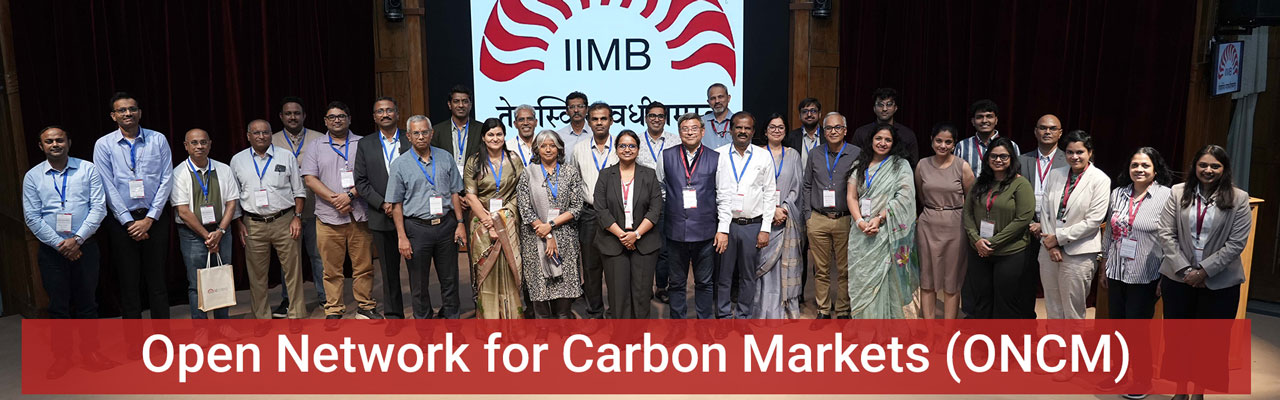
As India prepares to launch its Carbon Credit Trading System (CCTS), IIM Bangalore, through its Centre for Digital Public Goods (CDPG), hosted a multi‑stakeholder roundtable on 19 March 2026 to design the Open Network for Carbon Markets (ONCM). The roundtable brought together regulators, exchange operators, technology firms, policymakers, forest‑department officials, and corporate buyers, with the goal of building an open digital infrastructure for seamless, transparent, and inclusive carbon trading.
As India gears up to roll out its Carbon Credit Trading System (CCTS), the Indian Institute of Management Bangalore (IIMB), through its Centre for Digital Public Goods (CDPG), convened a high‑level roundtable on 19 March 2026 to design the Open Network for Carbon Markets (ONCM). The proposed ONCM is being developed in partnership with Networks for Humanity (NFH) and aims to tackle structural barriers that currently limit India’s participation in global carbon‑credit markets. The roundtable gathered regulators, market‑exchange operators, technology service providers, policymakers, senior forest‑department officers, and corporate buyers to align on the network’s architecture and implementation roadmap.
The ONCM is designed to overcome key constraints such as fragmented carbon‑credit registries, cross‑border trading hurdles, pricing opacity, and non‑standard monitoring‑review‑verification (MRV) processes. By building an open, interoperable digital infrastructure, the network seeks to enable seamless trading of carbon credits across jurisdictions while preserving the agency, autonomy, and data sovereignty of all participants. A core idea is to create a protocol‑based “digital plumbing” for carbon markets, similar to what Beckn and NFH have done for mobility, commerce (ONDC), and energy, allowing diverse market players to build their own applications on top.
The network also aims to democratise access at the grassroots level. Even a small‑scale farmer who wants to monetise farm‑based carbon sequestration would be able to register, verify, and trade credits through simple voice‑enabled interfaces on platforms of their choice, such as WhatsApp. At the same time, global buyers would gain confidence in the provenance and quality of these credits through programmable, interoperable authentication and audit mechanisms, coupled with transparent pricing.
Opening the roundtable, Professor R. Srinivasan, Chairperson of the CDPG, underscored the need for an open, interoperable network that allows Indian farmers, micro‑entrepreneurs, and industries to participate meaningfully in international carbon markets. Sujith Nair, Co‑founder of Beckn and Networks for Humanity, drew parallels with early‑internet and telecom protocols to illustrate how open‑protocol thinking has transformed mobility (for example, Namma Yatri), retail (ONDC), and energy (Digital Energy Grid). He emphasised that such protocols function as underlying “plumbing,” enabling a rich ecosystem of applications without central control. ONCM project lead Chaitrali Bhoi outlined the practical challenges in current carbon markets and set out the vision for a standards‑based, open‑source network.
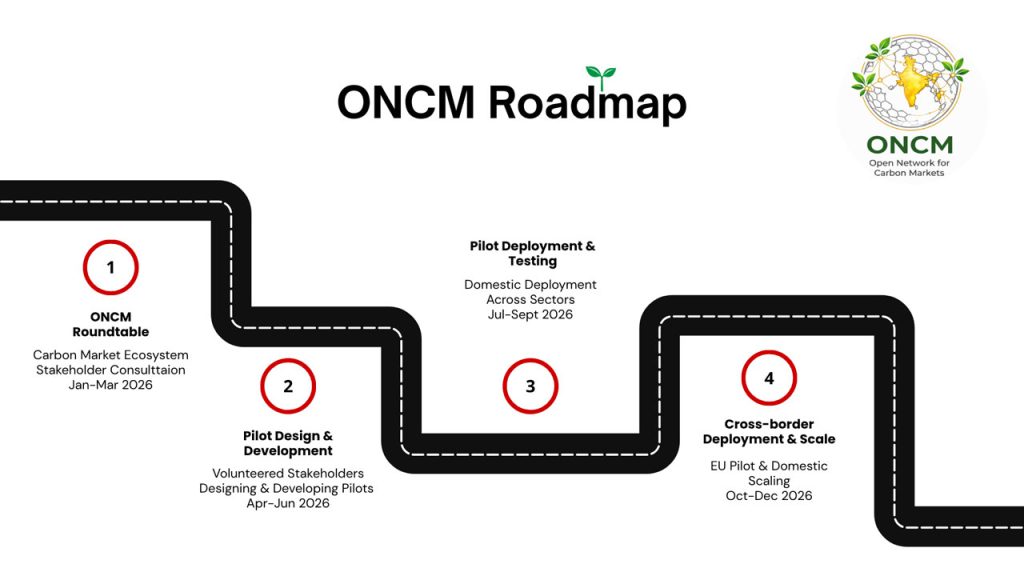
Participants were organised into four working groups – focused on market mechanisms and regulation, technology enablers, supply‑side actors, and demand‑side actors – to deliberate on design requirements, regulatory feasibility, and technical robustness. The groups agreed in principle on the need for pilot projects that test ONCM’s core components in real‑world contexts. The roundtable concluded with a synthesis of the proposed design and commitments from key stakeholders to advance pilot implementations, signalling strong multi‑sectoral support for the network’s evolution.
Prominent attendees included Ms. Praveena Rai, CEO of MCX; Dr. K. Ravichandran, Director of IIFM, Bhopal; Ms. Komal Shah of SML Ltd.; Dr. Ch. Sudhakar Reddy of NRSC/ISRO; and representatives from NFH, IIMB, NLSIU, Tata Consultancy Services, RenewCred, PhonePe, and Tata Motors – underscoring the broad‑based institutional backing for an open, interoperable carbon‑market infrastructure.
For more details Visit https://www.iimb.ac.in/cdpg/oncm.php