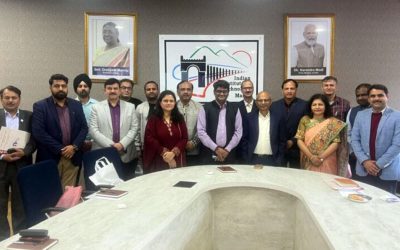

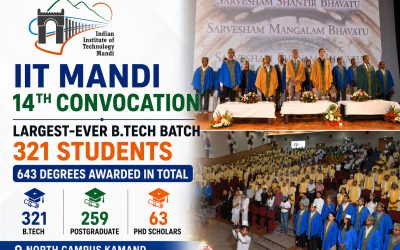
IIT Mandi TIH Pioneers Multimodal AI
IIT Mandi’s new MI-RA lab drives indigenous multimodal AI through TIHs, fostering datasets and deep-tech for healthcare, agriculture, and governance.
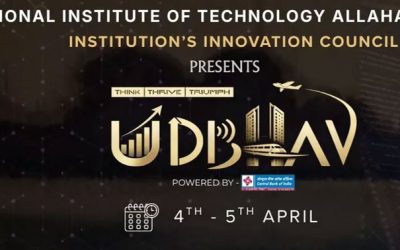
MNNIT Allahabad’s Udbhav 3.0 festival connects students with industry leaders, fostering startups through expert talks, networking, and campus innovation.
ANRF CEO’s IIT Mandi visit accelerates funding, interdisciplinary R&D, and Himachal’s research transformation aligned with Viksit Bharat.
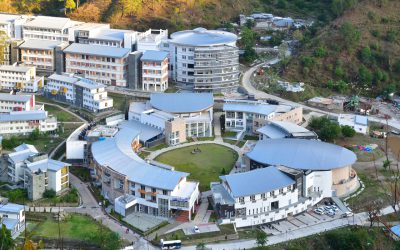
IIT Mandi marked its 17th Foundation Day by showcasing its AI‑led research, entrepreneurship focus, and a 2027 roadmap to grow to 5,000 students and over 350 faculty members.
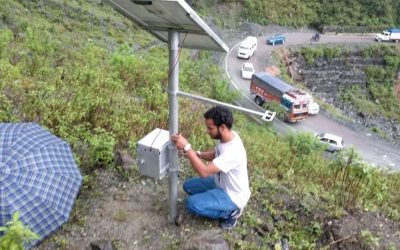
A low‑cost early warning system developed by IIT Mandi’s Professor Kala Venkata Uday can predict landslides up to three hours in advance with over 90% accuracy. Installed across 60 sites in Himachal Pradesh, the AI‑powered device uses sensors and machine learning to detect subtle slope movements and trigger timely alerts for at‑risk communities.
Fresh from IIM Kashipur, participatory communication scholar Dr. Aniruddha Jena joins IIT Mandi as Assistant Professor, poised for a Charles Wallace Fellowship at King’s College London.
The Himachal Pradesh High Court’s decision in Indian Institute of Technology, Mandi v. Central Public Works Department & Anr. reaffirms a critical principle: mere financial interest in an arbitral outcome does not amount to consent to arbitrate.
The inaugural Inter-IIT Undergraduate Innovation Meet, christened RISE 2026 and hosted by IIT Hyderabad as a flagship component of its third Innovation Day, celebrated groundbreaking student-led ingenuity.
Punjab has informed the National Green Tribunal that all 440 samples of crops, soil and irrigation water tested so far in a study on agricultural runoff and groundwater pollution were within prescribed safety limits.
IIT Mandi researchers mapped groundwater zones in the Beas Basin, identifying regions with ample water reserves and areas at risk of scarcity. Their study, using remote sensing and GIS, categorized zones based on water availability. Western areas, like Kangra, are groundwater-rich, while central regions require cautious management.