

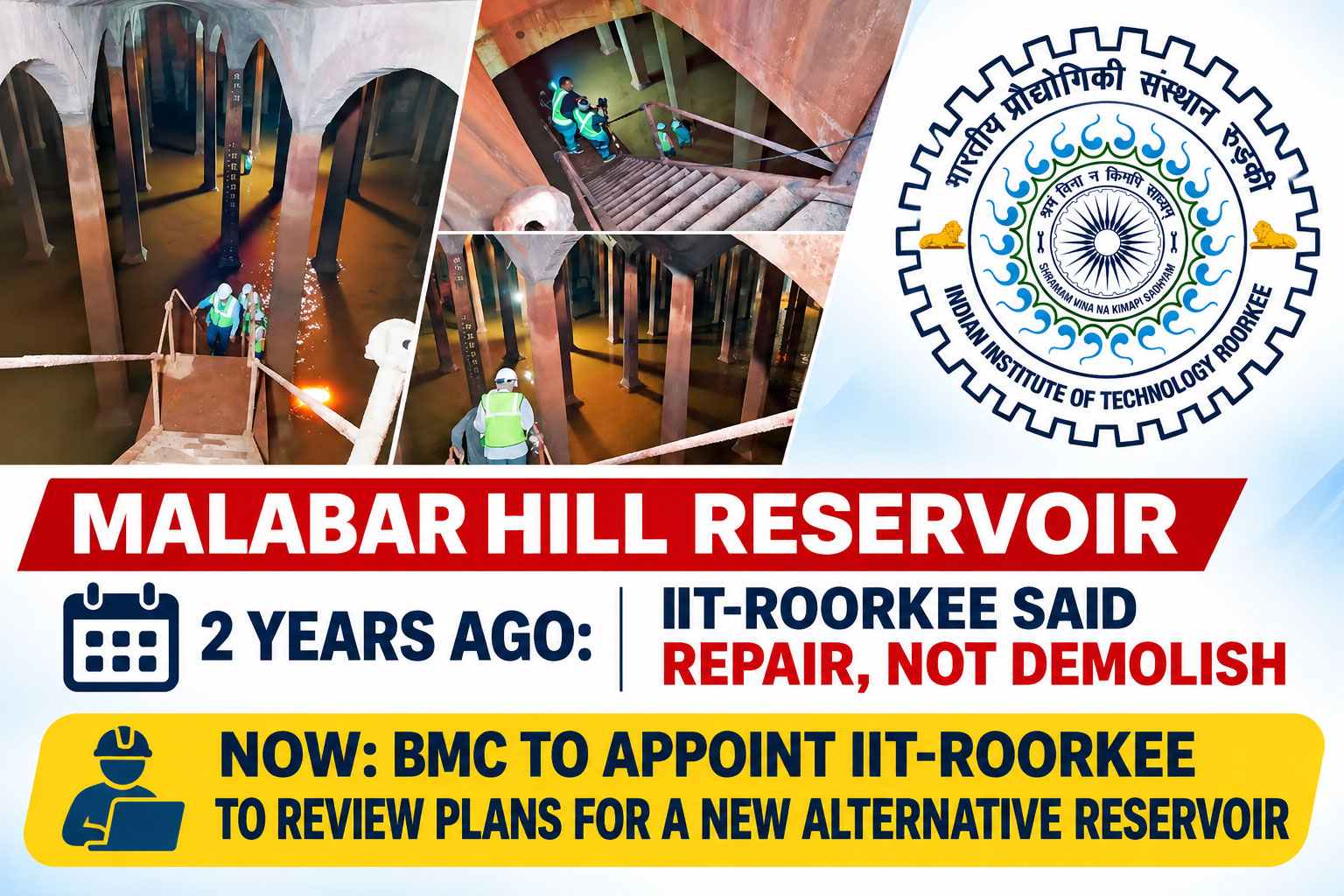
BMC seeks IIT-Roorkee’s independent review of new Malabar Hill reservoir plans, two years after the institute recommended repair over demolition.
A fresh technical review for a historic reservoir
Almost two years after an IIT-Roorkee team inspected Malabar Hill reservoir and concluded that the existing structure could be repaired rather than demolished and reconstructed, BMC now plans to appoint the institute to review its plans for a new alternative reservoir at the adjoining site. The proposal, listed before the civic Standing Committee on Sept 23, seeks approval to pay IIT-Roorkee Rs 22 lakh, excluding GST, to independently review the structural designs, plans and related proposals prepared by BMC’s project consultant, Pednekar Associates.
IIT-Roorkee team, during its earlier assessment, had recommended that the existing reservoir could be repaired and did not require demolition and reconstruction. At the same time, it had suggested construction of an alternative tank, adding that repairs to the existing reservoir could not be undertaken while water supply operations were in progress.
From demolition plan to alternative design
BMC’s earlier proposal to demolish and reconstruct Malabar Hill reservoir had faced opposition from local residents and environmentalists, particularly over concerns about the number of trees that could be affected by the project. In response, the civic body shifted towards an alternative that would preserve more of the existing heritage structure and surrounding green cover.
In an effort to minimise the impact on trees, the civic body subsequently examined alternative designs with IIT-Roorkee and proposed a three-tier reservoir with a storage capacity of 52 million litres on the western side of the existing reservoir. The proposed site is occupied by staff quarters and a pumping station. The plan also includes construction of a new valve gallery.
Pednekar Associates prepares structural designs
The structural designs, plans and related procedures for the alternative scheme have been prepared by Pednekar Associates. BMC now wants IIT-Roorkee to review these proposals, citing the technical complexity of the work. The institute’s prior familiarity with the reservoir’s condition and its earlier recommendations make it a natural choice for an independent technical audit.
The review will examine load paths, foundation assumptions, seismic considerations, construction methodology and phasing. It will also assess how the new tank interfaces with the old compartments, distribution chambers and incoming/outgoing mains.
Waiver of tender process for specialised review
The civic administration has sought permission under Section 72(3) of the Mumbai Municipal Corporation Act, 1888, to waive the requirement of inviting tenders through public advertisement for the review work. The administration has argued that IIT-Roorkee is a technically competent, govt-recognised institution and that inviting tenders through public advertisement would serve no useful purpose in this case.
By invoking this provision, BMC aims to expedite the review and avoid delays associated with a full tender process. Critics may question the waiver, but the civic body contends that the specificity of the task justifies direct engagement with IIT-Roorkee.
Historical significance and current role
Malabar Hill Reservoir, referred to as MHR by BMC officials, was constructed in 1887 and currently supplies water to various parts of the city through 19 distribution systems. The reservoir was originally built in three compartments – 1A, 1B and 2A. It was subsequently expanded in 1907 with two additional compartments, 1C and 2B, and was converted into a storage reservoir in 1916.
Over 135 years of service, the structure has become a landmark in South Mumbai. Its continued operation matters for water security, fire-fighting reserves and hydraulic stability in the distribution network. Any intervention must balance safety, capacity and heritage conservation.
Why an alternative tank matters
IIT-Roorkee’s earlier report created a dual-track approach: repair the existing reservoir while building an alternative to maintain supply during repairs. Without an alternative tank, BMC cannot isolate compartments for detailed rehabilitation without disrupting supply to large parts of the city.
The proposed three-tier design seeks to fit significant storage into a constrained, sloping site. By placing the new tank on the western side, BMC hopes to reduce tree felling compared with a full demolition and rebuild scenario.
Technical complexity and risk management
The alternative scheme involves complex interactions between old and new structures, temporary shoring, dewatering and phased construction. Errors in design or execution could compromise structural integrity or water quality. An independent review by IIT-Roorkee adds a layer of risk management.
The institute can validate assumptions, suggest design refinements and recommend construction sequences that minimise disruption. Its feedback can also inform environmental clearances, heritage consultations and stakeholder communications.
Stakeholder concerns and environmental impact
Local residents and environmental groups have closely watched the Malabar Hill reservoir file. They have raised concerns about tree loss, construction noise, dust and traffic. A robust, transparent review process can address some of these worries by demonstrating technical rigour and commitment to minimising impact.
BMC can use IIT-Roorkee’s recommendations to refine mitigation measures, such as tree transplantation, noise barriers and work-hour restrictions. Clear communication of the review’s findings can build public trust.
Timeline and next steps
The Standing Committee’s approval will allow BMC to issue a work order to IIT-Roorkee. The institute will then study Pednekar Associates’ designs, visit the site, hold technical discussions and submit its report. BMC can incorporate suggested changes before floating tenders for construction.
Parallelly, the civic body must finalise relocation or rehabilitation plans for staff quarters and the pumping station. Utility shifting, traffic management plans and environmental clearances will also need to progress in tandem. [No sources]
Balancing heritage, safety and water security
The Malabar Hill reservoir case illustrates the challenge of upgrading critical urban infrastructure in a dense, heritage-rich setting. Repairing the old tank preserves history but requires an alternative to maintain supply. Building a new tank adds capacity but demands careful design to protect trees and neighbourhoods.
IIT-Roorkee’s dual role, first as assessor and now as reviewer, positions it as a key technical anchor. Its guidance can help BMC deliver a solution that safeguards water security, respects heritage and reduces environmental impact.
#MalabarHillReservoir #BMC #IITRoorkee #WaterInfrastructure #HeritageConservation #AlternativeTank #Mumbai #StructuralReview #UrbanWater #PednekarAssociates
Disclaimer
The information in this article is based on available public sources and official statements as of the time of publication. While we aim for accuracy, we do not guarantee completeness or correctness. We advise readers to verify key details from official sources before making any decisions. The website (iitiimsamvaad.com) is not liable for any loss or damage arising from the use of this content. The authors are also not responsible for any such loss or damage.