

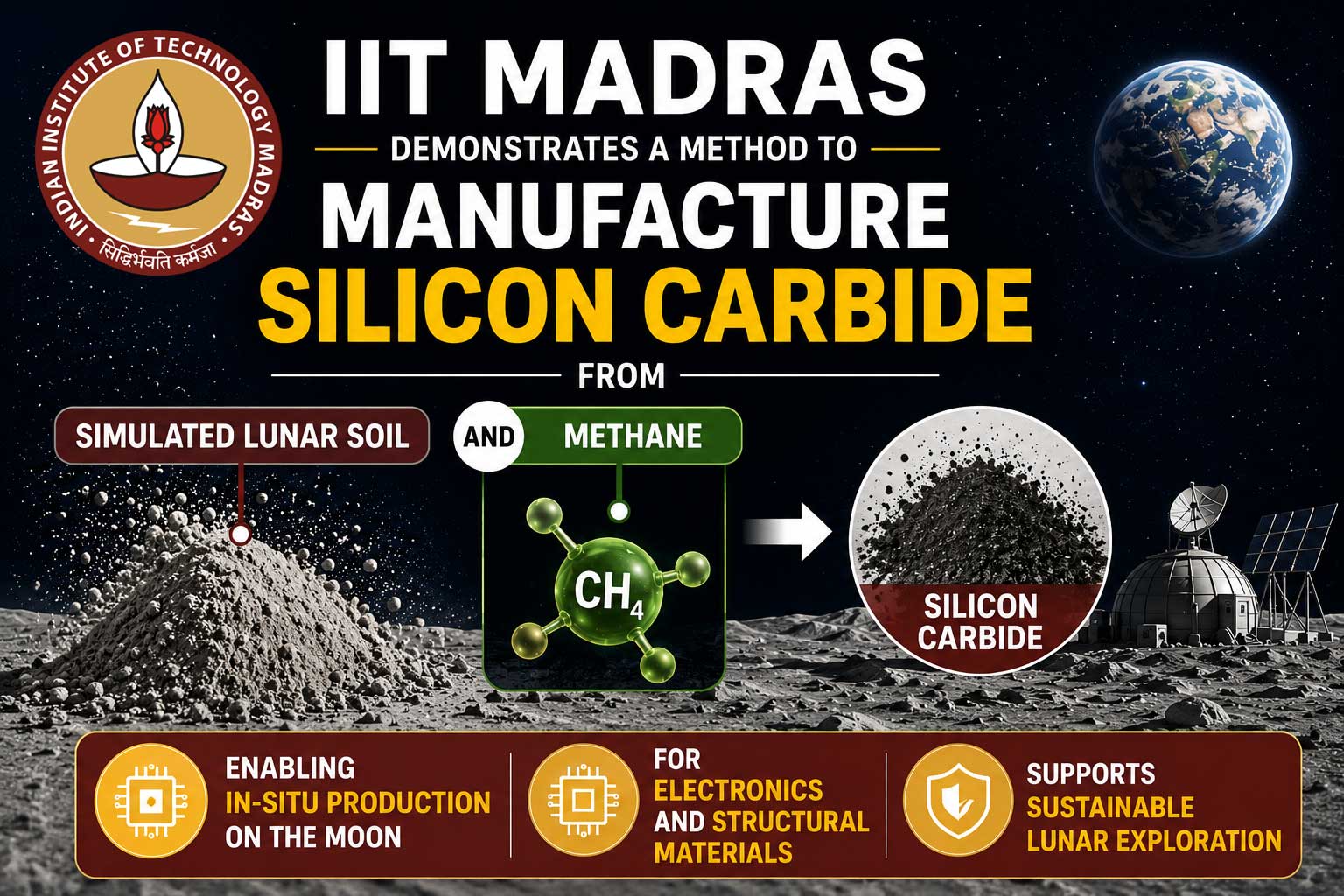
IIT Madras demonstrates a method to manufacture silicon carbide from simulated lunar soil and methane, enabling in‑situ production of electronics and structural materials on the Moon.
Turning lunar soil into advanced material
Researchers at the Indian Institute of Technology Madras (IIT‑M) have developed a method to convert simulated lunar soil into silicon carbide (SiC), a high‑performance material that could support future lunar habitats and infrastructure. The work targets one of the most pressing challenges in lunar exploration: how to build and sustain bases on the Moon without relying on repeated, costly supply missions from Earth. By using raw materials already present on the lunar surface, the team advances the concept of in‑situ resource utilisation (ISRU) for space‑based manufacturing.
Silicon carbide is a wide‑bandgap semiconductor and ceramic material with excellent mechanical strength, radiation resistance, and thermal stability, making it suitable for electronics, high‑temperature components, radiation shields, and structural elements in the harsh lunar environment. The IIT‑M team’s breakthrough lies in its ability to produce SiC directly from simulated lunar regolith and methane gas, bypassing the need to transport most of the raw materials from Earth.
Experimental method and key reactions
The researchers used LHS‑1, a lunar‑highland regolith simulant developed by the CLASS Exolith Lab at the University of Central Florida, which closely mimics the mineral chemistry and particle morphology of real Moon soil. LHS‑1 consists mainly of anorthosite and glass‑rich basalt, compositions similar to those found in the Moon’s highland regions.
In the lab, the team heated the LHS‑1 simulant to around 1,600°C inside a tubular furnace, causing it to release volatile vapours including silicon monoxide (SiO). The researchers then introduced methane (CH₄) gas into the chamber, where it reacted with the SiO vapours to form silicon carbide (SiC) whiskers. The team also confirmed the product using X‑ray diffraction, Raman spectroscopy, and electron microscopy, which revealed the presence of SiC whiskers with a core‑shell SiC‑SiOₓ structure.
In‑situ resource utilisation and methane integration
Professor Sathyan Subbiah, Centre Coordinator of the Extra Terrestrial Manufacturing (ExTeM) Research Centre at IIT‑M and corresponding author of the study published in Manufacturing Letters, highlighted the ISRU character of the process. “Our process produces it directly from the lunar soil underfoot, without shipping anything from Earth,” he said. “This is the essence of in‑situ resource utilisation: turning the Moon’s own materials into building blocks of a sustainable human presence there.”
The researchers also noted that future lunar bases could potentially produce methane through the Sabatier process, already used aboard the International Space Station. In that process, carbon dioxide released by astronauts is combined with hydrogen to produce oxygen and methane, creating a continuous, local source of the gas needed for the SiC‑forming reaction. This integration could further reduce dependence on Earth‑supplied feedstocks.
Advantages of methane‑based reduction
The IIT‑Madras team identified a key advantage of using methane as a gaseous reducing agent rather than solid carbon. Nithya Srimurugan, a research scholar at IIT‑M and the first author of the paper, explained that methane gives the team precise control over the reaction, allowing them to selectively produce high‑purity SiC whiskers.
“These single‑crystal SiC‑SIOₓ whiskers open up possibilities for on‑Moon electronics, high‑temperature device fabrication, and composite structural materials,” she said. The whiskers’ structure and high‑quality crystallinity make them attractive for use in ceramic composites, radiation‑resistant coatings, and high‑temperature electronic components that must operate in the Moon’s extreme conditions.
Current yield and future research directions
The team estimated the current SiC‑whisker yield at about 1 mg per gram of regolith, using roughly 50 units of electrical energy in the process. Although the team described these figures as preliminary and the process as not yet optimised, the demonstration proves that SiC can be synthesized from lunar‑simulant materials under realistic conditions.
Going forward, the researchers plan to study the electrical conductivity and photoluminescence properties of the whiskers for potential LED and optoelectronic applications. They also intend to explore how the whiskers can be incorporated into ceramic composites for use in lunar infrastructure, such as habitat walls, radiation‑shielding tiles, and high‑temperature electronic substrates. By refining the yield, energy efficiency, and scalability of the method, the team aims to help lay the foundation for self‑sustaining, Moon‑based manufacturing ecosystems that support long‑term human presence on the lunar surface.
Disclaimer
The information in this article is based on available public sources and official statements as of the time of publication. While we aim for accuracy, we do not guarantee completeness or correctness. We advise readers to verify key details from official sources before making any decisions. The website (iitiimsamvaad.com) is not liable for any loss or damage arising from the use of this content. The authors are also not responsible for any such loss or damage.