
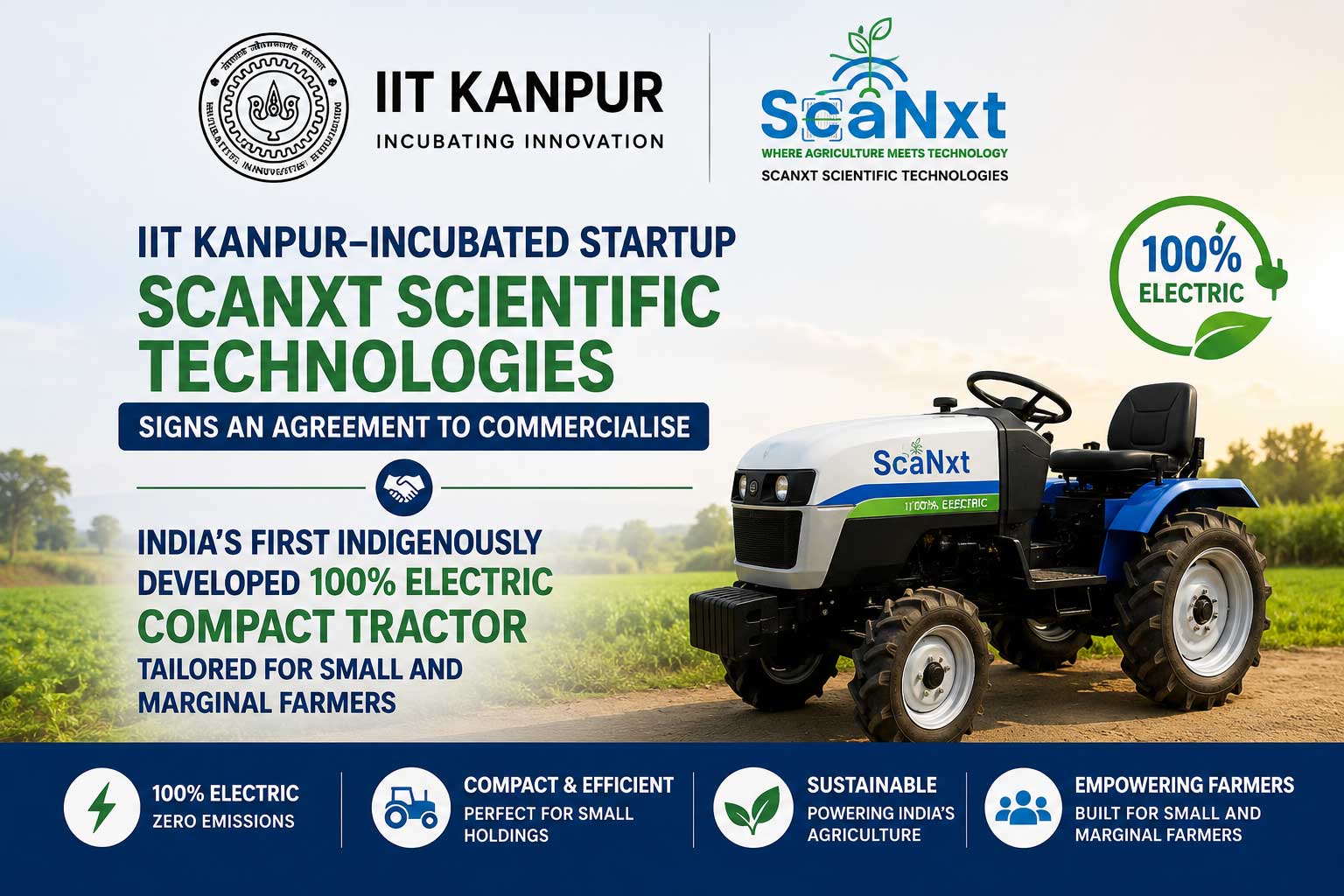
ScaNxt Scientific Technologies signs an agreement to commercialise India’s first indigenously developed 100% electric compact tractor, tailored for small and marginal farmers.
ScaNxt signs technology‑transfer pact
ScaNxt Scientific Technologies, a startup incubated at Startup Incubation and Innovation Centre (SIIC), IIT Kanpur, has signed an agreement for technology transfer of India’s first fully electric tractor. The pact, inked in collaboration with two institutions under the Ministry of Science and Technology, paves the way for bringing the tractor to market under ScaNxt’s brand as an affordable, energy‑efficient solution for India’s rural economy.
The electric compact tractor has been developed with over 90% indigenous components, underscoring India’s push toward Atmanirbhar Bharat in agricultural mechanisation and clean‑energy technologies. The agreement was formalised through a Memorandum of Understanding (MoU) signed between SIIC IIT Kanpur, CSIR‑CMERI, and the National Research Development Corporation (NRDC) during the Vigyan Tech 2026 exhibition in New Delhi.
Designing for small and marginal farmers
The tractor has been specifically designed for small and marginal farmers, who dominate India’s agricultural landscape. Over 86% of farming households operate on less than 2 hectares of land, yet conventional diesel‑based mechanisation models have historically remained economically inaccessible to this group due to high upfront costs and fuel‑price volatility.
The 100% electric compact tractor aims to bridge this structural productivity gap by offering a low‑running‑cost, environment‑friendly alternative to diesel tractors. By integrating electric‑drive technology into a compact, easy‑to‑operate architecture, ScaNxt seeks to make mechanisation viable for small holdings, where space, slope, and soil type often limit the use of large machines.
Features and rural‑centric innovations
The tractor integrates a fully electric drivetrain, enabling zero‑tailpipe‑emission operations and reduced dependence on fossil fuels. It also includes Vehicle‑to‑Load (V2L) functionality, allowing the tractor to power irrigation pumps and other farm equipment directly from its battery. This feature supports round‑the‑clock irrigation, cold‑chain connections, and tool‑charging, especially in areas with unreliable or limited grid access.
The compact operational design fits the scale and terrain of small farms and horticultural plots, while the simplified user interface and controls aim to improve accessibility for women farmers and first‑time tractor operators. By lowering technical and operational barriers, the tractor encourages wider adoption of mechanisation among traditionally underserved segments of the farming community.
Commercialisation and economic impact
Under the agreement, ScaNxt Scientific Technologies will commercialise the electric compact tractor technology under its own brand, with a clear focus on affordability, scalability, and rural‑suitable service networks. The company plans to build a manufacturing and distribution ecosystem that includes local assembly, skilling programmes for rural technicians, and digital‑enabled after‑sales support, thereby creating green‑technology jobs in rural India.
The ScaNxt team highlighted that the “Smart Compact EV Tractor” will not only cut cultivation costs but also generate employment in rural areas and support the transition to precision and prosperous farming. By enabling farmers to mechanise operations without incurring high fuel or maintenance expenses, the tractor contributes to better yields, lower drudgery, and higher farm incomes.
A new category in farm mechanisation
The launch of the electric compact tractor marks the emergence of a new category within India’s farm‑mechanisation landscape. While electric agricultural equipment remains at an early stage of adoption nationwide, the project opens opportunities for manufacturing, dealership expansion, maintenance‑service networks, and financing models tailored to smallholders.
The initiative also signals growing maturity in India’s translational innovation ecosystem, where publicly funded research, startup entrepreneurship, and institutional incubation converge to address large‑scale national challenges through indigenous technologies. The MoU reflects how research institutions such as CSIR‑CMERI and NRDC, along with incubators like SIIC IIT Kanpur, can jointly translate lab‑scale innovations into market‑ready, sustainable, and scalable solutions for rural mobility and agricultural development.
Disclaimer
The information in this article is based on available public sources and official statements as of the time of publication. While we aim for accuracy, we do not guarantee completeness or correctness. We advise readers to verify key details from official sources before making any decisions. The website (iitiimsamvaad.com) is not liable for any loss or damage arising from the use of this content. The authors are also not responsible for any such loss or damage.