

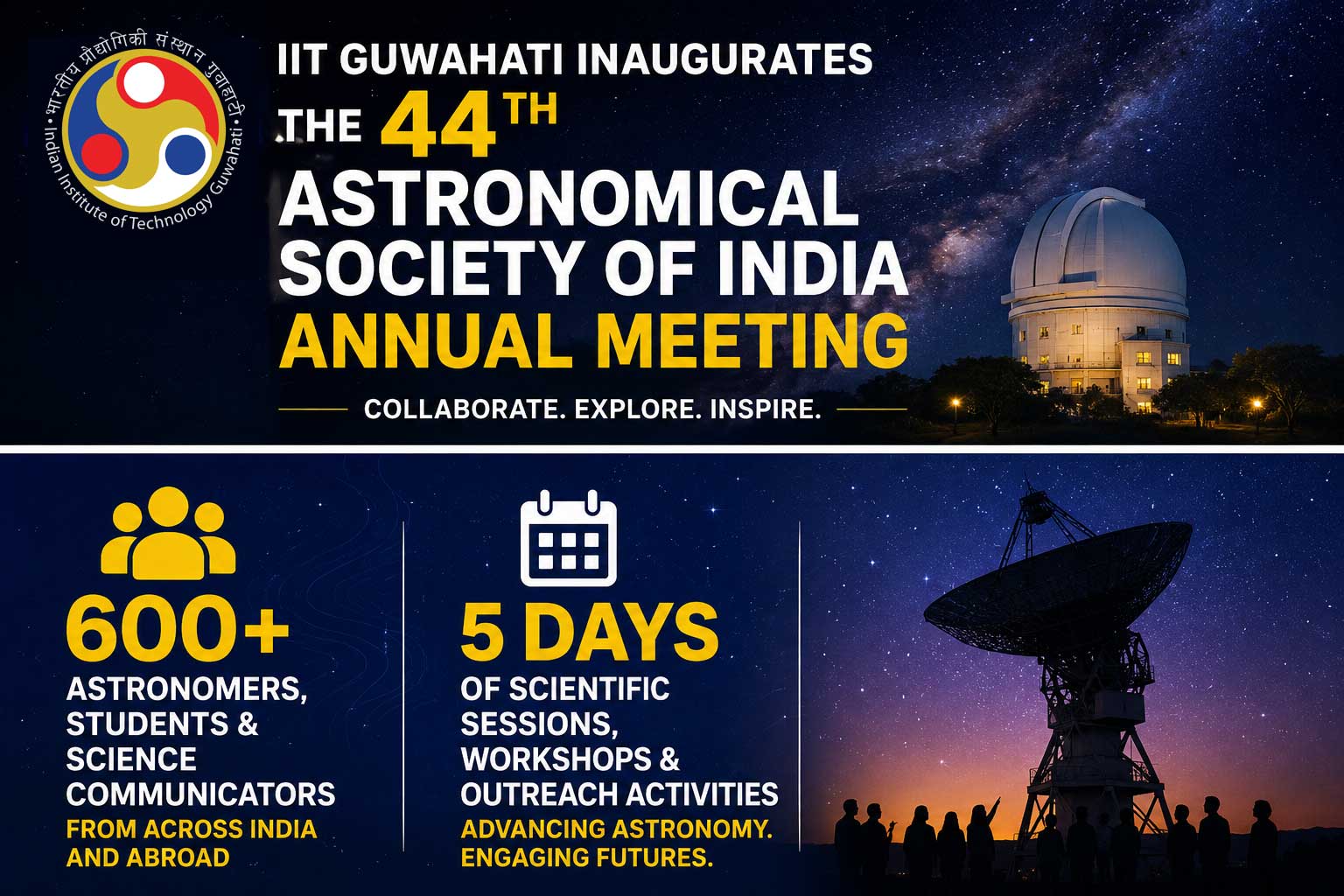
IIT Guwahati inaugurates the 44th Astronomical Society of India Annual Meeting, bringing over 600 astronomers, students, and science communicators together for five days of collaboration and outreach.
IIT Guwahati hosts 44th ASI meeting
The Indian Institute of Technology Guwahati (IIT‑Guwahati) formally inaugurated the 44th ASI Annual Meeting (Astronomical Society of India) on 16 May 2026, marking the start of a five‑day conference that has brought together over 600 astronomers, researchers, students, and science communicators from across India and abroad. The event provides a platform for presenting cutting‑edge research, fostering collaborations, and connecting the next generation of researchers with established leaders in the field.
The meeting also marks a rare return of the ASI Annual Meeting to the Northeast region, where the last such conference was hosted by Gauhati University in 1996. By choosing IIT Guwahati as the venue, the ASI strengthens the visibility of astronomy and astrophysics in this historically underserved region and encourages greater scientific engagement and infrastructure development across the Northeast. The conference also reinforces IIT‑Guwahati’s role as a regional hub for advanced scientific research and education in the natural sciences.
Inauguration highlights leadership and collaboration
The inaugural ceremony welcomed Prof. Devendra Ojha, President of the Astronomical Society of India, and Prof. Devendra Jalihal, Director of IIT‑Guwahati, as chief guests. Their presence underscored the importance of the event as a national‑level gathering of the astronomy community. The programme also recognised the institutional and logistical support provided by IIT‑Guwahati, the ASI national office, and the local‑organising and scientific‑organising committees that have worked for months to shape the technical and outreach components of the meeting.
Other dignitaries who attended the ceremony included Prof. Sukumar Nandi, Dean of Administration, and Prof. Santabrata Das, Chair of the Local Organizing Committee at IIT‑Guwahati, along with Prof. Sarita Vig, Secretary of the Astronomical Society of India; Prof. Anandamayee Tej, Chair of the Scientific Organizing Committee; Prof. Yashwant Gupta, Director of the National Centre for Radio Astrophysics (NCRA), Pune; Prof. Annapurni Subramaniam, Director of the Indian Institute of Astrophysics (IIA), Bengaluru; Prof. Dipankar Banerjee, Vice‑Chancellor of the Indian Institute of Space Science and Technology (IIST); and Prof. Manish K. Naja, Director of the Aryabhatta Research Institute of Observational Sciences (ARIES), Nainital. The presence of these leaders also reflects the interconnectedness of India’s astronomical ecosystem, spanning university departments, national observatories, and space‑research institutes.
Inspiring young minds in the Northeast
In his inaugural address, Prof. Devendra Jalihal, Director of IIT‑Guwahati, highlighted the Institute’s pride in hosting the 44th ASI Annual Meeting. “We are delighted to host the 44th Annual Meeting of the Astronomical Society of India at IIT Guwahati and bring together researchers, students, and members of the scientific community on our campus,” he said. Jalihal emphasised that such gatherings play a key role in inspiring young minds, especially in the Northeast, to connect with STEM disciplines and scientific innovation.
He further noted that the region has rich natural landscapes and clear‑ sky sites suitable for astronomical observation but has historically faced resource and infrastructure constraints. By hosting a major national astronomy conference, IIT‑Guwahati aims to stimulate local talent, strengthen academic‑industrial partnerships, and promote greater investment in research and observatory‑region infrastructure in the Northeast. Jalihal expressed confidence that the event would foster new ideas, collaborations, and deeper, long‑term engagement with science among students and researchers in the region.
ASI’s legacy and future vision in Indian astronomy
The Astronomical Society of India, established in 1972, serves as the professional association for astronomers in the country and currently counts over a thousand members from universities, research institutes, and observatories across India. The Society plays a central role in promoting astronomy research, maintaining national standards for academic practice, and advocating for observational infrastructure and funding.
The annual meeting is the ASI’s flagship platform for scientific exchange, capacity‑building, and public outreach. In his ASI Presidential Address, Prof. Devendra Ojha reflected on the Society’s five‑decade legacy and its evolution into a diverse, vibrant scientific community. “The Astronomical Society of India has a rich legacy spanning more than five decades since its establishment in 1972 and has evolved into a diverse and vibrant scientific community,” he said. Ojha highlighted how the ASI has supported India’s growing presence in optical, radio, and space‑based astronomy, including major national projects such as AstroSat, the upgraded Giant Metrewave Radio Telescope (uGMRT), and upcoming large‑aperture telescopes.
Ojha also expressed particular excitement about the ASI’s return to the Northeast after three decades. He described the conference as an opportunity to integrate regional talent into national networks, highlight emerging research centres in the Northeast, and attract new collaborations and funding initiatives. Looking ahead, he underscored how new facilities such as large telescopes and next‑generation observational infrastructure will shape the future of Indian astronomy, creating rich opportunities for research, discovery, and training.
Scientific programme and thematic diversity
The five‑day meeting will feature over 140 scientific talks and 355 poster presentations covering a broad spectrum of astronomical themes. Sessions include the Sun and Solar System, exoplanets and astrobiology, stars and galaxies, cosmology, astrochemistry, astronomy technologies, data science, astronomy education, heritage, and gender equity in science. The programme enables early‑career researchers and students to present their work alongside senior scientists, promoting inter‑generational learning, peer feedback, and the formation of long‑term collaborations.
The organisers hold parallel sessions to accommodate both theoretical and observational tracks, as well as instrumentation and software development themes, reflecting the increasingly interdisciplinary nature of modern astronomy. The conference also includes panel discussions on career pathways in astronomy, science communication, and the role of women and marginalised groups in building an inclusive scientific community.
Pre‑event lectures and specialised workshops
On 15 May, the opening‑day pre‑event activities included a public lecture titled “A Decade of AstroSat – India’s First Space Observatory”, delivered by Prof. Annapurni Subramaniam, Director of the Indian Institute of Astrophysics, Bengaluru, and recipient of the Vigyan Shri Award 2024. The talk traced the evolution of AstroSat from conception to operation, highlighting key scientific discoveries and the instrument’s role in positioning India among global players in X‑ray and ultraviolet astronomy.
The same day also hosted three thematic workshops on “Compact Objects in the AstroSat Era”, “Radio Astronomy from Space”, and “Rubin LSST: Exploring the Transient Sky”. These workshops provided hands‑on exposure to emerging observational techniques, data‑analysis tools, and large‑scale survey methodologies. Participants gained practical experience in handling big‑data resources, time‑domain‑astronomy pipelines, and simulations relevant to upcoming facilities such as the Vera C. Rubin Observatory and Indian‑led sky‑survey projects.
ASI awards and recognition of excellence
The inaugural event featured the presentation of ASI awards that recognise excellence in astronomy and astrophysics. The ASI Zubin Kembhavi Award went to the team behind the GROWTH‑India Telescope in Hanle, Ladakh, honouring their contributions to time‑domain astronomy and multi‑wavelength follow‑up of transient events. The Laxminarayana and Nagalaxmi Modali Award was conferred on Dr. Girish Kulkarni of the Tata Institute of Fundamental Research (TIFR) for outstanding research in high‑energy astrophysics. The Justice Oak Award for Outstanding Thesis in Astronomy was awarded to Dr. Prateek Mayank in recognition of an exceptional doctoral contribution to the field.
These awards not only celebrate individual and team achievements but also signal the ASI’s commitment to mentoring young researchers and maintaining high standards of scientific work. By highlighting promising early‑career scientists, the Society encourages diversity, resilience, and innovation within the Indian astronomy community.
Public outreach and education initiatives
Beyond the campus‑centric sessions, the Public Outreach and Education Committee (POEC) of ASI is running a wide range of astronomy‑themed activities across Guwahati and the wider Northeast. As part of this initiative, visiting astronomers and ASI members will engage with students at nearly 20 schools and colleges, delivering interactive sessions on stellar evolution, observational techniques, space‑missions, and the role of data science in modern astronomy.
Exhibitions of astrophotography are also on display at the Guwahati Planetarium and Guwahati Science City, showcasing stunning images of galaxies, nebulae, and solar‑system objects captured by professional and amateur astronomers. These visual narratives aim to make astronomy accessible and emotionally engaging for school‑going students, teachers, and the general public. The outreach activities are designed to convert curiosity into sustained interest, potentially guiding young learners toward STEM careers in astronomy, space science, and related technological fields.
Strengthening astronomy in the Northeast
The 44th ASI Annual Meeting at IIT‑Guwahati is expected to strengthen astronomy research and collaborative engagement in the Northeast while creating a durable bridge between regional talent and national institutions. The event lays the groundwork for long‑term collaborations, joint research projects, and student‑exchange programmes that can elevate the region’s scientific profile.
By fostering a culture of inquiry, open debate, and community‑driven learning, the conference encourages both students and citizens to explore the cosmos more deeply. Over time, such meetings can help build a self‑sustaining scientific ecosystem in the Northeast, where astronomy research, observatory‑based studies, and public‑education initiatives coexist and mutually reinforce one another, enriching India’s journey in space‑science and discovery.