
IIT Madras’ “100 Startups a Year” mission has incubated 567 deep‑tech ventures, a quarter of which have women co‑founders, revealing a strong push toward diversity and inclusive entrepreneurship across India.
A Growing Share of Women in Deep‑Tech
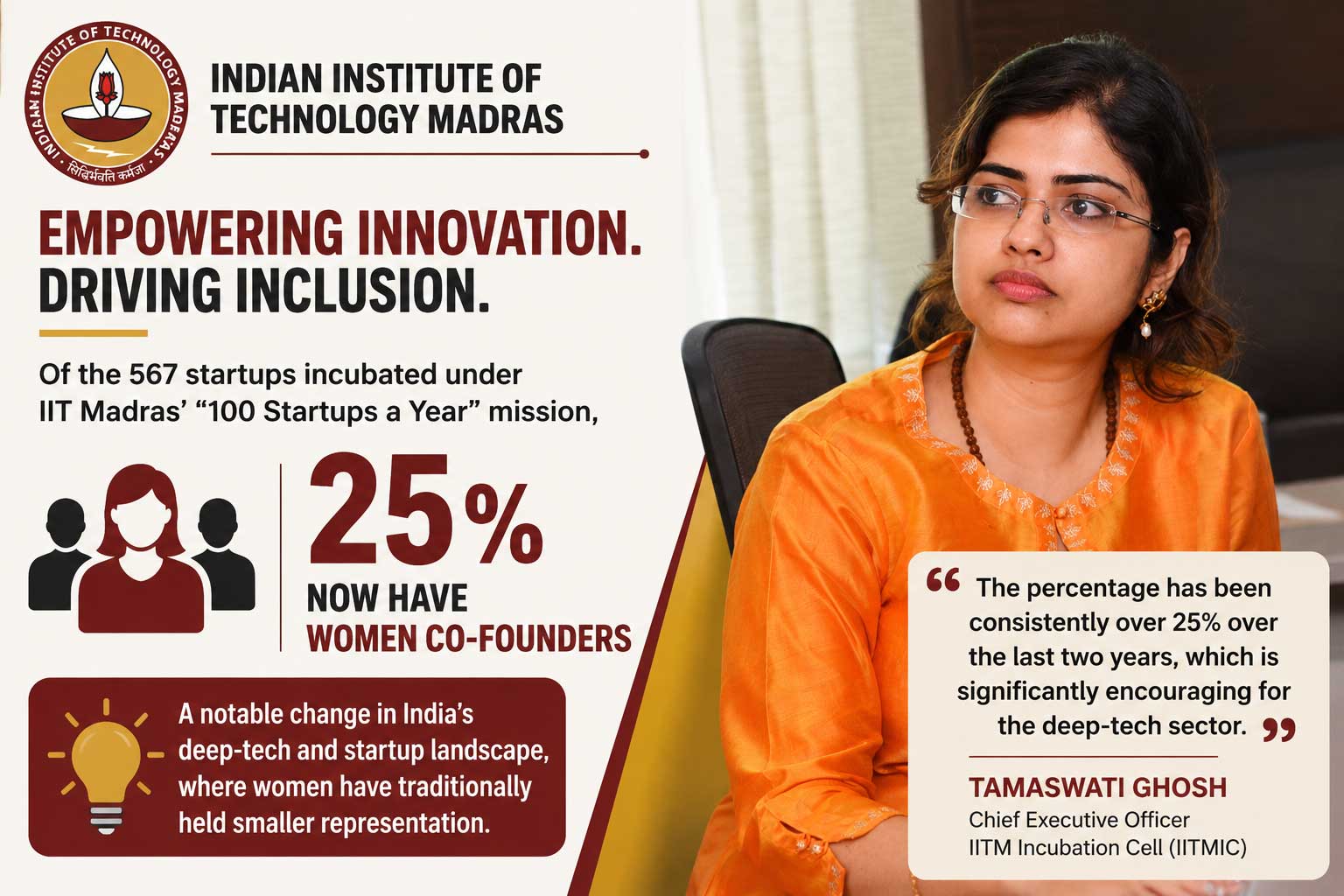
Of the 567 startups incubated under IIT Madras’ “100 Startups a Year” mission, 25% now have women co‑founders. This marks a notable change in India’s deep‑tech and startup landscape, where women have traditionally held smaller representation. “The percentage has been consistently over 25% over the last two years, which is significantly encouraging for the deep‑tech sector,” Tamaswati Ghosh, Chief Executive Officer of the IITM Incubation Cell (IITMIC), said.
The strong participation from women founders cuts across multiple domains, including healthtech, biotech, artificial intelligence, sustainability, and agritech. For both Startup Shatam cohorts in financial years 2024–25 and 2025–26, IITMIC has seen women‑led or women‑co‑founded startups form a robust share of the pipeline, Ghosh noted.
Funding Momentum and Grant Support
Startups incubated under the “100 Startups a Year” mission have begun raising external capital to scale their operations. Several ventures incubated in FY2024‑25, part of the first Startup Shatam milestone, have already secured angel investment and venture‑capital funding. In addition, IITMIC has supported them through internal grants and CSR‑backed programs run in collaboration with IIT Madras’ School of Innovation & Entrepreneurship.
Over the last two financial years, IITMIC released more than ₹20 crore in grant funding to about 100 early‑stage startups incubated in FY25 and FY26. These funds aim to accelerate product development and Go‑To‑Market (GTM) activities, with startups typically receiving between ₹15 lakh and ₹20 lakh in early‑stage grant support. The combination of external investment and structured grant programs highlights a growing ecosystem that bridges innovation with commercial viability.
Selective Growth and Survival Rates
When asked how many startups incubated last year failed to survive, Ghosh acknowledged that six startups from the FY24‑25 cohort have paused or wound down operations. She attributed these closures mainly to co‑founder incompatibility and unresolved internal issues, as well as an inability to achieve product‑market fit. She stressed that such exits are part of the natural selection process in a high‑risk, high‑growth environment.
Despite these setbacks, Ghosh remains confident about the sustainability of the 100‑startups‑a‑year model. “Incubating over 100 startups in a single financial year for two consecutive years is definitely ambitious,” she said. “But it has become sustainable because of the depth and maturity of the IIT Madras innovation and deep‑tech startup support ecosystem, and the national visibility IITMIC has built over the years through the success and impact of our portfolio companies.”
Pan‑India Representation and External Founders
Data from IITMIC shows that nearly 60% of the more than 567 founders are external entrepreneurs who did not graduate from IITs. This underlines the institute’s success in attracting talent from across India, well beyond its own campus. Today, the ecosystem includes startups from the North Eastern states, Jammu & Kashmir, Uttar Pradesh, the Delhi‑Maharashtra belt, Odisha, and various southern states.
By drawing founders from diverse regions and backgrounds, the program is helping standardise deep‑tech entrepreneurship practices across the country while also giving local innovators access to IIT Madras’ infrastructure, mentorship, and networks.
Maturing Startups and Market‑Ready Portfolios
A key highlight of the latest Startup Shatam milestone is the increasing maturity of startups entering the ecosystem. IITMIC now onboards a growing number of revenue‑generating ventures, startups that have already raised external funding (from seed to pre‑Series A stages), and companies founded by serial entrepreneurs working on their second or third ventures.
“This trend marks a shift from majorly early, product development‑stage incubation to a more balanced portfolio of early‑stage and market‑ready startups,” Ghosh said. “That strengthens the overall commercial depth of the ecosystem.”
In FY26 alone, IITMIC received over 1,200 applications for incubation from across India and selected 112 startups. The main challenge, Ghosh emphasised, is no longer in attracting applications but in identifying committed founders who are building genuinely differentiated deep‑tech solutions – often aligned with national or global technology priorities – and who are willing to work closely with IITMIC to build and scale their ventures for long‑term impact.
A Model for India’s Deep‑Tech Ecosystem
Through the 100‑startups‑a‑year push, IIT Madras has effectively turned its campus into a national hub for deep‑tech innovation. The rise in women co‑founders, the healthy mix of internal and external founders, and the growing pipeline of funded, market‑ready ventures all point to a more diverse, commercial‑oriented, and geographically inclusive startup ecosystem. As IITMIC continues to refine its selection, funding, and support mechanisms, its model is likely to influence how other academic institutions approach deep‑tech incubation across India.
Disclaimer
The information in this article is based on available public sources and official statements as of the time of publication. While we aim for accuracy, we do not guarantee completeness or correctness. We advise readers to verify key details from official sources before making any decisions. The website (iitiimsamvaad.com) is not liable for any loss or damage arising from the use of this content. The authors are also not responsible for any such loss or damage.