
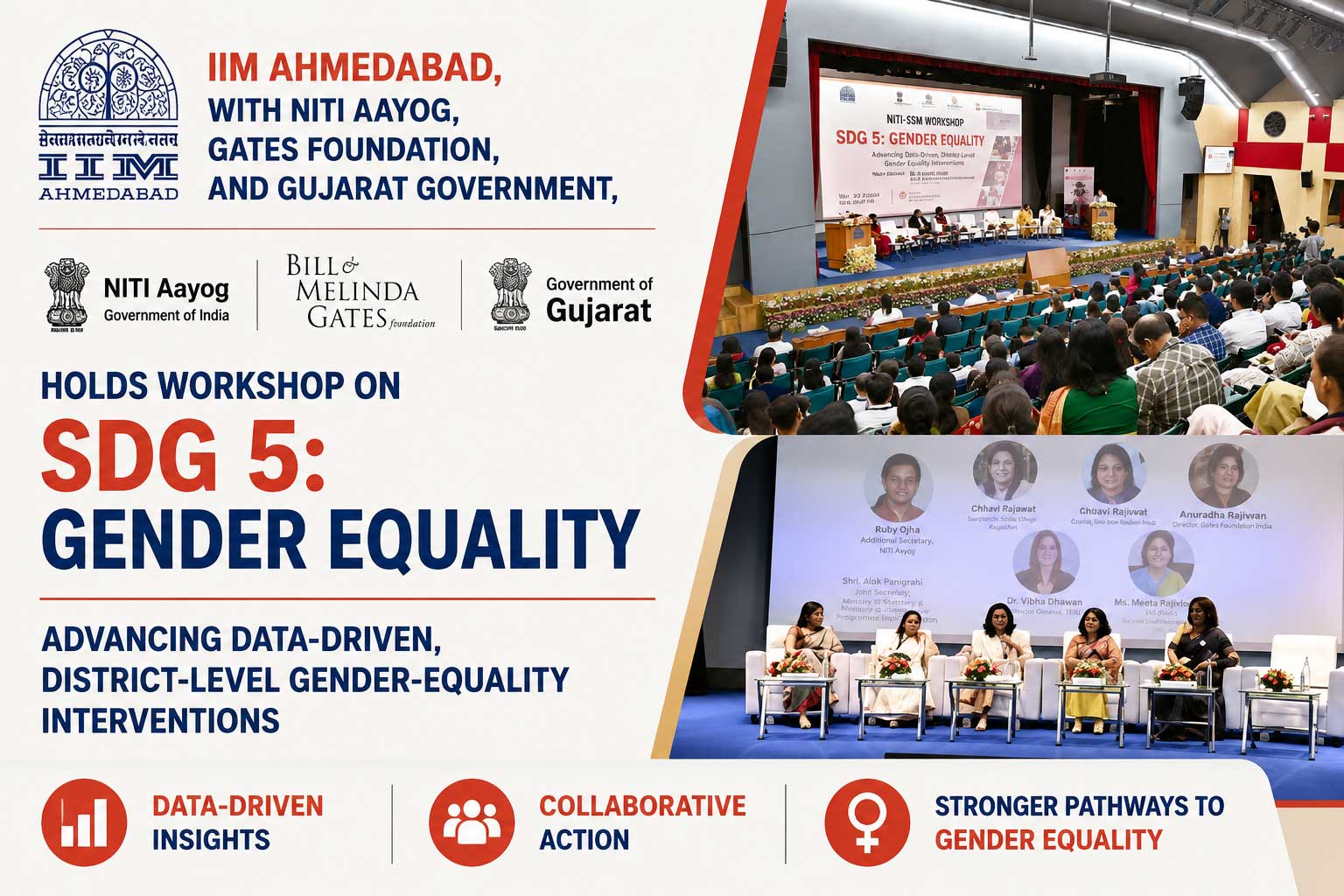
IIM Ahmedabad, with NITI Aayog, Gates Foundation, and Gujarat government, hosts a workshop on SDG 5 to advance data‑driven, district‑level gender‑equality interventions.
IIMA hosts SDG 5 workshop on gender equality
The Indian Institute of Management Ahmedabad (IIM‑A), in collaboration with NITI Aayog, the Bill & Melinda Gates Foundation, and the Government of Gujarat, hosted a national workshop on Sustainable Development Goal (SDG) 5: Gender Equality at the IIM‑A campus. The event focused on accelerating women‑led development through evidence‑based policymaking and district‑level interventions, bringing together senior policymakers, bureaucrats, researchers, and development‑practitioner stakeholders.
The workshop also marked the launch of SDG‑5 State, Union Territory, and District Reports, which compile data‑driven insights on 26 gender‑equality indicators across India’s 792 districts. These reports provide a granular picture of disparities in areas such as health, education, economic participation, political representation, and safety, enabling policymakers to monitor progress and design targeted interventions.
Launch of SDG 5 district‑level reports
The SDG‑5 reports synthesise data from national surveys, administrative records, and program‑monitoring systems to track gender‑related outcomes at the state, union‑territory, and district levels. By mapping key indicators such as female labour‑force participation, wage gaps, educational attainment, institutional delivery rates, and representation in local governance, the reports help identify regions that lag behind and require focused policy attention.
Organisers highlighted that the reports would support governments in strengthening monitoring systems, prioritising interventions, and improving resource allocation for women‑centric schemes. District‑level data, they said, also enables line departments to tweak program design, strengthen last‑mile delivery, and address localised barriers to women’s empowerment.
Virtual address by Union Minister
The inaugural session featured a virtual address by Annpurna Devi, Union Minister for Women and Child Development. She underscored the transformative potential of technology‑enabled governance and real‑time monitoring in improving outcomes for women and children. The Minister also emphasised that governments must move beyond aggregate‑level statistics and leverage granular, real‑time data and artificial intelligence to personalise and optimise service delivery.
Devi linked the workshop’s work to the Government of India’s broader Viksit Bharat 2047 vision, which places women‑led development at the core of the country’s growth and equity agenda. She urged administrators and researchers to integrate data‑driven feedback loops into existing women‑development programmes, ensuring that policies adapt to evolving social and economic realities.
Gujarat government’s district‑level perspective
Manisha Vakil, Gujarat Minister for Women and Child Development, described the SDG‑5 district‑level reports as a critical step toward data‑driven governance and transparent implementation of women‑empowerment initiatives. She highlighted that Gujarat has increasingly relied on district‑level dashboards and performance‑monitoring frameworks to track the rollout of schemes such as skill‑development programmes, financial‑literacy camps, and childcare‑support measures.
Vakil added that the reports would help Gujarat fine‑tune its interventions by identifying specific geographies and demographics where access, participation, or quality of services falls short. She also welcomed the partnership with IIM‑A, NITI Aayog, and the Gates Foundation as a model of how state‑level, academic, and international actors can co‑produce actionable knowledge for inclusive development.
IIMA’s commitment to inclusive growth
IIM‑A Director Bharat Bhasker opened the workshop by contextualising the event within the institute’s long‑standing commitment to inclusive growth and women empowerment. He noted that IIM‑A has supported women entrepreneurs and women leaders through executive‑education programmes, mentorship initiatives, and entrepreneurship‑support platforms.
Bhasker stressed that the SDG‑5 initiative reflects IIM‑A’s effort to embed research and teaching in real‑world policy challenges. By collaborating with NITI Aayog and the Government of Gujarat, the institute also aims to translate data analysis into practical guidance for district‑level administrators and program managers, helping them design and refine gender‑sensitive interventions.
Panel discussions on data and empowerment
The workshop featured three panel discussions on data‑driven SDG monitoring, women’s economic empowerment, and social‑empowerment strategies. Experts from government bodies, international organisations, NGOs, and policy‑research institutions examined how data can inform better program design, improve targeting, and strengthen accountability at the district level.
Panellists debated the role of gram‑sabha‑level registers, mobile‑based feedback systems, and AI‑supported dashboards in making governance more responsive. Several speakers also called for greater investment in longitudinal data collection and cross‑sectoral analysis to understand how education, health, and economic‑opportunity initiatives interact in shaping women’s life outcomes.
Towards district‑focused gender‑equality strategies
Organisers concluded that the workshop reinforced the need for district‑focused strategies and stronger collaboration among governments, academic institutions, and development agencies to accelerate progress toward SDG‑5. They also argued that only by embedding granular data, real‑time feedback, and gender‑sensitive indicators into routine decision‑making can India narrow regional disparities and ensure that women‑led development becomes a measurable reality, not just a policy aspiration.
Disclaimer
The information in this article is based on available public sources and official statements as of the time of publication. While we aim for accuracy, we do not guarantee completeness or correctness. We advise readers to verify key details from official sources before making any decisions. The website (iitiimsamvaad.com) is not liable for any loss or damage arising from the use of this content. The authors are also not responsible for any such loss or damage.