


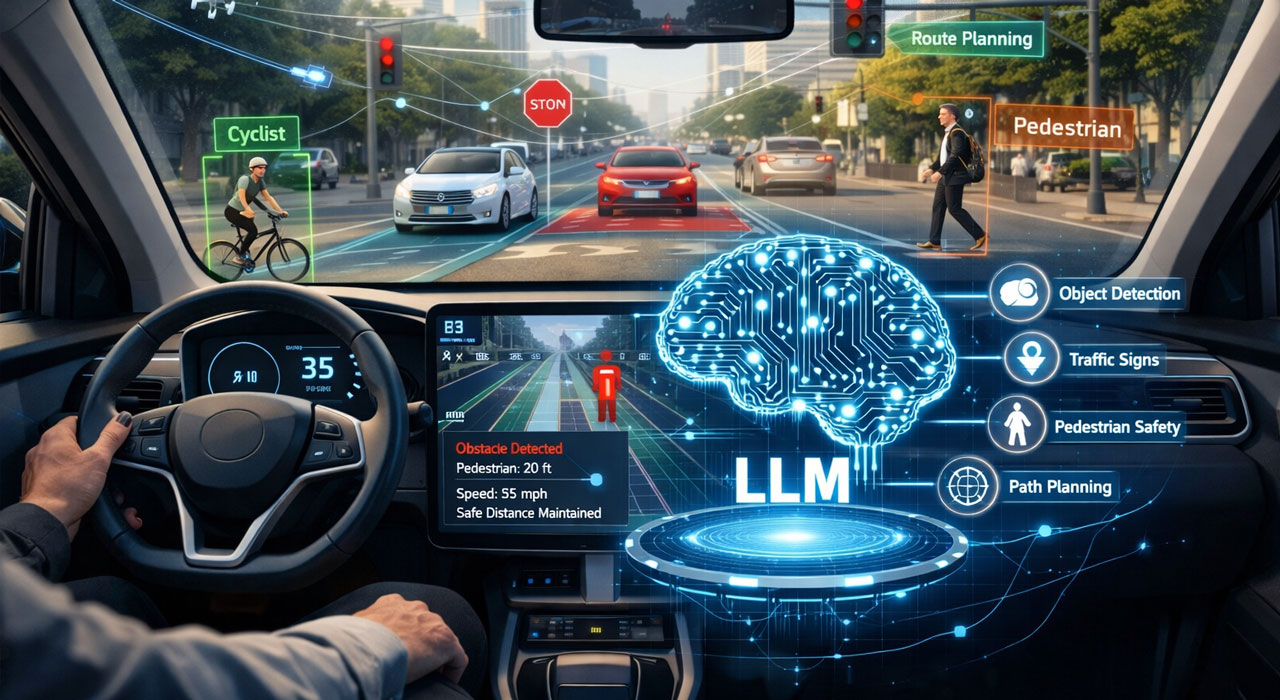
Researchers at the Indian Institute of Information Technology Allahabad (IIIT‑A) are developing a breakthrough semantic communication system that could reshape how autonomous vehicles perceive and respond to their environment. Traditional self‑driving systems depend on continuous, high‑volume streams of raw sensor data, which can slow decision‑making and strain onboard processing. The IIIT‑A system addresses this by using artificial intelligence to extract only the most meaningful, context‑rich information, then transmitting it in a compact, semantics‑based format that autonomous vehicles can interpret instantly and act upon.
Unlike conventional bit‑level communication, where every transmitted symbol is treated as equally important, semantic communication focuses on understanding the “meaning” behind the data. In practice, this means that when an autonomous vehicle encounters a pothole, debris, or an unexpected pedestrian, the system can immediately convey the critical meaning of the event – its type, location, and urgency – rather than flooding the network with terabytes of raw video, radar, or LiDAR traces. According to the IIIT‑A team led by Sunil Kumar Yadav and Radhika from the Electronics and Communication Engineering department, this approach can sharply reduce reaction times and enhance the reliability of accident‑avoidance mechanisms in real‑world traffic.
The project is being carried out in collaboration with IIIT Gwalior and IIIT Jabalpur, emphasizing a multi‑institutional push toward India‑led innovation in intelligent mobility. It is supported by a ₹1.46 crore grant from the Department of Telecommunications, underscoring the central government’s backing for advanced AI‑enabled research in communication and autonomous systems.
Beyond autonomous driving, IIIT‑A’s semantic communication framework opens doors for several high‑impact applications. In urban environments, it could improve real‑time traffic signal optimization, allowing adaptive lights to respond to congestion, accidents, or emergency vehicles with far greater speed and efficiency. The same principles can be applied to remote healthcare monitoring, where wearable devices send only the clinically relevant changes in a patient’s condition instead of streaming raw vital‑sign data, reducing bandwidth and power consumption while preserving critical medical insights. The technology is also viewed as a key enabler for future 6G wireless networks, where compact, semantics‑aware data transmission can ease the burden on spectrum and infrastructure while supporting ultra‑low‑latency services.
Experts in the field believe that semantic communication may be a game‑changer for India’s position in intelligent mobility. By shifting from raw data processing to “message meaning” interpretation, the approach aligns closely with the country’s push toward AI‑driven digital infrastructure and self‑reliant technology ecosystems. For IIIT‑A, this project strengthens its reputation in next‑generation communications and edge‑AI, and it positions India to compete in the global race for smarter, safer vehicle‑to‑everything (V2X) communication standards.
The ongoing work at IIIT‑Allahabad demonstrates how academic research can help close the gap between theoretical AI concepts and real‑world deployment in safety‑critical domains. By enabling machines to interpret “what matters” rather than just processing bits, semantic communication could become a foundational layer for safer, more responsive autonomous vehicles, smart cities, and next‑generation wireless networks, with India at the forefront of this emerging paradigm.