

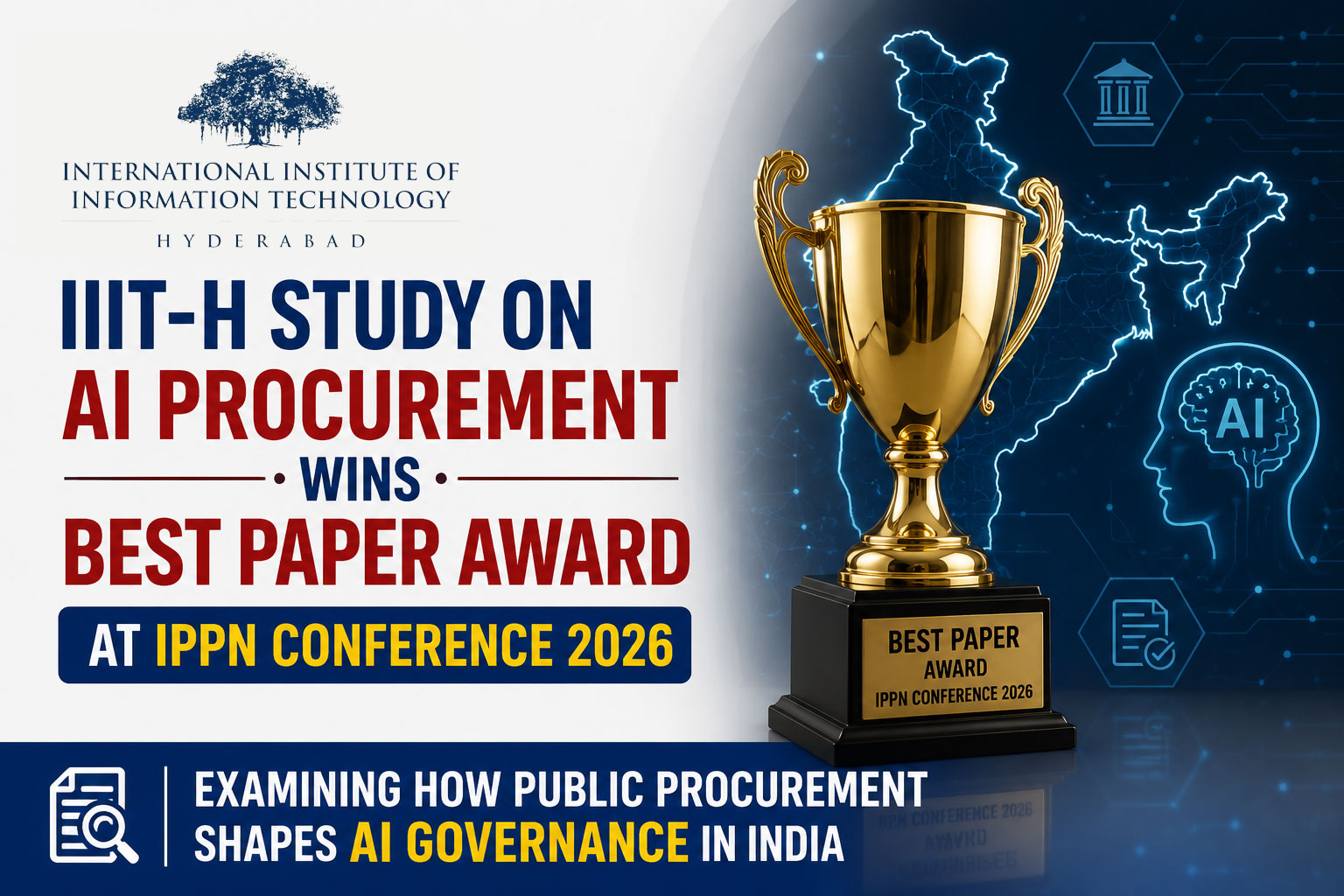
IIIT-Human Sciences Research Centre study wins Best Paper Award at IPPN 2026 analyzing how government procurement processes shape AI governance, revealing procurement as emerging mechanism for delegating and implementing AI governance in India.
IIIT-H Researchers Win Best Paper Award at Leading Public Policy Conference
An exploratory study by the Human Sciences Research Centre (HSRC) at IIIT Hyderabad has won the Best Paper Award (Practice Track) at the 6th India Public Policy Network (IPPN) Conference 2026 for examining how public procurement processes are shaping the governance and development of Artificial Intelligence (AI) systems in India. The award validates the research team’s innovative approach to understanding AI governance through operational mechanisms rather than traditional legislative frameworks.
The award-winning paper, titled “Emerging Institutional Pathways for AI Governance in India: Evidence from Public Procurement and Outsourcing,” was authored by Prof. Aakansha Natani, Assistant Professor at HSRC, Siddhi Wadekar, a PhD scholar, and Sujal Deoda, a dual-degree student pursuing BTech in Computer Science and MS in Computing and Human Sciences. This interdisciplinary authorship reflects the collaborative nature of modern policy research.
The National Law School of India University (NLSIU) hosted the conference from June 8 to 11, and it ranked among India’s leading public policy forums. It organized the event in collaboration with the University of Cambridge, the National Council of Applied Economic Research (NCAER), the International Public Policy Association (IPPA), and other institutions. Winning at this prestigious forum demonstrates the research’s significant contribution to public policy discourse.
Study Emerges from Ongoing Research Project Examining Policy Gaps in AI Infrastructure
The study emerged from an ongoing HSRC research project examining policy gaps in India’s AI and data infrastructure. Researchers identified a critical regulatory vacuum that requires alternative governance approaches. “Unlike the EU, India currently does not have a dedicated AI Act. Instead, AI governance is guided through advisory documents, frameworks, and guidelines, and this regulatory landscape is still evolving,” said Siddhi Wadekar.
This regulatory gap led researchers to investigate where AI governance practices are actually emerging from in the absence of comprehensive legislation. The team recognized that governance must be happening through practical mechanisms even without formal legislation. Understanding these emerging pathways provides crucial insights for policymakers developing future AI regulations.
Researchers Analyze Government Tenders Related to AI Systems
To answer this question, the team analysed publicly available government tenders related to AI systems. As governments increasingly adopt AI-driven technologies across citizen services, administration, and law enforcement, many departments rely on private companies and startups to build and manage these systems due to limited in-house technical expertise. The procurement process became the focus because it represents where government AI commitments translate into actual implementation.
“The government needs AI-driven technologies but may not have the necessary capacities and expertise to build and maintain them. So it often resorts to outsourcing these services through tenders,” said Sujal Deoda. The researchers examined procurement notices, tender documents, technical specifications, eligibility criteria, contractual obligations, and compliance requirements issued by central and state government agencies. This comprehensive analysis covered the full spectrum of procurement documentation.
Study Combines Computational Analysis with Qualitative Policy Analysis
The study combined computational analysis with qualitative policy analysis to understand both the language used in procurement documents and the governance implications embedded within them. Rather than focusing solely on what governments were procuring, the researchers examined how tender documents define expectations for AI systems and whether procurement itself is becoming a mechanism that delegates, negotiates, and implements AI governance.
The findings highlighted procurement and outsourcing as increasingly important elements of India’s AI governance ecosystem, suggesting that governance frameworks are emerging not only through regulations but also through operational mechanisms such as procurement processes. This discovery fundamentally changes how we understand AI governance implementation in practice.
Understanding AI Governance Requires Expertise Across Multiple Disciplines
Prof. Aakansha Natani said understanding AI governance requires expertise across multiple disciplines. “For this kind of research, you need computer science expertise to understand the technical specifications required for AI systems, as well as political science expertise to examine what’s being written and what is not being written in policy and procurement documents,” she said. The project brought together expertise from computer science, computational social sciences, public policy, and political science, reflecting IIIT Hyderabad’s interdisciplinary research environment.
This interdisciplinary approach enabled the team to decode technical language in tender documents while simultaneously analyzing their policy implications. Computer science expertise helped the researchers understand what specific AI capabilities governments requested, while political science expertise revealed what governance mechanisms were embedded in procurement language.
Study Points to Broader Trend Where Governance Shaped Through Everyday Processes
According to the researchers, the study points to a broader trend where governance is increasingly shaped not only through legislation but also through everyday processes by which technologies are commissioned, procured, and deployed. This insight has profound implications for how policymakers should approach AI regulation. Rather than waiting for comprehensive legislation, governments can implement governance through procurement requirements immediately.
The research demonstrates that procurement documents serve as de facto governance mechanisms, establishing standards, accountability requirements, and performance expectations for AI systems. Government agencies can embed ethical AI principles, data protection requirements, and transparency obligations directly into tender specifications. This approach provides immediate governance while formal legislation develops.
IIIT-H’s award-winning study reveals that public procurement processes shape AI governance in India by delegating, negotiating, and implementing governance through operational mechanisms, demonstrating that procurement and outsourcing serve as increasingly important elements of India’s AI governance ecosystem alongside evolving regulatory frameworks.
#IIITHyderabad #AIGovernance #PublicProcurement #IPPN2026 #BestPaperAward #AIPolicy #HumanSciencesResearchCentre #GovernmentTenders #InterdisciplinaryResearch #AIRegulation
Disclaimer
The information in this article is based on available public sources and official statements as of the time of publication. While we aim for accuracy, we do not guarantee completeness or correctness. We advise readers to verify key details from official sources before making any decisions. The website (iitiimsamvaad.com) is not liable for any loss or damage arising from the use of this content. The authors are also not responsible for any such loss or damage.