

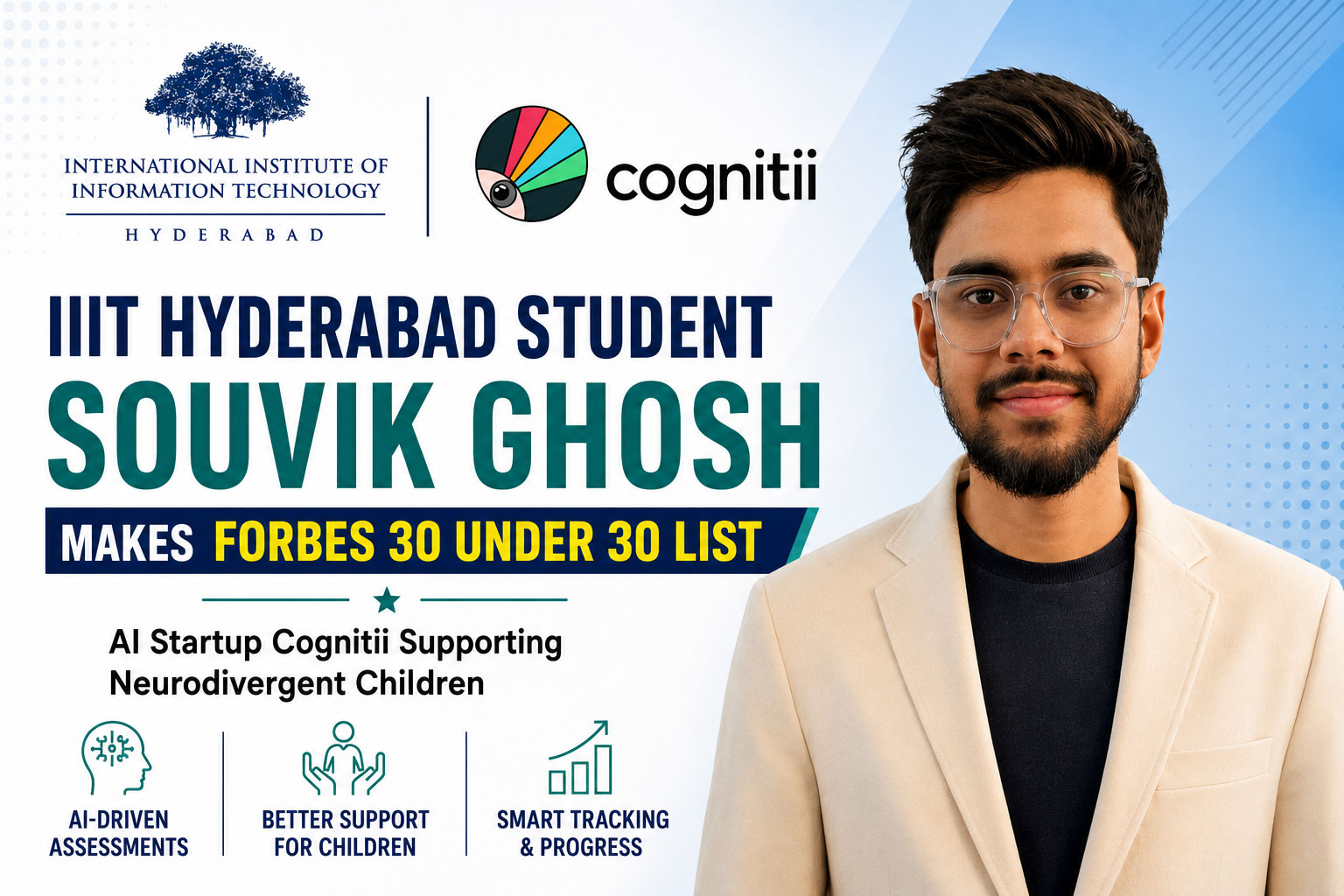
IIIT-H student Souvik Ghosh joins Forbes 30 Under 30 for Cognitii, an AI-driven edtech platform improving screening, support and tracking for neurodivergent children.
IIIT-H Student Honoured by Forbes for Social Impact
Souvik Ghosh, a final‑year MS by Research student at IIIT Hyderabad, earned a spot on the Forbes 30 Under 30 Asia 2026 list in the Social Impact category for co‑founding Cognitii, an AI‑enabled edtech startup focused on India’s special education gaps. The recognition highlights Cognitii’s blend of machine intelligence and human‑centred support designed to help schools, clinicians and governments identify and support children with developmental and learning challenges. Ghosh’s achievement marks a milestone for student‑driven social entrepreneurship emerging from India’s research universities.
Early Activism and a Non‑linear Path to AI
Ghosh’s route to AI began with social work in Kolkata, where he volunteered on projects addressing child trafficking and women’s safety before moving into tech solutions for social problems. He and his early teams built AI systems for harassment detection on CCTV and Helpby, a mobile app linking people in distress with nearby verified helpers. Those initiatives exposed him to technology’s power to protect and include vulnerable people and seeded his interest in building AI for social good.
Transition to Research at IIIT Hyderabad
Inspired by research outputs from IIIT‑H’s CVIT lab, including breakthroughs in multimodal AI, Ghosh joined the institute initially as a research assistant and later enrolled in the MS by Research programme. He said the experience humbled him: “I came here and realized how little I knew about AI; it burst my bubble in the nicest possible way.” At IIIT‑H he specialised in multimodal AI – combining text, audio, images and video – and worked on projects such as generating speech from silent lip movements and aligning subtitles where audio is unavailable. Over three years he contributed to multiple research papers submitted to international conferences.
Cognitii’s Mission: Make Neurodivergent Children Visible
Founded in 2024 by Ghosh with co‑founders Jhillika Trisal and Falguni Shrivastava, Cognitii targets the fragmentation in India’s special education ecosystem. Many schools lack standardised screening, documentation and continuous intervention tracking for children with conditions such as autism, ADHD, dyslexia and intellectual disabilities. Cognitii’s platform combines AI‑assisted assessments with human oversight to create personalised support plans, track developmental progress, and recommend educator interventions – while keeping clinical judgment and caregivers central to decisions. The founders describe the platform as a digital data infrastructure layer that gives each child a continuous identity in educational and health records.
Product, Partnerships and Early Traction
Cognitii currently serves more than 20 schools and child development centres and is in talks with state governments for larger collaborations. The platform provides screening tools, individualized learning pathways, and dashboards that help educators monitor interventions and outcomes over time. By generating structured, longitudinal data about developmental progress, Cognitii aims to make neurodivergent children “visible” in policy discussions and funding decisions – a step its founders liken to how national identity systems enabled more inclusive public services.
Balancing Research, Startups and Personal Motivation
Ghosh acknowledges the strain of juggling coursework, publications, product development and stakeholder engagement. “Honestly, I don’t know how I managed it,” he admitted, reflecting the intense effort behind the startup’s early growth. His personal history – speech‑related difficulties in childhood that produced feelings of exclusion – gives the work deep emotional resonance. That lived experience informs Cognitii’s design choices prioritising dignity, agency and human oversight rather than purely automated decision‑making.
Academic Impact and Future Research Plans
While scaling Cognitii, Ghosh continues to advance his MS thesis in multimodal AI, aiming to translate research into practical tools that work in noisy, resource‑constrained school environments. His academic contributions – including work on lip‑reading and multimodal alignment – reinforce the startup’s technical foundation and demonstrate how academic research can feed deployable social technologies.
Forbes Recognition and What It Means
Being named to Forbes 30 Under 30 gives Cognitii and IIIT‑H visibility among investors, policymakers and potential partners across Asia, and it validates the startup’s social mission. The accolade increases the likelihood of resource flows, research collaborations and pilot opportunities with education and health departments. For Ghosh and his co‑founders, the recognition strengthens the case that technology, when combined with human judgement and compassionate design, can reduce long‑standing inequities in education.
Next Steps and Wider Significance
With his thesis nearing completion, Ghosh plans to continue scaling Cognitii while pursuing research that yields real‑world impact. The startup’s early traction underscores a broader trend: Indian research students are increasingly translating lab‑scale AI into socially meaningful products. Cognitii’s approach – pairing AI with human expertise to serve neurodivergent children – offers a replicable model for inclusive technology interventions in other low‑visibility, high‑need domains.
#SouvikGhosh #Cognitii #Forbes30Under30 #IIITHyderabad #Edtech #Neurodiversity #MultimodalAI #SocialImpact #SpecialEducation #AIforGood
Disclaimer
The information in this article is based on available public sources and official statements as of the time of publication. While we aim for accuracy, we do not guarantee completeness or correctness. We advise readers to verify key details from official sources before making any decisions. The website (iitiimsamvaad.com) is not liable for any loss or damage arising from the use of this content. The authors are also not responsible for any such loss or damage.