

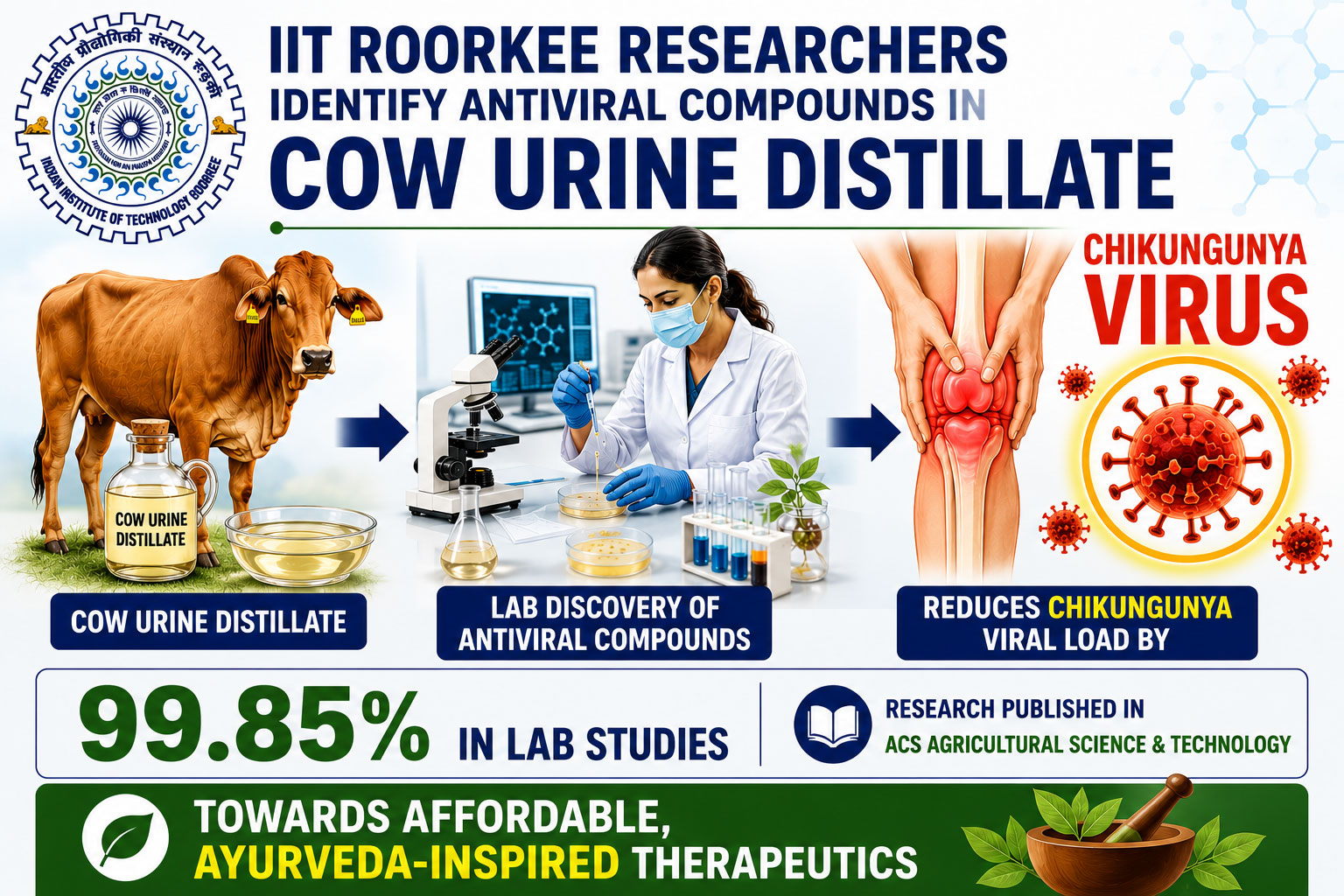
IIT Roorkee researchers identified antiviral compounds in cow urine distillate reducing Chikungunya viral load by 99.85 percent, publishing findings in ACS Agricultural Science & Technology for affordable Ayurveda-inspired therapeutics.
IIT Roorkee Researchers Report Promising Antiviral Findings Against Chikungunya
Researchers at the Indian Institute of Technology Roorkee (IIT Roorkee) have reported promising findings in the fight against Chikungunya Virus, a mosquito-borne viral disease that continues to pose a significant public health challenge in tropical and subtropical regions. The study identifies key bioactive compounds present in cow urine distillate (CUD) that demonstrate substantial antiviral activity against the Chikungunya virus (CHIKV), opening new avenues for the development of Ayurveda-inspired and affordable antiviral therapeutics.
The research, recently published in the prestigious journal ACS Agricultural Science & Technology, was led by Prof Shailly Tomar and her team from the Department of Biosciences and Bioengineering, IIT Roorkee, in collaboration with researchers from leading Ayurveda and biomedical institutions across India. The publication validates the scientific rigor of the study and establishes its credibility within the global research community.
Study Combines Advanced Virology with Metabolomics and Molecular Docking
The study combined advanced virology, metabolomics, molecular docking, and biochemical analyses to identify compounds responsible for antiviral activity. Researchers used cutting-edge laboratory techniques to isolate, characterize, and test bioactive molecules from cow urine distillate. Molecular docking simulations predicted how these compounds interact with viral proteins, while biochemical assays confirmed their antiviral effects in laboratory conditions.
Researchers found that treatment with cow urine distillate reduced Chikungunya viral levels by more than 90 percent at safe concentrations. An optimised combination of cow urine distillate, thymoquinone (derived from Nigella sativa), and piperine (from black pepper) achieved an impressive 99.85 percent reduction in viral load under laboratory conditions. This synergistic formulation demonstrates the power of combining natural compounds for enhanced therapeutic effects.
Benzoic Acid, Hippuric Acid and Oleic Acid Identified as Key Antiviral Constituents
Further investigations identified benzoic acid, hippuric acid, and oleic acid as key constituents contributing to the antiviral activity. These compounds were shown to interfere with critical viral proteins involved in replication, highlighting their potential as candidates for future antiviral drug development. The researchers mapped how each compound binds to viral proteins and disrupts essential functions required for viral survival.
Benzoic acid demonstrated strong inhibitory effects on viral protein synthesis, while hippuric acid interfered with viral envelope formation. Oleic acid disrupted viral membrane integrity, preventing the virus from entering host cells. This multi-target approach makes the formulation more effective than single-compound treatments, as the virus cannot easily develop resistance against multiple simultaneous attacks.
IIT Roorkee Director Emphasizes Interdisciplinary Science Bridging Traditional and Modern Knowledge
On the significance of the research, Prof. Kamal Kishore Pant, Director of IIT Roorkee, said: “Emerging and re-emerging viral diseases demand innovative, affordable, and scientifically validated solutions. This research exemplifies IIT Roorkee’s commitment to advancing interdisciplinary science that bridges traditional knowledge systems with modern biotechnology to address pressing global health challenges.”
The Director highlighted that India possesses centuries-old traditional knowledge systems that offer valuable insights into disease treatment. Modern scientific validation of these traditional remedies enables their integration into contemporary healthcare systems, providing affordable alternatives to expensive pharmaceutical drugs. This approach particularly benefits populations in developing countries with limited access to costly medications.
Corresponding Author Highlights Power of Synergistic Natural Formulations
Highlighting the scientific importance of the findings, Prof. Shailly Tomar, Department of Biosciences and Bioengineering at IIT Roorkee and corresponding author of the study, said: “Our research not only identifies specific bioactive molecules in Ayurvedic Gau mutra ark responsible for antiviral activity but also demonstrates the power of synergistic natural formulations. These findings provide a strong foundation for developing next-generation antiviral strategies against Chikungunya and potentially other related viral infections. Further pre-clinical and translational studies will be essential to evaluate their therapeutic applicability.”
Prof. Tomar emphasized that the research moves beyond anecdotal claims to provide molecular-level evidence for antiviral activity. The identification of specific bioactive molecules enables targeted drug development, formulation optimization, and quality control standards for pharmaceutical production. This scientific rigor transforms traditional Ayurvedic preparations into evidence-based therapeutics.
Chikungunya Virus Causes Severe Fever and Debilitating Joint Pain
Chikungunya virus is transmitted primarily through Aedes mosquitoes and can cause severe fever, debilitating joint pain, and long-term health complications. Despite its growing global burden, there are currently limited antiviral treatment options available. Most patients receive only symptomatic treatment including pain relievers and fever reducers, without addressing the underlying viral infection.
The findings from IIT Roorkee contribute valuable scientific insights toward addressing this unmet medical need. An effective antiviral treatment would reduce disease severity, prevent long-term complications, and decrease healthcare costs associated with chronic pain management. The affordable nature of cow urine distillate-based therapeutics makes them particularly suitable for widespread deployment in resource-limited settings.
Ministry of AYUSH Supported Research Validating Traditional Ayurvedic Remedies
The research was supported by the Ministry of AYUSH and involved extensive laboratory validation, computational screening, and antiviral testing. The Ministry’s support demonstrates the government’s commitment to scientifically validating traditional Ayurvedic practices and integrating them into modern healthcare systems. This backing enables large-scale research projects that individual institutions might not afford independently.
The study further underscores the importance of exploring natural bioactive compounds and integrative scientific approaches for developing future healthcare solutions. Natural compounds offer advantages including lower toxicity, reduced side effects, and broader acceptance among populations familiar with traditional medicine. Integrative approaches combine the strengths of traditional knowledge and modern science to create more effective treatments.
IIT Roorkee’s discovery of antiviral compounds in cow urine distillate represents a significant breakthrough in Chikungunya treatment research, demonstrating how Ayurvedic traditional knowledge combined with modern biotechnology can produce affordable, scientifically validated therapeutics for addressing global public health challenges.
#IITRoorkee #Chikungunya #AntiviralCompounds #CowUrineDistillate #Ayurveda #GauMutraArk #ViralDisease #TherapeuticDevelopment #InterdisciplinaryScience #NaturalCompounds
Disclaimer
The information in this article is based on available public sources and official statements as of the time of publication. While we aim for accuracy, we do not guarantee completeness or correctness. We advise readers to verify key details from official sources before making any decisions. The website (iitiimsamvaad.com) is not liable for any loss or damage arising from the use of this content. The authors are also not responsible for any such loss or damage.