
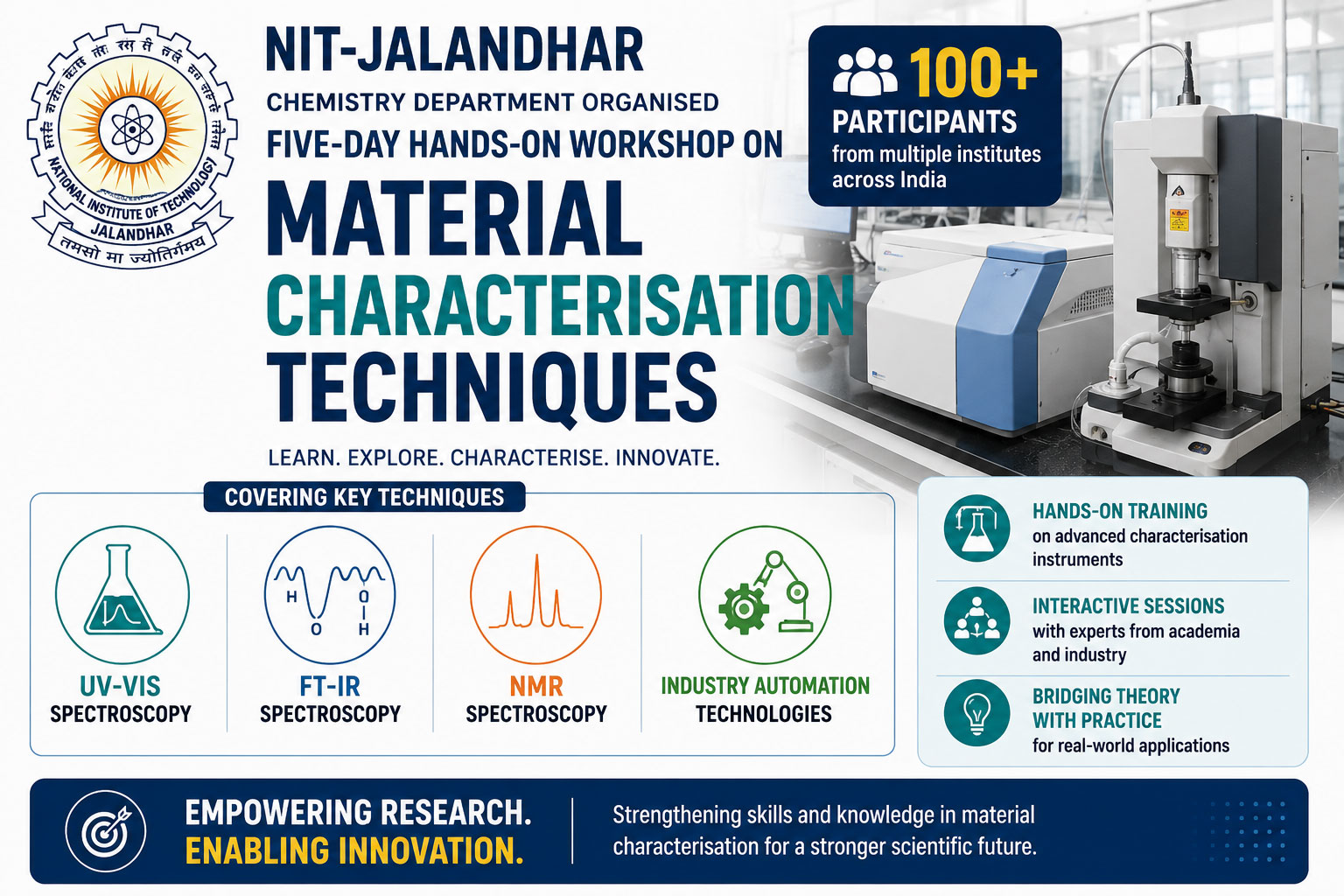
NIT-Jalandhar’s Chemistry Department organised five-day hands-on workshop on Material Characterisation Techniques with 100+ participants from multiple institutes, covering UV-Vis, FT-IR, NMR and industry automation technologies.
NIT-Jalandhar Chemistry Department Organises Material Characterisation Workshop
The Department of Chemistry at Dr B R Ambedkar National Institute of Technology (NIT), Jalandhar, successfully organised a five-day hands-on workshop on “Material Characterisation Techniques” from June 2 to 6. The workshop brought together faculty members, PhD research scholars, postgraduate students, and undergraduate students from various institutes and universities across northern India for intensive training in advanced material analysis methods.
The event witnessed enthusiastic participation from attendees representing GNDU Amritsar, DS College Aligarh Uttar Pradesh, Lovely Professional University, IK Gujral Punjab Technical University main campus Kapurthala, Burdwan Institute of Management and Computer Science, Babasaheb Bhimrao Ambedbar University Lucknow, and Chandigarh University. Over 100 participants engaged in lectures, hands-on sessions, and interactive discussions throughout the five-day programme.
Institute Leadership Commends Initiative for Promoting Advanced Research
The workshop was coordinated under Chairman BoG Prof J S Yadav, Director Prof B K Kanaujia, Registrar Prof Anish Sachdeva, Dean of Academics Prof Raman Bedi, Dean of Research and Consultancy Prof Rohit Mehra, Dean of Industry and International Affairs Prof Ajay Bansal, and Head of Department Dr Uma Shanker, who commended the initiative for promoting advanced research capabilities. All faculty members of the department were present throughout the workshop, ensuring comprehensive support for participants.
Institute leadership emphasized that the workshop aligns with NIT-Jalandhar’s mission to strengthen research infrastructure and build capacity in advanced characterization techniques. The department’s commitment to organizing such programmes demonstrates its dedication to advancing materials science education. It also demonstrate supporting the broader scientific community’s research needs.
Faculty Delivers Expert Lectures on Six Key Characterisation Techniques
Faculty from the Department of Chemistry delivered expert lectures on techniques such as UV-Visible Spectroscopy, Fluorescence Spectroscopy, Contact Angle Analyzer, Fourier Transform Infrared Spectroscopy (FT-IR), Nuclear Magnetic Resonance Spectroscopy (NMR), and Cyclic Voltammetry. Each lecture covered fundamental principles, instrumentation details, sample preparation methods, data interpretation approaches, and applications in materials research.
UV-Visible Spectroscopy lectures explained electronic transitions in molecules and quantification methods. Fluorescence Spectroscopy sessions covered excited state dynamics and applications in studying molecular interactions. Contact Angle Analyzer lectures addressed surface characterization and wetting properties. FT-IR sessions explained molecular vibration analysis and functional group identification. NMR lectures covered nuclear spin properties and structural determination. Cyclic Voltammetry sessions explained electrochemical characterization and redox behavior analysis.
Industry Expert Introduces Hydrogen Electrolyzer Technology and AI Automation
An industry expert, Dr Ishu Singhal from Hydrocell, delivered a lecture on Hydrogen Electrolyzer Technology and AI-Enabled Hardware Automation Systems for Advanced Materials Research. Dr Singhal explained how hydrogen electrolyzers produce clean energy through water splitting and how AI-enabled automation systems optimize materials research processes.
The lecture connected traditional characterization techniques with modern automation and AI technologies, showing participants how industry applies these methods for commercial product development. Dr Singhal’s presentation highlighted emerging trends in materials research including machine learning for data analysis, automated sample handling, and real-time process monitoring. Participants gained insights into industry applications and career opportunities in materials science.
Hands-On Sessions Enable Instrument Operation and Data Analysis
A dedicated hands-on session allowed participants to operate instruments, analyse real samples, and interpret data under expert guidance. The interactive format encouraged lively discussions on research challenges and emerging trends in materials science. Participants appreciated the balanced blend of theory and practice. The morning lectures providing conceptual foundations followed by afternoon laboratory sessions for practical application.
During hands-on sessions, participants directly operated UV-Vis spectrophotometers, FT-IR instruments, NMR machines, and cyclic voltammetry systems. They prepared samples, collected data, processed results, and interpreted findings with faculty mentorship. This experiential learning approach ensured participants developed practical skills they could immediately apply in their own research laboratories.
Workshop Concludes with Networking and Vote of Thanks
The workshop concluded with a vote of thanks and fostered valuable networking among the scientific community. Participants exchanged contact information, discussed potential collaborative research projects, and planned future interactions with colleagues from different institutions. Many attendees expressed interest in organizing similar workshops at their home universities.
Organizers received positive feedback regarding the workshop’s comprehensive curriculum, expert faculty presentations, well-structured hands-on sessions, and effective organization. Participants appreciated the opportunity to learn advanced characterization techniques from experienced practitioners and operate sophisticated instruments typically unavailable at their home institutions.
Workshop Builds Capacity in Advanced Materials Research
The five-day workshop successfully built capacity in advanced materials research among participants from multiple institutions. Attendees gained competencies in six key characterization techniques, enabling them to analyze material properties more effectively in their research work. The programme addressed a critical need for training in material characterization across northern India’s academic and research institutions.
NIT-Jalandhar’s Department of Chemistry demonstrated its expertise in materials science education and commitment to serving the broader scientific community. The workshop’s success establishes a foundation for organizing similar programmes in future years, potentially expanding to include additional characterization techniques and attracting participants from across India.
The Material Characterisation Techniques workshop represents a significant contribution to advancing materials science research capabilities in northern India, equipping researchers with practical skills in essential analytical techniques while fostering collaborative networks among the scientific community.
#NITJalandhar #MaterialCharacterisation #ChemistryWorkshop #UVVisibleSpectroscopy #FTIR #NMR #CyclicVoltammetry #MaterialsScience #HandsOnTraining #ResearchCapacity
Disclaimer
The information in this article is based on available public sources and official statements as of the time of publication. While we aim for accuracy, we do not guarantee completeness or correctness. We advise readers to verify key details from official sources before making any decisions. The website (iitiimsamvaad.com) is not liable for any loss or damage arising from the use of this content. The authors are also not responsible for any such loss or damage.