
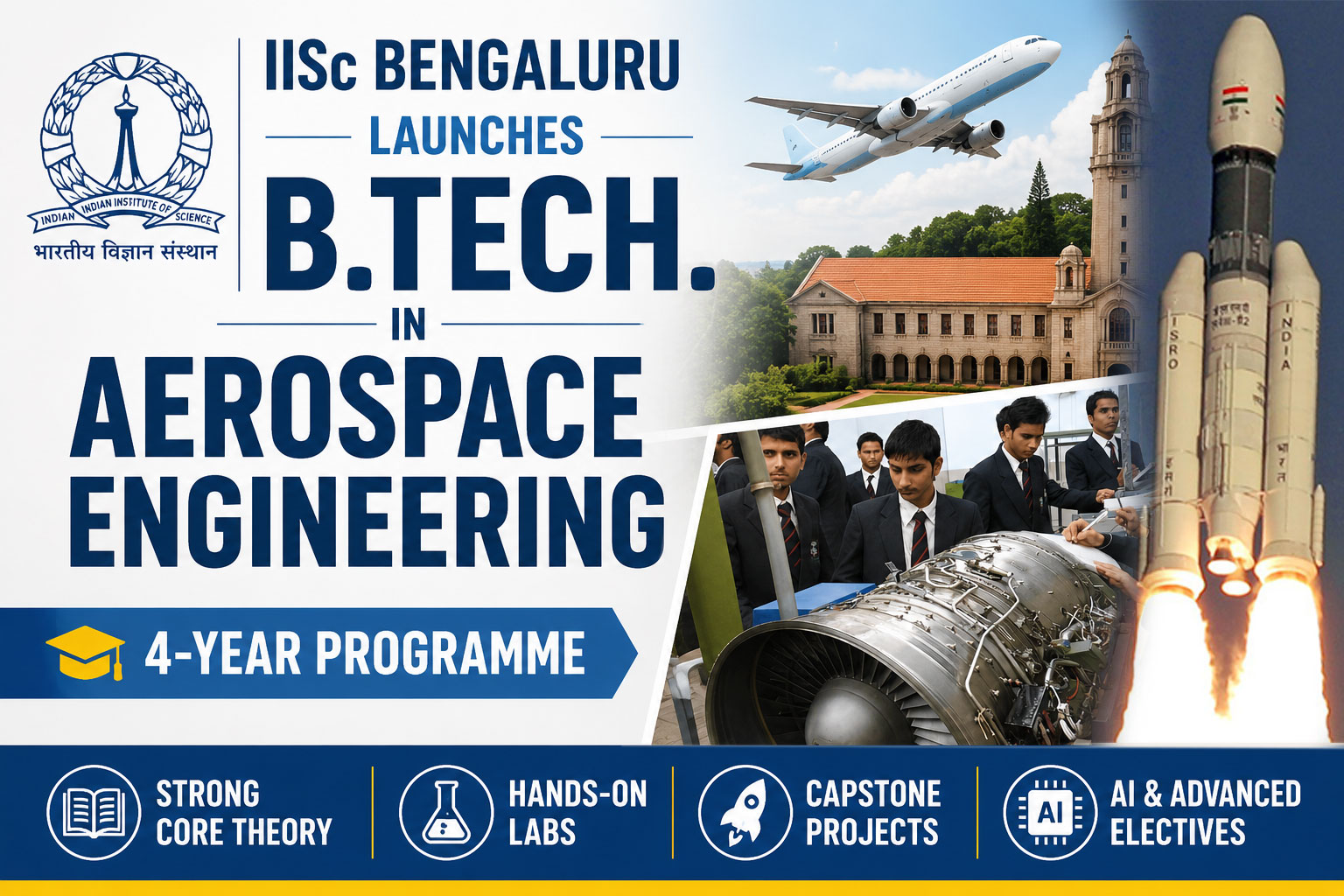
IISc Bengaluru opens a four-year B.Tech. in Aerospace Engineering, combining core theory, labs, capstone projects and AI electives to build India’s aerospace talent pipeline.
A new undergraduate milestone
IISc Bengaluru has opened admissions for its new four-year BTech in Aerospace Engineering, marking a notable expansion in its undergraduate portfolio. The first batch will begin in August 2026, and admissions will follow the Joint Seat Allocation Authority process used by India’s premier engineering institutes. With eight semesters, 128 credits, and a curriculum designed around both fundamentals and hands-on training, the programme signals IISc’s intent to play a more direct role in aerospace education.
Why this launch matters
The move arrives at a time when India’s aerospace ambitions are expanding quickly. Recent milestones in space exploration, including Chandrayaan and Gaganyaan, have increased the need for engineers who can work across design, propulsion, structures, control systems, and mission technologies. By launching a dedicated aerospace undergraduate degree, IISc adds a powerful new channel for talent development in a sector that now demands deeper technical specialisation than ever before.
IISc’s entry also matters because the institute has long built its reputation on research excellence rather than undergraduate scale. A BTech in Aerospace Engineering therefore carries symbolic and practical weight. It broadens access to one of India’s most prestigious scientific institutions while creating a pathway for exceptional students to enter aerospace research and industry earlier in their academic journey.
Curriculum with a practical edge
The programme combines aerospace fundamentals with strong practical exposure. Students will train in the Aerospace Engineering X Lab, work on structured research projects from the third year, and complete a design-build-fly capstone project. That structure should help them move beyond classroom learning and into engineering application, where they can test ideas, iterate designs, and understand real-world constraints.
The curriculum also gives students room to explore interdisciplinary domains. Electives in artificial intelligence, robotics, and materials science will let them connect aerospace with adjacent technologies that increasingly define the future of flight and space systems. That flexibility matters because modern aerospace work rarely sits inside one discipline; it demands familiarity with computation, control, manufacturing, and advanced materials.
Early access to advanced learning
One distinctive feature of the new programme is the possibility for exceptional students to take graduate-level courses alongside postgraduate students. That design can accelerate learning for high performers and expose them early to advanced research methods. It may also help IISc create a more seamless academic ecosystem, where undergraduate curiosity and graduate-level inquiry reinforce one another.
This approach suits aerospace education particularly well. The field rewards students who can handle rigorous mathematics, scientific modelling, and systems thinking from the beginning. By allowing strong students to move quickly into deeper material, IISc can nurture a generation of engineers who arrive at research and industry with sharper technical maturity.
A broader shift in engineering education
IISc’s decision could influence the structure of engineering education in India. For years, specialised aerospace degrees have largely concentrated in IITs and a few other institutions. IISc’s entry into the undergraduate space may encourage other universities to expand their own offerings or create more specialised streams within engineering.
That shift could benefit the wider ecosystem. India needs not only more engineers, but also more engineers trained for high-value sectors such as satellites, launch systems, autonomous aircraft, and advanced manufacturing. If more institutions begin to offer specialised undergraduate pathways, students will have greater freedom to match their interests with national needs.
Industry and research potential
The new programme may also deepen IISc’s linkages with industry and research organisations. Aerospace companies, defence manufacturers, and space-tech startups all need a stronger talent pipeline. A programme that blends labs, design projects, and interdisciplinary learning can produce graduates ready for both R&D roles and production-oriented engineering work.
IISc’s research culture may give it an added advantage in this area. Students immersed in a research-driven environment often develop stronger problem-solving habits and greater comfort with experimentation. That can help them contribute not only to existing aerospace systems but also to the next generation of technologies, from reusable launch systems to intelligent flight control.
A talent magnet for top rankers
The programme could quickly become attractive to top JEE rankers looking for a prestigious and focused aerospace education. If IISc succeeds in positioning the course as both academically rigorous and industry-relevant, it may emerge as a serious rival to established aerospace routes at IITs and other technical institutes. That competition could raise standards across the sector.
Such a programme can also shape student aspirations. Many strong students seek environments where they can combine prestige, research access, and career relevance. IISc’s aerospace BTech offers exactly that blend, especially for those drawn to space exploration, aviation, robotics, and advanced engineering design.
A long-term national asset
In the longer term, the programme could help India build a more resilient aerospace talent base. Whether graduates enter research labs, launch companies, aircraft design teams, or public-sector agencies, they will carry specialised training from one of the country’s most respected institutions. That makes the new BTech more than just another degree: it becomes an investment in India’s future capability.
If the programme gains momentum, it may do two things at once. It could strengthen IISc’s undergraduate identity and help normalize specialised engineering education across India. More importantly, it could help ensure that India’s aerospace ambitions rest on a broader, deeper foundation of skilled talent.
#IIScBengaluru #AerospaceEngineering #BTechAdmissions #JoSAA #IndiaAerospace #SpaceEducation #Chandrayaan #Gaganyaan #EngineeringEducation #FutureOfFlight
Disclaimer
The information in this article is based on available public sources and official statements as of the time of publication. While we aim for accuracy, we do not guarantee completeness or correctness. We advise readers to verify key details from official sources before making any decisions. The website (iitiimsamvaad.com) is not liable for any loss or damage arising from the use of this content. The authors are also not responsible for any such loss or damage.