
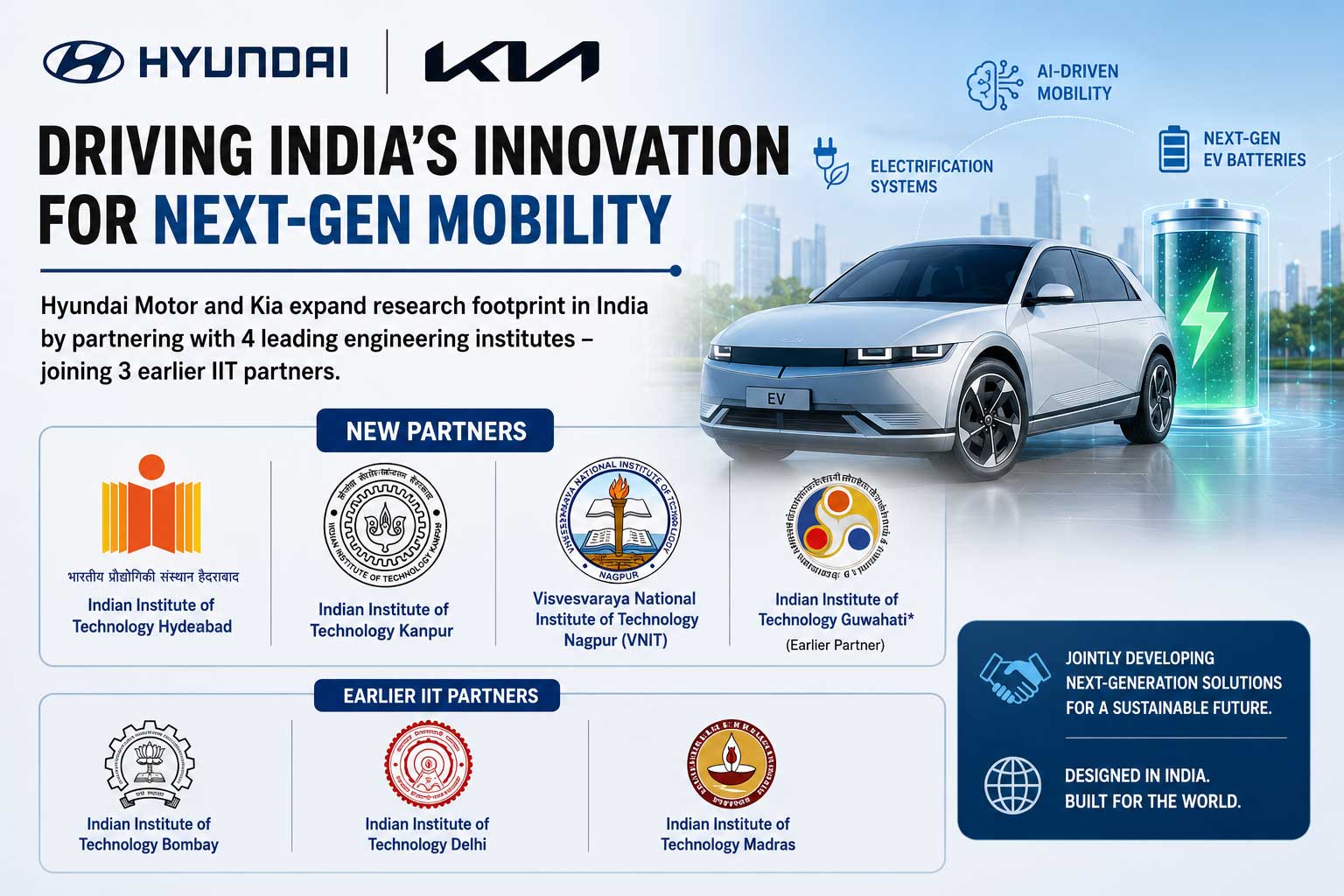
Hyundai Motor and Kia have expanded their domestic research footprint by signing agreements with four leading Indian engineering institutes – joining three earlier IIT partners – to jointly develop next‑generation EV batteries, electrification systems, and AI‑driven mobility solutions across India.
Strengthening India‑Focused EV R&D
Hyundai Motor and Kia have announced a fresh wave of academic partnerships in India, joining forces with four top engineering institutions to accelerate research in electric‑vehicle (EV) batteries and broader electrification technologies. The collaborations, managed through the Hyundai Future Mobility Innovation Center, complement existing ties with IIT Madras, IIT Delhi, and IIT Bombay and extend Hyundai and Kia’s long‑term industry–academia strategy in the country.
The agreements with the Indian Institute of Technology Hyderabad, IIT Kanpur, Visvesvaraya National Institute of Technology (VNIT) Nagpur, and Tezpur University went into effect on May 15, forming a structured joint‑research framework. Hyundai and Kia say the expanded network will enhance their ability to respond quickly to India‑specific market needs in EV design, performance, and manufacturing.
A Growing Network of Academic Partners
Hyundai Motor and Kia launched the Hyundai Future Mobility Innovation Center in April last year as a mid‑to‑long‑term platform to co‑develop advanced technologies with India’s premier technical universities. The initiative aims to build stronger ties between global automotive OEMs and India’s engineering and manufacturing ecosystem, helping both sides grow in tandem.
With the new additions, the Innovation Center now spans seven institutions across the country. IIT operates 23 campuses nationwide and is recognised as India’s top engineering education network, founded in 1951. VNIT Nagpur, a national institute of technology, has already built a track record in EV‑system research, while Tezpur University, a central‑government public university established in 1994, offers multidisciplinary expertise relevant to smart‑mobility and energy systems.
Researchers from these seven universities will run a total of 39 industry–academia projects under the joint‑research framework. Hyundai and Kia describe the effort as a deliberate push to deepen local technical capabilities and embed India‑centric innovation into their global EV roadmap.
Focus Areas: Batteries, Materials, and AI‑Driven Systems
The newly signed projects will cover core areas such as battery design, electrification performance, advanced materials, and AI‑based Vehicle‑to‑Grid (V2G) platforms. Hyundai and Kia are particularly focusing on localized battery design and adapting EV powertrain performance to Indian driving conditions, climate, and grid infrastructure.
Through these collaborations, the automakers aim to develop more efficient, durable, and cost‑effective battery packs and electrified powertrains, while Indian universities contribute modelling, testing, and materials‑science expertise. The AI‑based V2G platform projects will explore how EVs can actively interact with the power grid, including load‑balancing, smart charging, and grid‑support services, which could support India’s renewable‑energy and smart‑grid ambitions.
The joint research will also address new materials for lightweighting, thermal management, and battery safety, which are critical for improving EV range, reliability, and safety in India’s diverse operating environments.
Talent Development and Global Exposure
Beyond technology outcomes, Hyundai and Kia are emphasising talent development as a central pillar of the partnerships. The automakers plan to strengthen India’s human‑capital pipeline for future mobility by involving faculty and students in real‑world EV and electrification projects.
As part of this effort, Hyundai and Kia intend to invite deans and professors from the seven universities to South Korea next month to discuss further cooperation, share best practices, and align research roadmaps. The company hopes these visits will deepen institutional ties and expose Indian educators to global automotive R&D processes, standards, and manufacturing practices.
The expanded collaboration also aims to create internship, project, and career opportunities for Indian engineering students, positioning them to lead India’s transition to electrified and software‑defined mobility. Hyundai and Kia see these partnerships as a long‑term investment in indigenous capability rather than a one‑off project cycle.
A Shared Vision for Sustainable Mobility
Kim Chang‑hwan, Executive Vice President in charge of Electrification & Energy Solutions at Hyundai Motor and Kia, described the latest agreements as a “shared promise for the future.” He said the Hyundai Motor Group and Indian academia will work together to build a sustainable, innovative, and brighter future for mobility.
By combining Hyundai and Kia’s global scale, EV platforms, and manufacturing know‑how with India’s strong engineering talent and growing domestic EV ecosystem, the expanded Innovation Center network aims to position India as a key hub for advanced battery and electrification research. The initiative also aligns with India’s broader push toward clean energy, smart cities, and a technology‑driven manufacturing base.
With 39 coordinated projects now underway and a growing academic footprint, Hyundai and Kia are signalling that India will play a central role in shaping the next generation of electric vehicles and smart‑mobility systems worldwide.
Disclaimer
The information in this article is based on available public sources and official statements as of the time of publication. While we aim for accuracy, we do not guarantee completeness or correctness. We advise readers to verify key details from official sources before making any decisions. The website (iitiimsamvaad.com) is not liable for any loss or damage arising from the use of this content. The authors are also not responsible for any such loss or damage.