
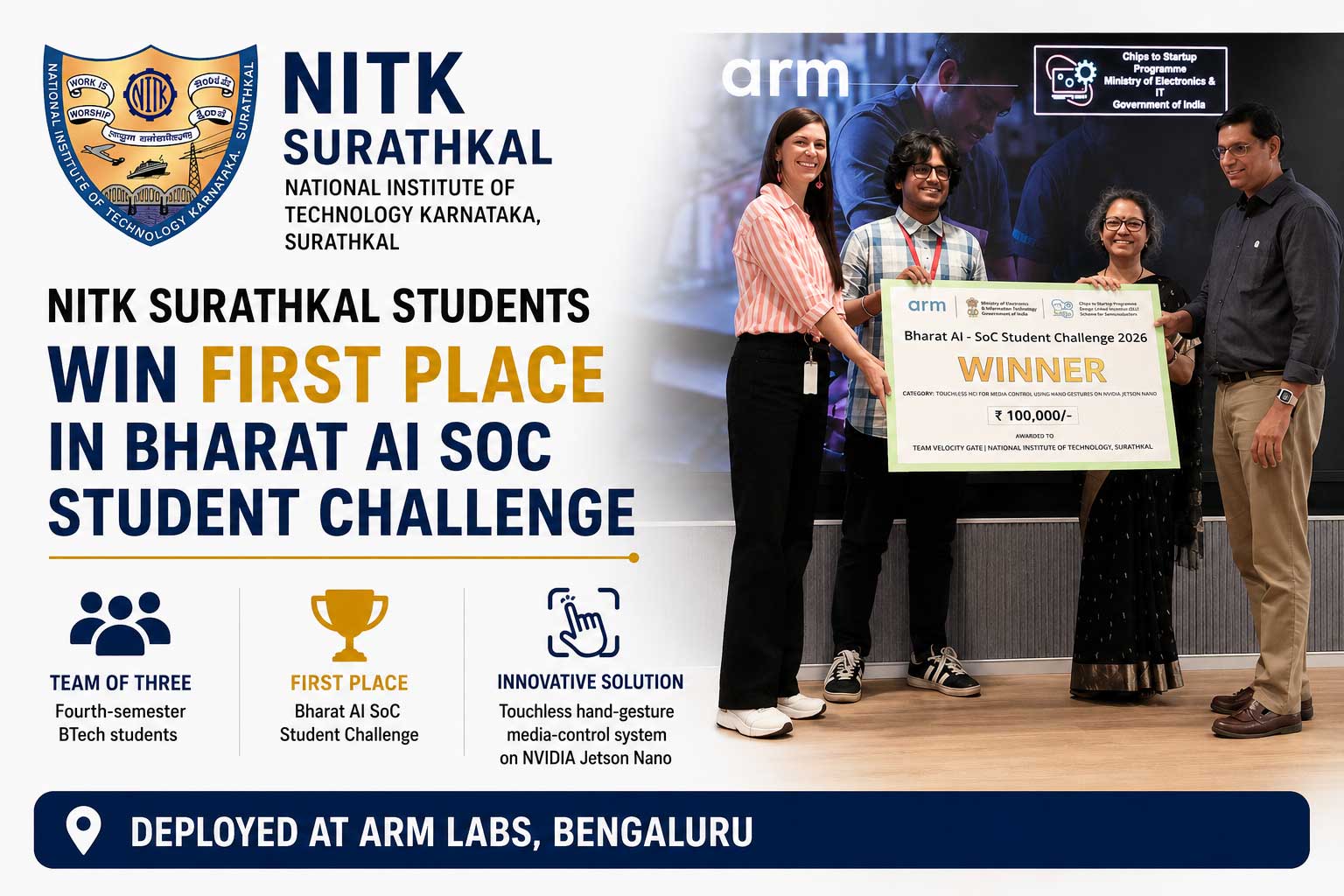
A team of three fourth‑semester BTech students from NITK Surathkal’s Electronics and Communication Engineering department has won first place in the Bharat AI SoC Student Challenge for a touchless hand‑gesture media‑control system built on the NVIDIA Jetson Nano and deployed at ARM Labs, Bengaluru.
NITK Team Tops National AI SoC Contest
A team of three BTech students from National Institute of Technology Karnataka (NITK) Surathkal has claimed first position in the Bharat AI SoC Student Challenge, a national competition for AI and System‑on‑Chip (SoC) projects. The students – Shresh Parti, Rushil Jain, and Sriprahlad Mukunthan from the Department of Electronics and Communication Engineering – competed in the category “Touchless HCI for Media Control Using Hand Gestures on NVIDIA Jetson Nano.”
Their project, mentored by Prof. Suman David of the ECE department, developed a touchless human–computer interaction system that turns real‑time hand gestures into media‑control commands for VLC Media Player. The team will receive a cash prize of ₹1 lakh and a certificate at ARM Labs, Bengaluru.
How the Touchless System Works
The NITK team built a gesture‑based media controller that tracks hand movements without physical contact. The system runs on an NVIDIA Jetson Nano, a compact AI‑enabled SoC platform widely used in robotics and edge computing. The students used MediaPipe, an open‑source framework, to detect hand landmarks in real time and classify both static and dynamic gestures.
They then mapped recognised gestures – such as hand‑up, swipe, or pinch – to specific keyboard shortcuts for VLC Media Player, enabling commands like play/pause, volume up/down, and track change. The entire pipeline integrates Python libraries for image processing, gesture classification, and system‑level control, creating a low‑cost, software‑driven interface that works on standard desktop hardware.
A Rigorous Five‑Week AI Challenge
The Bharat AI SoC Student Challenge is a five‑week virtual programme designed to strengthen industry‑relevant skills in artificial intelligence and SoC technologies through project‑based learning. Organised jointly by ARM, the Chip to Startup Programme, the Ministry of Electronics & IT (MeitY), and IIT Delhi, the challenge invited students from across India to build AI‑driven SoC applications.
Out of 340 project submissions nationwide, the organisers shortlisted six teams per category for the final presentation round. The NITK team impressed the judging panel with the clarity of their concept, technical robustness, and practical relevance of the touchless media‑control interface. Their project also stood out for its efficient use of the NVIDIA Jetson Nano and its potential to extend to other gesture‑based HCI applications beyond media control.
Recognition at ARM Labs, Bengaluru
The award ceremony took place on May 14 at ARM Labs in Bengaluru, where the NITK team formally received the ₹1 lakh prize and certificates. The students also toured ARM’s design and research facilities and interacted with senior engineers and chip designers, gaining firsthand exposure to India’s semiconductor and AI‑hardware ecosystem.
Prof. B. Ravi, Director of NITK Surathkal, congratulated the team on their achievement and highlighted how their success brings national recognition to the institute. He also praised the ECE department’s evolving focus on AI, embedded systems, and hardware–software co‑design, calling the win a reflection of the institute’s growing strength in applied research and student‑led innovation.
From Lab to Real‑World Applications
The NITK gesture‑control system opens doors to several practical applications beyond media playback. The same architecture can support touchless interfaces in smart‑home control, assistive technology for people with mobility challenges, sterile environments such as operating rooms, and public kiosks where physical contact with touchscreens is undesirable.
By running on an affordable SoC like the NVIDIA Jetson Nano and using open‑source tools such as MediaPipe and standard Python libraries, the team has also demonstrated a scalable, low‑barrier‑to‑entry model for hardware‑aware AI projects. This aligns with the broader goals of the Bharat AI SoC Student Challenge and the Chip to Startup Programme: to nurture India‑born talent in semiconductor, AI, and embedded systems and to accelerate the country’s transition toward indigenous hardware and AI solutions.
With this national win, the NITK Surathkal team has not only earned a cash prize and recognition but also set an example for how student‑driven projects can bridge academic learning, industry tools, and real‑world user needs in the AI‑SoC domain.
Disclaimer
The information in this article is based on available public sources and official statements as of the time of publication. While we aim for accuracy, we do not guarantee completeness or correctness. We advise readers to verify key details from official sources before making any decisions. The website (iitiimsamvaad.com) is not liable for any loss or damage arising from the use of this content. The authors are also not responsible for any such loss or damage.