

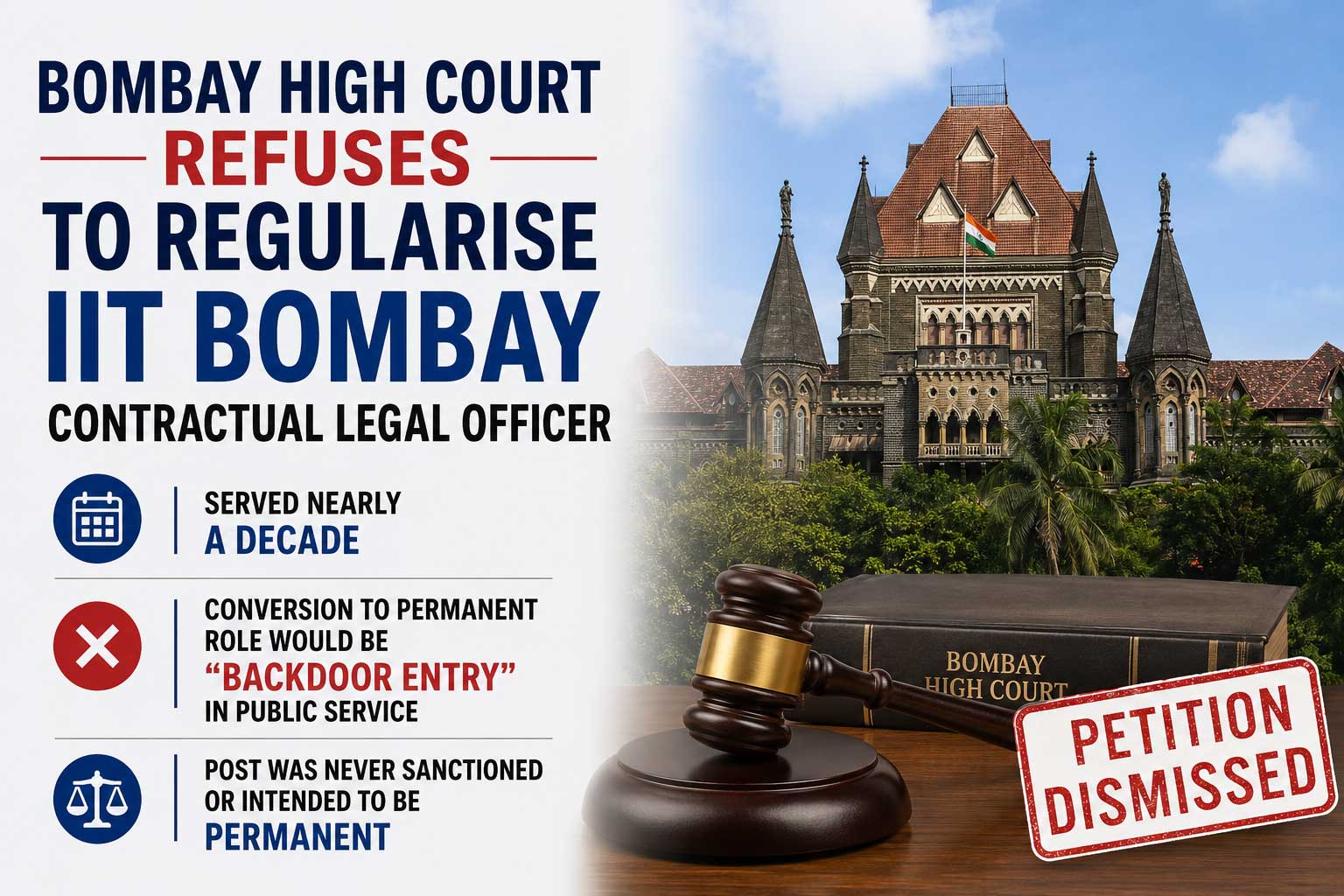
The Bombay High Court has refused to regularise a contractual legal officer at IIT Bombay who had served nearly a decade, ruling that converting his temporary role into permanent employment would amount to a “backdoor entry” in public service, as the post was never sanctioned or intended to be permanent.
Court Rejects Demand for Regularisation
The Bombay High Court has dismissed a plea by Yuvraj Balasaheb Vharamble, a former executive officer (legal) at IIT Bombay, seeking permanency after almost 10 years of contractual service. A bench comprising Justices R. I. Chagla and Advait M. Sethna held that granting him regularisation in the absence of any statutory or sanctioned post would effectively create a “backdoor entry” into public employment.
Vharamble had challenged a termination notice dated March 13 that ended his contractual engagement from April 23, 2026, and sought regularisation either as executive officer (legal) or deputy registrar (legal), along with salary arrears and service benefits.
Nature of the Contractual Appointment
The court noted that the post of “executive officer (legal)” was explicitly created as a temporary, ad‑hoc position to meet specific administrative exigencies at IIT Bombay. The 2015 recruitment advertisement clearly stated that the appointment was contractual for three years, and every subsequent office order reaffirmed that all other terms and conditions of his engagement would remain unchanged.
He joined IIT Bombay on April 11, 2016, under an offer letter dated February 8, 2016, offering the position on a contract basis for three years. Over the years, the institute periodically extended his tenure through re‑appointment orders, often after consolidating or enhancing his salary, but each communication reiterated that the appointment remained purely contractual and temporary.
The court held that where the employer expressly specifies the temporary and contractual nature of a post, courts cannot later convert such engagement into permanent service merely because an individual has served for a long period.
“Backdoor Entry” and Sanctioned Posts
The bench emphasised that the executive officer (legal) post was not a sanctioned, regular post in IIT Bombay’s establishment. It was created on an exigency basis within the then‑existing administrative framework and did not flow from any statutory or formally approved post‑sanction.
The judges observed that accepting the petitioner’s claim for permanent absorption would amount to bypassing the proper recruitment and appointment procedures, which would be contrary to Articles 14, 16, and 21 of the Constitution that guarantee fairness, transparency, and equality in public employment. Merely serving for close to a decade, the court held, cannot override the absence of a sanctioned post or the declared contractual nature of the role.
Counsel’s Arguments and Court’s Response
Appearing for Vharamble, advocate Aseem Naphade argued that the termination order was arbitrary because it ended his service without specifying any reason and that using labels such as “temporary,” “contractual,” or “ad hoc” could not strip him of what he contended were his substantive employment rights.
He also highlighted that the petitioner had received continuous increments, performance‑linked rewards, and no adverse record, and that he had served diligently for almost 10 years. Naphade contended that even if the petitioner did not meet the age criteria for regular posts, that factor alone should not defeat the claim when he had already completed a lengthy, unblemished tenure at the institute.
The court, however, rejected this line of reasoning. It held that continuous service, increments, and good performance, while commendable, cannot alter the foundational character of an appointment that was expressly contractual and unsanctioned. The structure of the IIT statutes and the terms of his appointment letter clearly distinguished regular employment from contractual roles, and the court declined to blur that distinction.
Warranty of Fairness and Statutory Boundaries
The bench reiterated that fairness and transparency in public appointments are not matters of grace but constitutional obligations. Regularisation or permanent absorption must follow prescribed procedures, including sanctioned posts, proper recruitment, and legislative or statutory backing.
The court also allowed Vharamble to continue occupying official accommodation provided by IIT Bombay until June 8, 2026, giving him a short grace period to settle his personal and residential arrangements after the termination of his contract.
The judgment ultimately underscores that long‑term service, however meritorious, cannot override the absence of a sanctioned post or the explicitly stated contractual and temporary nature of an appointment, and that any attempt to regularise such a role would improperly circumvent the statutory framework governing public employment.
Disclaimer
The information in this article is based on available public sources and official statements as of the time of publication. While we aim for accuracy, we do not guarantee completeness or correctness. We advise readers to verify key details from official sources before making any decisions. The website (iitiimsamvaad.com) is not liable for any loss or damage arising from the use of this content. The authors are also not responsible for any such loss or damage.