
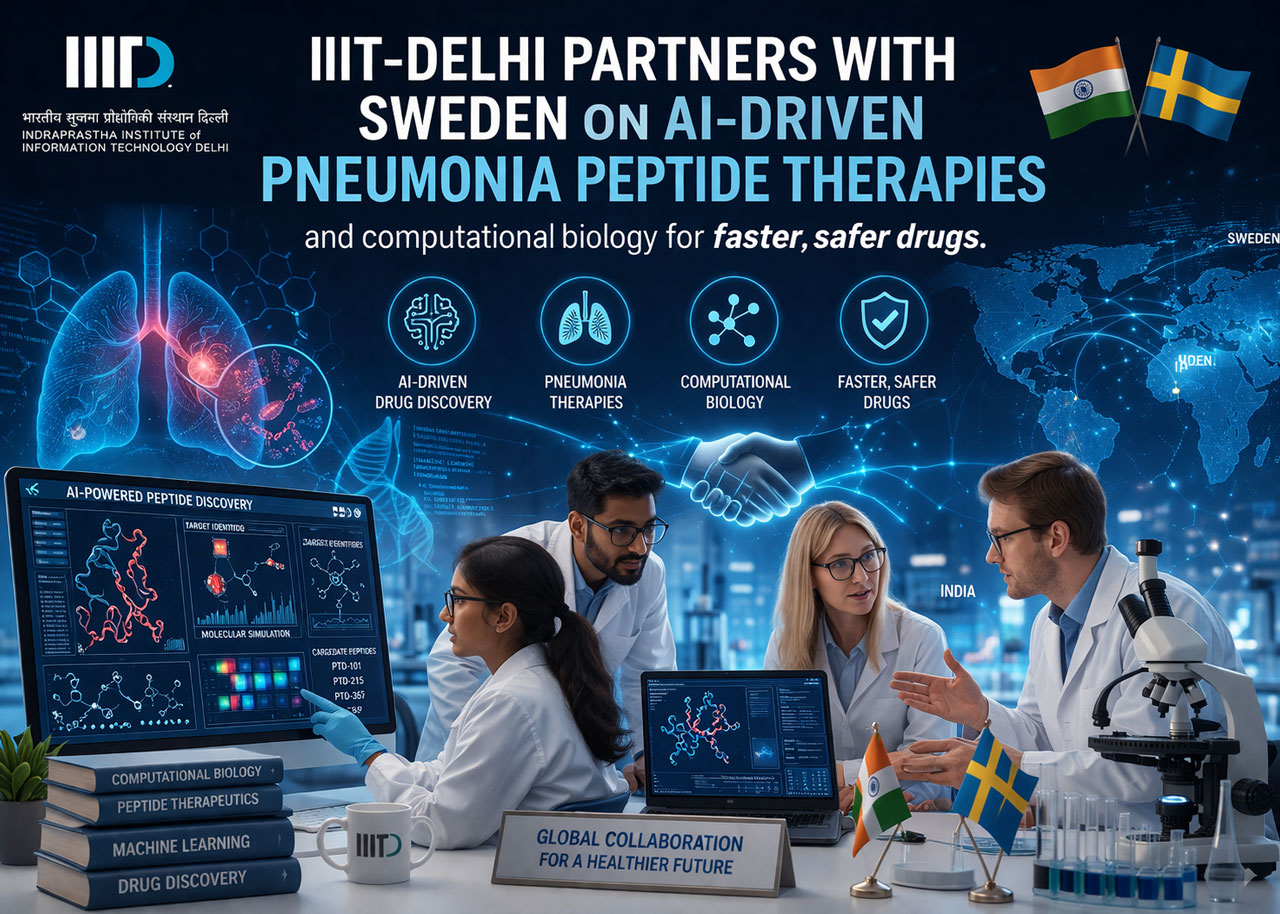
IIIT-Delhi collaborates with Swedish researchers on an AI-powered project to revolutionize pneumonia treatments using machine learning and peptide therapies for faster, safer drugs.
Indraprastha Institute of Information Technology Delhi (IIIT-Delhi) has forged a groundbreaking international partnership with Swedish researchers to tackle pneumonia – a leading cause of mortality worldwide, especially in vulnerable populations like children and the elderly. The project leverages artificial intelligence (AI) and computational biology to pioneer peptide-based therapies targeting pneumonia-causing pathogens, promising faster, more affordable drug discovery.
Prestigious Funding and Collaborative Framework
This initiative has secured prestigious funding under a joint programme by India’s Department of Biotechnology (DBT) and Sweden’s innovation agency Vinnova. The project receives Rs 52.2 lakh from India and 2.8 million SEK (approximately Rs 2.2 crore) from Sweden. These resources will not only fuel research but also facilitate researcher exchanges, fostering long-term India-Sweden scientific ties.
The collaboration unites top talent from both nations. At IIIT-Delhi, the team is led by Docent N. Arul Murugan, with co-investigators GPS Raghava and Vibhor Kumar from the Department of Computational Biology. On the Swedish side, Vaibhav Srivastava from KTH Royal Institute of Technology heads the effort, alongside Ujwal Nyogi from the Karolinska Institute – a globally renowned center for medical research.
Harnessing AI for Peptide Innovation
Pneumonia, often triggered by bacterial or viral pathogens, demands targeted therapies that minimize side effects and resistance risks. Traditional drug development is slow and costly, taking years and billions. This project disrupts that paradigm by deploying machine learning (ML) models to analyze peptide properties – short chains of amino acids with potent antimicrobial potential.
Researchers will train ML algorithms on vast datasets to predict peptides’ antimicrobial efficacy, safety profiles, and potential side effects. Generative AI, a cutting-edge tool capable of creating novel molecular structures, will then design optimized peptide candidates. These virtual designs will undergo rigorous lab validation, including tests on lung organoids – miniature, lab-grown models mimicking human lung tissue. This iterative process ensures candidates are effective against pathogens while safe for human use.
“This India-Swedish collaboration displays IIIT-Delhi’s commitment to utilising computational biology, AI, and Gen-AI to address critical health challenges on a global scale,” said Docent N. Arul Murugan. “In the coming years, biomedical discovery will be heavily transformed by artificial intelligence’s contribution. The integration of advanced machine learning and experimental validation can accelerate the discovery of peptide therapeutics to combat pneumonia-causing pathogens.”
Accelerating Drug Discovery and Global Health Impact
The project’s core aim is to streamline drug discovery, slashing timelines from years to months and costs dramatically. By decoding infection mechanisms at a molecular level, it will deepen understanding of pathogen behavior, enabling precision therapies. Peptides offer advantages over conventional antibiotics: they are less prone to resistance, biodegradable, and versatile against multiple pathogens.
For India, where pneumonia claims over 300,000 lives annually (per WHO data), this holds immense promise. Sweden’s expertise in biotech complements IIIT-Delhi’s AI prowess, creating a synergistic model for global health challenges like antimicrobial resistance (AMR) – a crisis projected to cause 10 million deaths yearly by 2050 if unchecked.
Broader Implications for Research Ties
Beyond immediate outcomes, the partnership strengthens bilateral innovation. Researcher exchanges will build capacity, with Indian scientists gaining access to Karolinska’s advanced labs and Swedish counterparts benefiting from IIIT-Delhi’s computational infrastructure. This aligns with global trends, where AI is reshaping healthcare – from protein folding predictions (e.g., AlphaFold) to personalized medicine.
IIIT-Delhi’s focus on AI for drug development positions it as a leader in computational biology. Past contributions from Raghava’s team, including peptide databases like APD3, underpin this work. The project could yield open-source tools, accelerating worldwide research.
In summary, this collaboration exemplifies how Indo-Swedish synergy, powered by AI, can deliver life-saving innovations. By targeting pneumonia’s root causes with smart peptides, it paves the way for safer treatments, healthier futures, and enduring research alliances.
Disclaimer
The information in this article is based on available public sources and official statements as of the time of publication. While we aim for accuracy, we do not guarantee completeness or correctness. Readers are advised to verify key details from official sources before making any decisions. The website (iitiimsamvaad.com) is not liable for any loss or damage arising from the use of this content. The authors are also not responsible for any such loss or damage.