

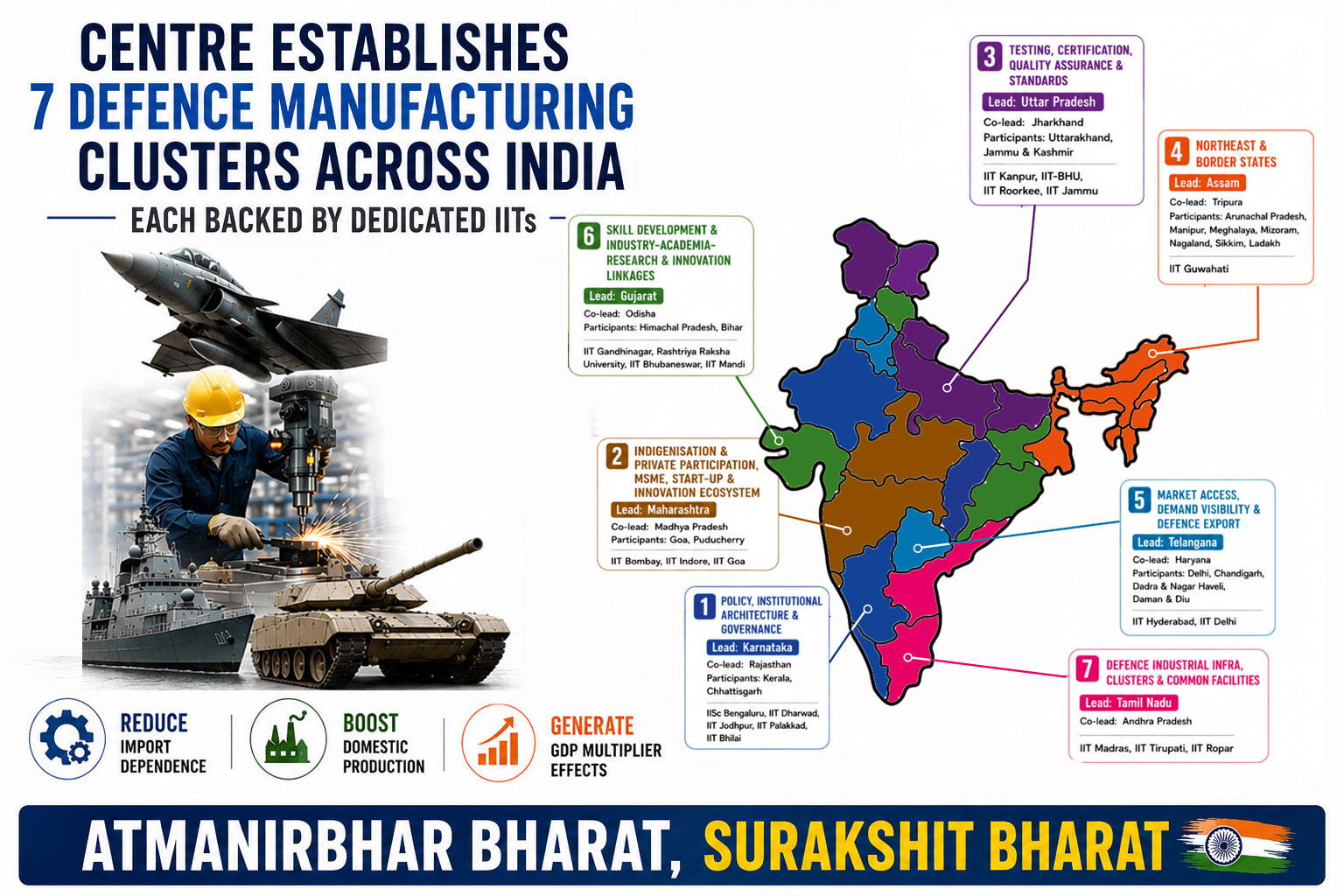
Centre formalized seven defence manufacturing clusters each backed by dedicated IITs with thematic hubs, aiming to reduce import dependence, boost domestic production, and generate GDP multiplier effects across India.
Centre Creates Federal Architecture for Defence Manufacturing
For the first time, the Centre is working towards creating clusters of States and Union Territories, each backed by dedicated IITs and other centres of excellence, to build a federal architecture for defence manufacturing aimed at reducing import dependence and boosting economic growth. The seven proposed clusters are independent of the existing defence industrial corridors in Uttar Pradesh and Tamil Nadu. This strategic initiative represents a paradigm shift from corridor-based development to cluster-based federal empowerment.
“The Ministry of Defence’s whole-of-nation proposal is at an advanced stage of consideration. Defence Production Secretary Sanjeev Kumar has already held two stakeholder meetings, on June 2 and June 10. All seven clusters were formalised and assigned themes for preparing roadmaps or vision documents,” an official source told businessline. The formalization of all seven clusters demonstrates the government’s commitment to implementing this comprehensive defence manufacturing strategy.
Clusters Submit Reports Detailing Thematic Contributions and Infrastructure Needs
The clusters have been asked to submit reports by next month, detailing their contribution to the thematic agenda, pain points, infrastructure needs, regulatory requirements, and ease-of-doing-business measures. Based on these inputs, the Centre is expected to deliberate on policy interventions to strengthen defence manufacturing and the broader economy. This structured approach ensures that policy decisions are grounded in ground-level realities and specific regional requirements.
“This will generate direct value addition and wider macroeconomic benefits, acting as an ‘output GDP multiplier’ whereby every rupee spent in defence manufacturing creates more than double the economic activity across the country,” the official said. The GDP multiplier effect means defence manufacturing investments will stimulate economic growth across multiple sectors including steel, electronics, logistics, and services.
Each Cluster Has Lead State, Co-Lead and Designated IIT Partners
Each cluster has a lead State, co-lead State, participating States or UTs, and designated IITs and centres of excellence to provide R&D and innovation support. This structured governance framework ensures coordinated implementation while leveraging regional strengths and institutional expertise. The IIT partnerships provide technical backbone for research, innovation, and skill development within each cluster.
Karnataka leads the first cluster, with Rajasthan as co-lead and Kerala and Chhattisgarh as participating States. IISc Bengaluru, IIT Dharwad, IIT Jodhpur, IIT Palakkad, and IIT Bhilai will support the theme: “Policy, Institutional Architecture and Governance”. This cluster establishes the foundational framework for all other clusters.
Maharashtra Leads Cluster Focused on Indigenisation and Private Participation
The second cluster, themed “Indigenisation & Enhanced Private Participation, MSME, Start-up & Innovation Ecosystem”, is led by Maharashtra with Madhya Pradesh as co-lead and Goa and Puducherry as participating UTs. Institutional partners are IIT Bombay, IIT Indore, and IIT Goa. This cluster aims to increase domestic content in defence products and expand private sector involvement in defence manufacturing.
The third cluster is led by Uttar Pradesh, with Jharkhand as co-lead and Uttarakhand and Jammu & Kashmir as participants. IIT Kanpur, IIT-BHU, IIT Roorkee, and IIT Jammu will support the theme: “Testing, Certification, Quality Assurance and Standards”. This cluster will establish standardized testing facilities and quality certification systems essential for defence manufacturing.
Assam Leads Northeastern Cluster Focused on Border States
Assam leads the fourth cluster, focused on northeastern and border States, with Tripura as co-lead and Arunachal Pradesh, Manipur, Meghalaya, Mizoram, Nagaland, Sikkim, and Ladakh participating. IIT Guwahati is the institutional partner. This cluster addresses the unique strategic requirements of border regions and promotes defence manufacturing in northeastern India.
The fifth cluster, themed “Market Access, Demand Visibility & Defence Export”, is led by Telangana with Haryana as co-lead and Delhi, Chandigarh, Dadra & Nagar Haveli, and Daman & Diu as participants. IIT Hyderabad and IIT Delhi are stakeholders. This cluster focuses on expanding international market access for Indian defence products.
Gujarat Leads Cluster on Skill Development and Industry-Academia Linkages
Gujarat leads the sixth cluster, with Odisha as co-lead and Himachal Pradesh and Bihar participating. IIT Gandhinagar, Rashtriya Raksha University, IIT Bhubaneswar, and IIT Mandi will support the theme: “Skill Development & Industry-Academia-Research & Innovation Linkages”. This cluster addresses the critical need for skilled workforce in defence manufacturing.
The seventh cluster, led by Tamil Nadu with Andhra Pradesh as co-lead, will focus on “Defence Industrial Infra, Clusters & Common Facilities” with support from IIT Madras, Tirupati, and Ropar. This cluster will develop shared infrastructure facilities reducing individual manufacturer investment requirements.
Seven Clusters Independent from Existing Defence Industrial Corridors
The seven proposed clusters are independent of the existing defence industrial corridors in Uttar Pradesh and Tamil Nadu, creating a comprehensive national network rather than concentrating development in two regions. This geographic diversification ensures broader economic benefits and reduces regional disparities in defence manufacturing capacity.
The cluster-based approach enables each region to leverage its unique strengths, available infrastructure, and institutional capabilities. States can develop specialized capabilities aligned with their industrial base and technical expertise rather than competing for identical manufacturing activities.
Seven defence manufacturing clusters backed by IITs establish a transformative federal architecture reducing import dependence, boosting domestic production, and generating GDP multiplier effects while enabling regional specialization and inclusive economic growth across India.
#DefenceManufacturing #SevenClusters #IITs #ImportDependence #DomesticProduction #GDPMultiplier # DefenceIndustrialCorridors #Indigenisation #SkillDevelopment #DefenceExports
Disclaimer
The information in this article is based on available public sources and official statements as of the time of publication. While we aim for accuracy, we do not guarantee completeness or correctness. We advise readers to verify key details from official sources before making any decisions. The website (iitiimsamvaad.com) is not liable for any loss or damage arising from the use of this content. The authors are also not responsible for any such loss or damage.