

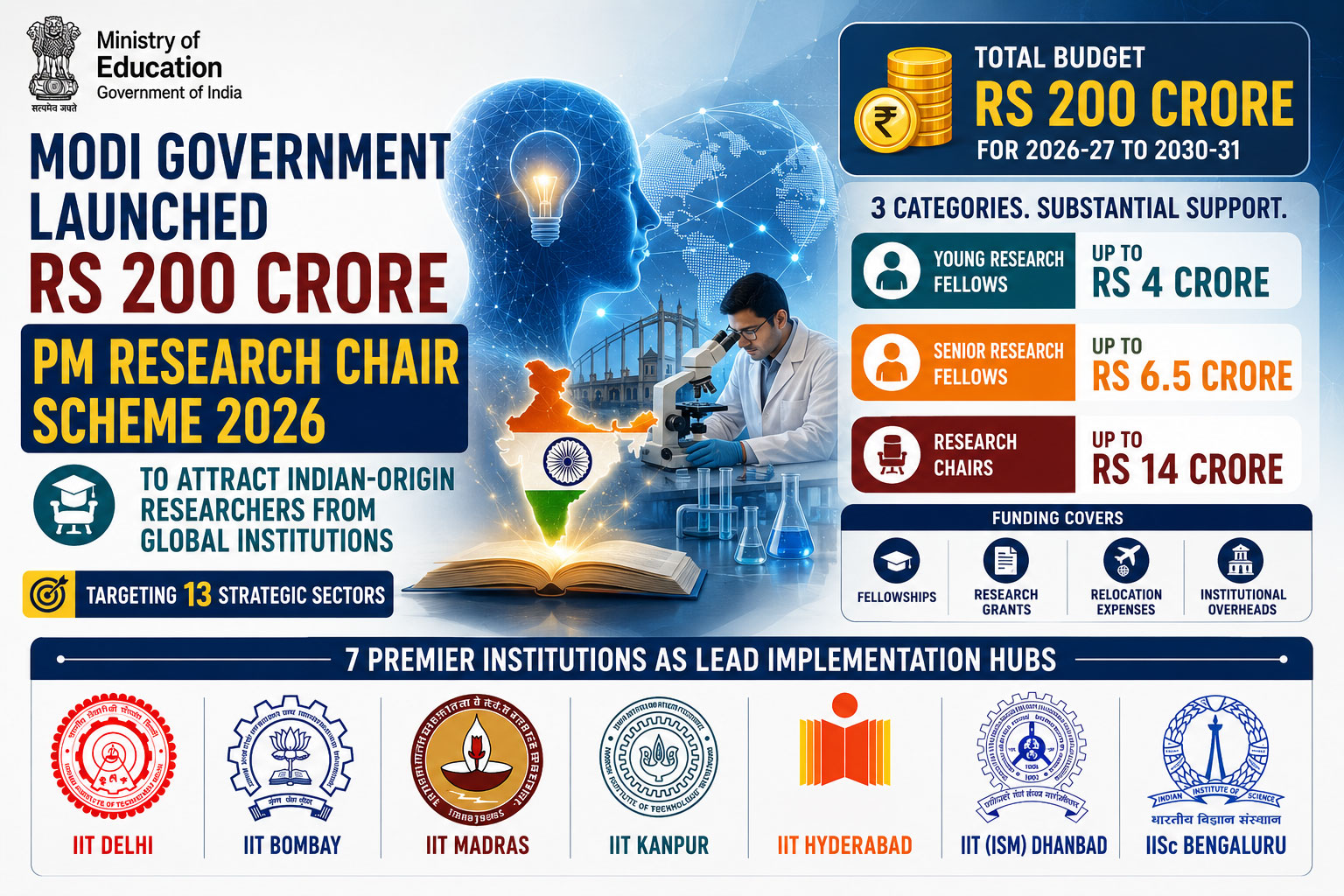
Modi government launched Rs 200 crore PM Research Chair Scheme 2026 targeting 13 strategic sectors, offering up to Rs 14 crore funding to attract Indian-origin researchers from global institutions.
Modi Government Launches Prime Minister Research Chair Scheme 2026
The Narendra Modi government has launched a renewed effort to address India’s long-standing brain drain by introducing the Prime Minister Research Chair Scheme 2026, an initiative aimed at attracting Indian-origin researchers, scientists, technologists, and professionals working at leading universities and research institutions across the world. The programme seeks to strengthen India’s research ecosystem by encouraging global talent to collaborate with higher education institutions, national laboratories, and research centres in the country.
This initiative represents the government’s most ambitious effort to reverse decades of talent migration that has seen many of India’s top graduates build careers overseas. The scheme addresses a critical national challenge by providing substantial financial incentives and institutional support for returning researchers.
Scheme Identifies 13 Strategic Sectors Critical for India’s Future Growth
The scheme identifies 13 strategic sectors considered critical for India’s future growth, including advanced computing, artificial intelligence, quantum computing, semiconductors, cybersecurity, biotechnology, healthcare, advanced materials, space, defence, sustainability, manufacturing, agriculture, blue economy, and nuclear energy. These sectors represent areas where India needs to achieve technological self-reliance and global competitiveness.
To support research in these fields, the government has designated seven premier institutions as lead implementation centres, including IIT Delhi, IIT Bombay, IIT Madras, IIT Kanpur, IIT Hyderabad, IIT (ISM) Dhanbad, and the Indian Institute of Science Bengaluru. These institutions provide the research infrastructure, administrative support, and academic environment necessary for high-impact scientific work.
Programme Offers Up to Rs 14 Crore Financial Support Across Three Categories
Backed by a total budget of Rs 200 crore for the 2026-27 to 2030-31 period, the programme offers substantial financial support through three categories. Young Research Fellows can receive up to Rs 4 crore, Senior Research Fellows up to Rs 6.5 crore, and Research Chairs up to Rs 14 crore, with funding covering fellowships, research grants, relocation expenses, and institutional overheads.
The government hopes the initiative will help reverse decades of talent migration that has seen many of India’s top graduates build careers overseas. The significant funding amounts enable researchers to establish comprehensive research programs without financial constraints, including hiring research teams, purchasing equipment, and conducting extensive experiments.
Industry Leaders Welcome Initiative as Significant Step Forward
Industry leaders and entrepreneurs have welcomed the initiative, describing it as a significant step toward strengthening India’s scientific and technological capabilities. They believe the focus on areas such as semiconductors, artificial intelligence, quantum technologies, defence, and biotechnology aligns with the country’s long-term ambition of achieving greater self-reliance and global competitiveness.
Experts also noted that the involvement of leading academic institutions could help establish a sustainable research ecosystem driven by merit and innovation. The partnership between government, industry, and academia creates a comprehensive support system for returning researchers, providing career opportunities, funding access, and collaboration networks.
Experts Caution That Financial Incentives Alone May Not Attract Top Talent
However, several experts cautioned that financial incentives alone may not be enough to attract top global talent back to India. They pointed to concerns such as comparatively lower salaries, bureaucratic hurdles, delays in research grants, procurement challenges, infrastructure gaps, and quality-of-life issues in many cities. These non-financial factors significantly influence researchers’ decisions about relocation.
They stressed that improving laboratory facilities, administrative efficiency, academic freedom, and civic infrastructure would be essential to ensure returning researchers can work at international standards. Researchers need modern equipment, timely grant approvals, streamlined procurement processes, and freedom to pursue innovative ideas without excessive administrative interference.
Global Shifts Create Opportunity for India to Attract Skilled Professionals
The initiative also comes at a time when outbound student mobility has slowed due to stricter visa policies, rising education costs, and changing geopolitical conditions in countries such as the United States, Canada, Australia, and the United Kingdom. Experts believe these global shifts could create an opportunity for India to attract highly skilled professionals, provided the programme is implemented effectively and backed by sustained institutional support.
Strict immigration policies in traditional destination countries have made it harder for Indian professionals to secure long-term positions abroad. Rising education costs have reduced the affordability of graduate programs in Western countries. Geopolitical tensions have created uncertainty about long-term career stability overseas. These factors make India’s Research Chair Scheme more attractive to professionals considering career options.
Transparent Selection Processes and Reduced Bureaucracy Determine Scheme Success
They maintain that transparent selection processes, reduced bureaucracy, and long-term policy commitment will ultimately determine whether the scheme succeeds in reversing India’s brain drain. Researchers need confidence that selection decisions are based on merit rather than political considerations or personal connections. Bureaucratic delays in fund disbursement, equipment procurement, and administrative approvals frustrate researchers and reduce program effectiveness.
Long-term policy commitment ensures that researchers can plan multi-year projects without uncertainty about funding continuity. The government must demonstrate sustained support for the initiative beyond the initial five-year period, establishing it as a permanent component of India’s research infrastructure rather than a temporary program.
The Prime Minister Research Chair Scheme 2026 establishes a transformative Rs 200 crore initiative targeting 13 strategic sectors with funding up to Rs 14 crore, aiming to reclaim India’s brightest minds from global institutions while addressing brain drain through comprehensive financial support and institutional collaboration.
#PMResearchChair #BrainDrain #Rs200Crore #IndianResearchers #ResearchEcosystem #IITs #StrategicSectors #TalentMigration #ScientificCapabilities #ModiGovernment
Disclaimer
The information in this article is based on available public sources and official statements as of the time of publication. While we aim for accuracy, we do not guarantee completeness or correctness. We advise readers to verify key details from official sources before making any decisions. The website (iitiimsamvaad.com) is not liable for any loss or damage arising from the use of this content. The authors are also not responsible for any such loss or damage.