
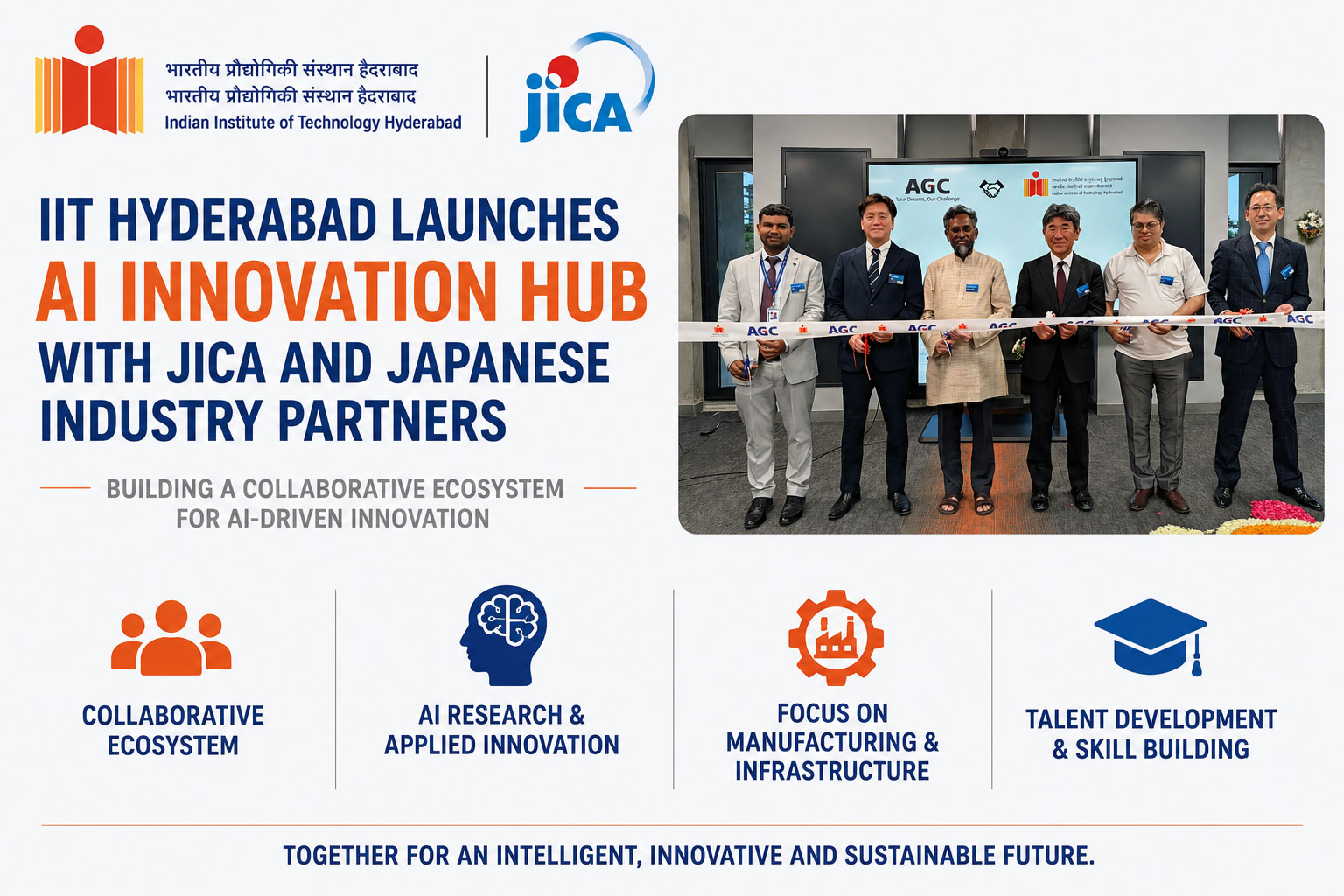
IIT Hyderabad launched AI Innovation Hub with JICA and Japanese industry partners, creating collaborative ecosystem for AI research, applied innovation, and talent development across manufacturing and infrastructure sectors.
IIT Hyderabad Launches AI Innovation Hub with JICA Support
The launch of a new Artificial Intelligence Innovation Hub at IIT Hyderabad marks a significant step forward in Indo–Japan collaboration in advanced technology. Supported by the Japan International Cooperation Agency (JICA) along with Japanese industry partners, the initiative is designed to deepen cooperation in AI research, applied innovation, and talent development. The launch event took place at IIT Hyderabad’s campus, attended by institute officials, JICA representatives, Japanese industry leaders, and academic partners.
At its core, the hub aims to move beyond traditional academic research structures. Instead of operating as an isolated centre, it functions as a collaborative ecosystem where academia and industry work together on shared problem statements. The focus is on developing practical, scalable AI solutions that can be deployed across sectors such as manufacturing, infrastructure systems, and digital transformation.
Collaborative Ecosystem Combines Academic Depth with Industry Execution
The initiative reflects a growing global trend: innovation is increasingly driven by partnerships that combine academic depth with industry execution. In this case, IIT Hyderabad brings strong research capability and technical expertise, while Japanese partners contribute industrial experience and application-oriented perspectives. Together, this creates a framework where ideas can be tested, refined, and translated into real-world impact more efficiently.
IIT Hyderabad’s researchers provide cutting-edge AI algorithms, machine learning models, and computational frameworks. Japanese industry partners offer real-world deployment contexts, manufacturing processes, and customer requirements. This combination ensures that research outcomes address actual industry needs rather than purely theoretical questions, increasing the likelihood of successful commercialization.
Students Gain Exposure to International Innovation Standards
For students and researchers, the hub opens up valuable opportunities for exposure to international standards of innovation. Structured engagement through internships, joint research projects, and industry-led challenges will allow participants to work on real use cases rather than purely theoretical problems. This strengthens their readiness for global technology roles and enhances practical problem-solving skills.
Students will participate in internships at Japanese companies, gaining firsthand experience with international business practices and technology deployment strategies. Joint research projects enable Indian and Japanese researchers to collaborate on AI applications, sharing methodologies and perspectives. Industry-led challenges present students with actual problems from Japanese manufacturers, requiring them to develop functional AI solutions under real constraints.
Japan Accesses India’s Growing AI Talent Pool
From Japan’s perspective, the collaboration provides access to one of the world’s fastest-growing pools of AI talent. India’s engineering ecosystem, known for its scale and adaptability, offers a strong foundation for co-developing next-generation technologies. Japanese companies gain access to skilled Indian engineers who can contribute to AI product development, research initiatives, and technology commercialization efforts.
For India, the partnership reinforces its position as an emerging global hub for AI research and innovation. The collaboration also brings Japanese investment, technology transfer, and market access to Indian AI developers. Indian researchers learn from Japanese expertise in precision manufacturing, quality control, and systematic innovation processes, enhancing their capabilities in industrial AI applications.
Strategic Alignment with Broader India–Japan Relations
Strategically, the initiative also aligns with broader India–Japan relations, which have steadily expanded into areas such as digital technologies, clean energy, and advanced manufacturing. The AI Innovation Hub adds a focused dimension to this partnership by targeting a technology that is expected to shape productivity and competitiveness across industries. Both governments recognize AI’s transformative potential and support collaborative initiatives that advance mutual technological capabilities.
The hub supports India’s National AI Strategy and Japan’s AI Strategy 2025, creating alignment between national policy objectives. Joint research outcomes contribute to both countries’ technological sovereignty goals while maintaining open collaboration frameworks. This balanced approach ensures that collaboration benefits both nations without creating dependency relationships.
Applied Outcomes Drive Commercial Viability
More importantly, the hub emphasises applied outcomes. The goal is not only to generate research outputs but to ensure that innovations can transition into commercially viable solutions. This industry-linked approach increases the relevance of academic work and strengthens the overall innovation pipeline. Research projects include commercialization pathways, with clear milestones for prototyping, testing, and market deployment.
Industry partners provide funding for research projects with specific commercial objectives, ensuring that academic work addresses market needs. The hub facilitates technology transfer agreements, intellectual property sharing, and joint venture formation between Indian and Japanese entities. These mechanisms accelerate the transition from research to commercial products.
Cross-Border Collaboration Accelerates Frontier Technology Progress
In a rapidly evolving global technology landscape, such cross-border collaborations are becoming increasingly important. The IIT Hyderabad–JICA AI Innovation Hub stands as a strong example of how shared infrastructure and joint expertise can accelerate progress in frontier technologies. The hub’s collaborative model demonstrates how international partnerships can overcome resource limitations, access diverse expertise, and achieve faster innovation cycles than isolated efforts.
As India continues to expand its role in the global AI ecosystem, initiatives like this are likely to play a key role in shaping how research, talent, and industry come together to drive the next wave of innovation. The hub establishes a framework for futuro Indo–Japan technology collaborations, potentially expanding to other domains such as robotics, autonomous systems, and quantum computing.
The IIT Hyderabad–JICA AI Innovation Hub represents a strategic investment in India–Japan technological cooperation, creating a sustainable platform for AI research, talent development, and applied innovation that will benefit both nations while contributing to global AI advancement.
#IITHyderabad #JICA #AIHub #IndoJapanCollaboration #ArtificialIntelligence #AIResearch #TalentDevelopment #AppliedInnovation #ManufacturingAI #DigitalTransformation
Disclaimer
The information in this article is based on available public sources and official statements as of the time of publication. While we aim for accuracy, we do not guarantee completeness or correctness. We advise readers to verify key details from official sources before making any decisions. The website (iitiimsamvaad.com) is not liable for any loss or damage arising from the use of this content. The authors are also not responsible for any such loss or damage.