
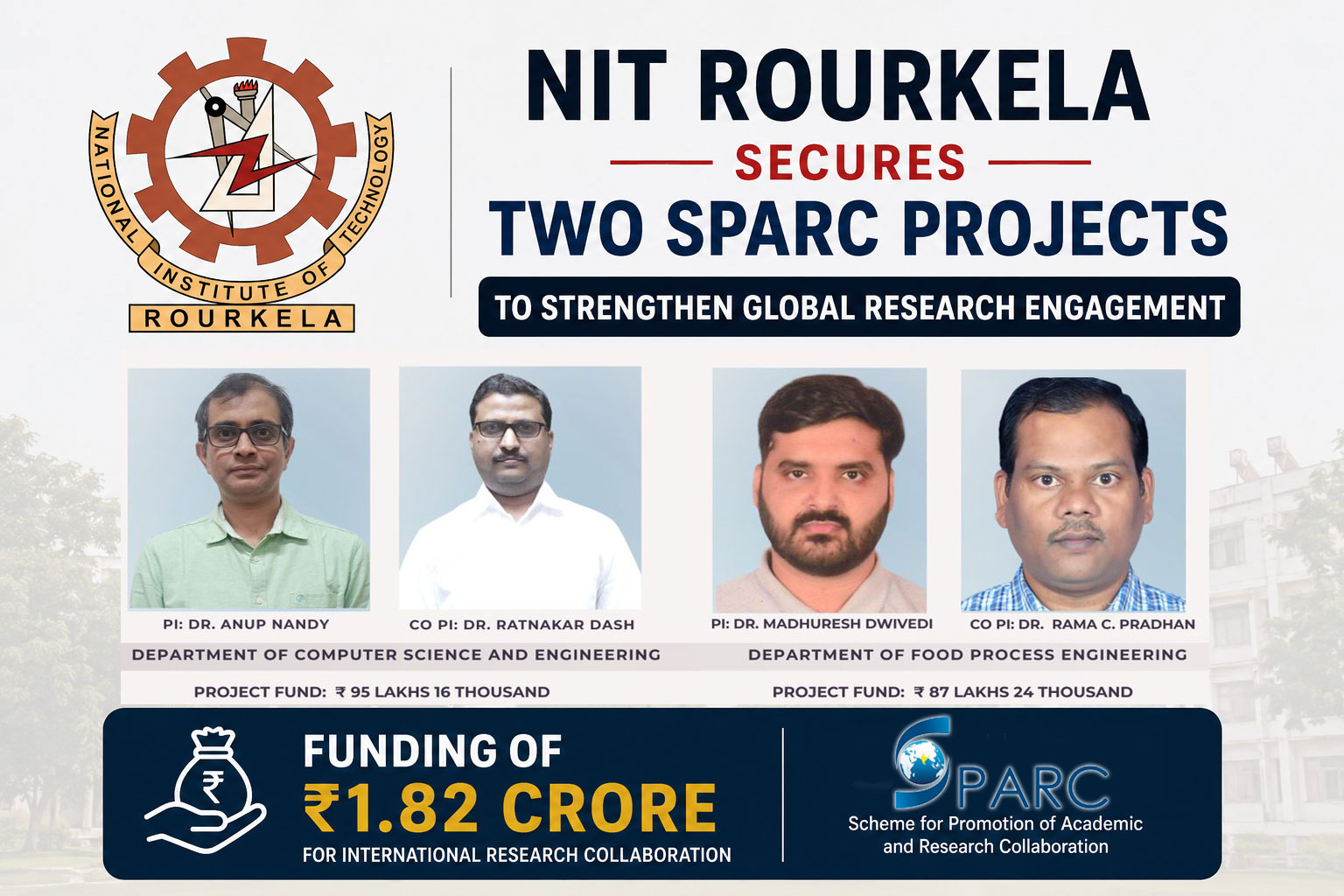
NIT-Rourkela secured two SPARC projects totaling ₹1.82 crore for global research collaboration with University of Nebraska and UBC Canada on exoskeletons and agri-food technology.
NIT-Rourkela Secures Two SPARC Research Projects
The National Institute of Technology-Rourkela has secured two research projects under the Scheme for Promotion of Academic and Research Collaboration (SPARC) of the Union Ministry of Education. A total of Rs 1.82 crore has been sanctioned for the projects, each of which has a two-year duration. With this achievement, NIT-R will be able to cement high-impact global research engagement.
SPARC is a national initiative aimed at strengthening India’s research ecosystem by promoting structured collaboration between higher education institutions of the country and leading global universities. It also enables joint research, academic exchange, and research capacity building in identified priority areas. The scheme facilitates knowledge transfer, technology development, and skill enhancement through international partnerships.
First Project Develops Smart Exoskeletons for Rural Healthcare
The first project ‘Smart Exoskeletons in Healthcare: Principle and Practices for Developing Scalable Exosuits for Rural Applications’ has a sanctioned value of Rs 95.16 lakh. Associate professor in the Department of Computer Science and Engineering Anup Nandy serves as principal investigator (PI), and associate professor Ratnakar Dash is the co-PI. The project is being implemented in collaboration with the University of Nebraska at Omaha, USA, with Prof Mukul Mukherjee as foreign PI and Prof Philippe Malcolm as the co-PI.
This project also focuses on developing wearable robotic devices known as exoskeletons, which assist individuals in regaining or improving mobility after illness or injury. Researchers from both sides will design affordable, scalable, and easy-to-use exosuits tailored for elderly individuals and post-stroke patients, particularly in local clinical and rural healthcare contexts. The wearable systems aim to support lower-limb movement and use smart sensors and artificial intelligence to analyze patient motion and assist in correcting movement patterns during rehabilitation.
Exoskeleton Partnership Includes Student and Researcher Exchanges
This institutional partnership involves joint coursework, hands-on design and prototyping workshops, and student and researcher exchanges. Students from NIT-Rourkela will work alongside University of Nebraska students on exoskeleton design projects, gaining exposure to international research methodologies and collaborative problem-solving approaches. The workshops also provide practical training in robotics, sensor integration, and AI algorithms for motion analysis.
Researchers will share expertise in biomechanics, control systems, and medical applications. The collaboration will produce prototype exosuits that undergo clinical testing in both Indian and American healthcare settings. Results will inform design improvements and validate the technology’s effectiveness across diverse patient populations and healthcare environments.
Second Project Creates Smart Sensing Technology for Agri-Food Systems
The second project ‘Novel Disruptive Technology: Design and Development of Smart and Sustainable Technology for Agri-Food Systems’ has a sanctioned value of Rs 87.24 lakh. Associate professor in the Department of Food Process Engineering Madhuresh Dwivedi serves as PI, and Prof Rama Chandra Pradhan is the co-PI. Anubhav Pratap Singh from the University of British Columbia (UBC), Vancouver, Canada is the foreign PI. The co-PI is Anika Singh, affiliated with UBC, Canada, and the British Columbia Institute of Technology, Burnaby.
This project aims to develop a simple, rapid, and non-destructive technology for assessing the quality and safety of agri-food products without cutting, cooking, or chemically testing them. Scientists from NIT-R will collaborate with foreign researchers to create a smart sensing system that uses mild electrical signals to evaluate food quality, similar in principle to a medical scan but applied to food products.
Food Sensing Technology Enables Field-Deployable Quality Assessment
The envisaged technology is expected to make food testing quicker, more reliable, and field-deployable. It seeks to help improve food safety, reduce wastage, and support farmers, food processors, and consumers, particularly in resource-limited environments. The system will enable rapid quality assessment at farm level, during storage, at transportation checkpoints, and at retail locations without requiring laboratory infrastructure.
Traditional food testing methods involve destructive sampling, chemical analysis, and laboratory equipment, making them slow, expensive, and impractical for field use. The new smart sensing technology addresses these limitations by providing instant results using portable devices that operate without specialized infrastructure. This capability also transforms food quality assurance from a centralized laboratory function to a distributed, real-time monitoring system.
SPARC Collaboration Strengthens Research Capacity
Both projects demonstrate how SPARC enables NIT-Rourkela to build research capacity through international partnerships. The exoskeleton project develops expertise in robotics, AI, and biomedical engineering while the agri-food project advances knowledge in food sensing, electrical signal processing, and quality assurance technologies. These capabilities position NIT-Rourkela as a contributor to global research in healthcare technology and food safety.
The collaborations bring international best practices, advanced methodologies, and cutting-edge equipment access to NIT-Rourkela researchers. Faculty members gain exposure to different research cultures and approaches, enhancing their individual capabilities and institutional knowledge. Students benefit from international mentorship, collaborative projects, and potential opportunities for foreign research experiences.
Projects Address Critical Societal Challenges
Both projects address critical societal challenges: healthcare accessibility for elderly and disabled populations in rural areas, and food safety assurance for farmers and consumers in resource-limited environments. The exoskeleton project also aims to provide affordable mobility assistance to post-stroke patients who cannot access expensive rehabilitation equipment. The agri-food project seeks to reduce food wastage and improve safety through rapid, accessible quality testing.
These research outcomes will also have direct impact on society by improving health outcomes, reducing economic losses from food spoilage, and enhancing food security. The technologies developed through these projects will be scalable and adaptable to various contexts, ensuring broad applicability beyond the initial research settings.
NIT-Rourkela’s two SPARC projects establish robust global research partnerships that advance technological innovation in healthcare robotics and food safety while building institutional capacity for international collaboration and contributing to societal welfare through practical technology solutions.
#NITRourkela #SPARC #GlobalResearch #Exoskeletons #AgriFoodTechnology #InternationalCollaboration #HealthcareTech #FoodSafety #ResearchFunding #UniversityPartnership
Disclaimer
The information in this article is based on available public sources and official statements as of the time of publication. While we aim for accuracy, we do not guarantee completeness or correctness. We advise readers to verify key details from official sources before making any decisions. The website (iitiimsamvaad.com) is not liable for any loss or damage arising from the use of this content. The authors are also not responsible for any such loss or damage.