
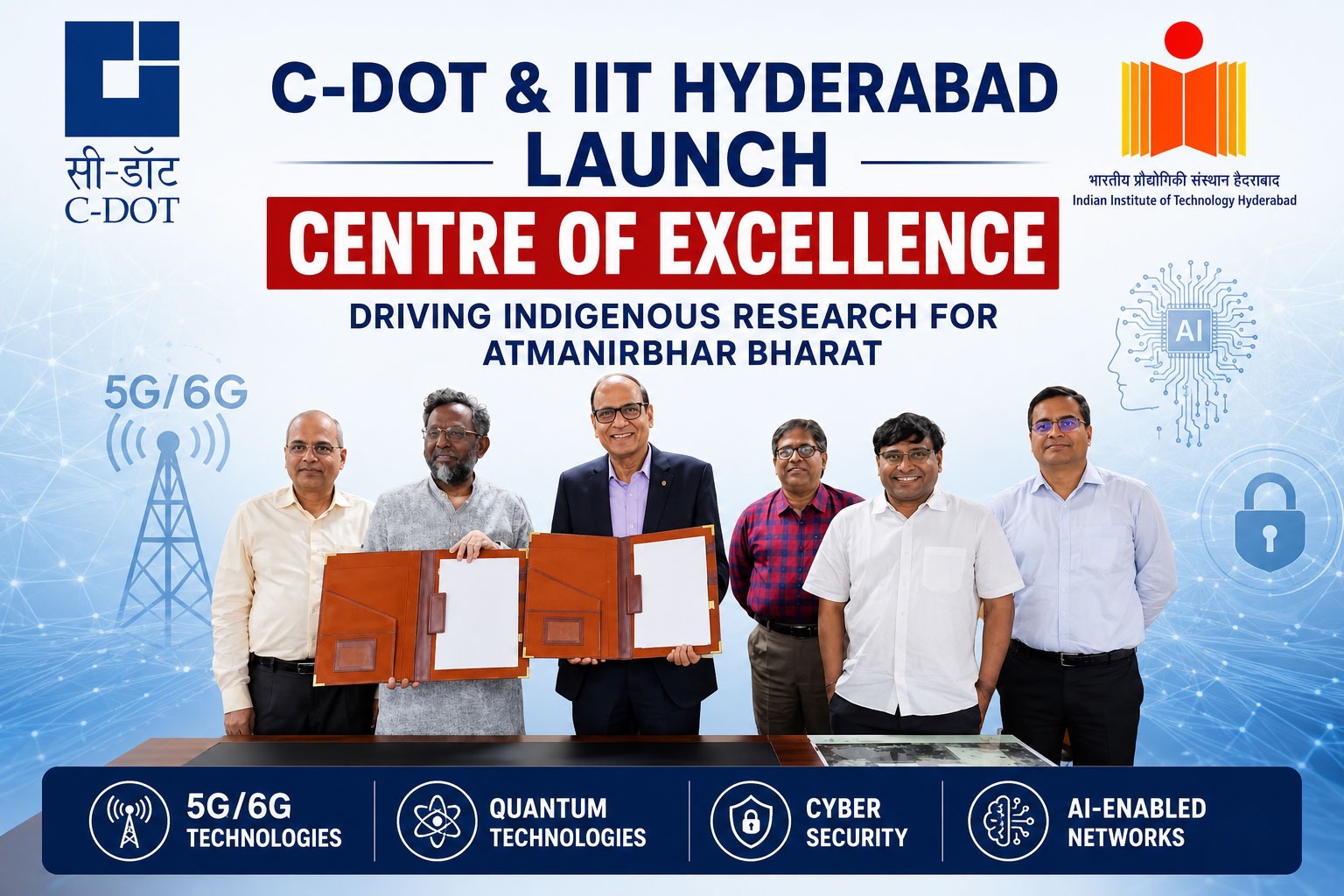
C-DOT and IIT Hyderabad launch a Centre of Excellence to drive indigenous research in 5G/6G, quantum, cybersecurity and AI-enabled networks for Atmanirbhar Bharat.
A strategic partnership
C-DOT (Centre for Development of Telematics) and IIT Hyderabad have signed an MoU to establish a Centre of Excellence (CoE) on the IIT-H campus. The collaboration brings India’s premier telecom R&D body and a top engineering institute together to accelerate research, prototype development, and talent creation in communication technologies. By situating the CoE within IIT Hyderabad, the partners also aim to fuse academic rigour with applied engineering to deliver market-ready solutions.
Expanding a national network of excellence
This new CoE marks C-DOT’s fourth such collaboration following centres at IIT Kanpur, IIT Gandhinagar, and IIT Roorkee. C-DOT now builds a geographic and intellectual network across India that connects academic researchers, industry practitioners, and government R&D. The distributed CoE model also enables shared platforms, cross-institutional projects, and faster translation of lab innovations into deployable telecom products.
Focused research domains
The CoE will target high-impact research areas that shape next-generation communications. Key focus areas include:
- Wireless communication and next-generation networks, to design protocols and hardware beyond present 5G capabilities.
- Quantum technology, to exploit quantum effects for ultra-secure communications and novel network primitives.
- Cybersecurity, to develop resilient defenses for national telecom infrastructure against evolving threats.
- AI-driven applications, to embed intelligence for traffic management, predictive maintenance, and autonomous network optimisation.
Pushing toward 5G, 6G and beyond
Researchers at the CoE will work on foundational and applied problems needed for 6G-era networks. Teams will develop new spectrum-sharing strategies, low-latency protocols, and hardware-software co-designs that meet stringent performance goals. The centre will also pursue Massive MIMO research to enable ultra-high capacity base stations and reduce inter-user interference, an essential element for dense urban deployments.
Integrating sensing and communications
The CoE will explore integrated sensing and communications systems that allow network elements to both communicate and sense the environment. Such dual-use architectures unlock use cases in autonomous vehicles, smart cities, and industrial automation. By co-designing sensing algorithms with communication stacks, researchers also plan to deliver multifunctional network nodes that increase spectral efficiency and situational awareness.
Building AI-enabled, self-healing networks
The centre will prioritise AI-enabled networks able to self-configure, self-heal, and dynamically manage energy. Machine learning models will also run at the edge and in the cloud to predict faults, allocate resources, and adapt routing in real time. These capabilities will improve user experience while lowering operational expenditure for service providers.
Securing a post-quantum future
Recognising the risk that quantum computing poses to classical cryptography, the CoE will work on quantum-safe encryption standards and hardware implementations. Teams will also design and test post-quantum algorithms, and investigate quantum key distribution and other quantum-native techniques to future-proof critical communications infrastructure.
Bridging academia and industry
The CoE will create a direct pipeline from academic research to commercial products. IIT Hyderabad will supply faculty expertise, doctoral and postdoctoral talent, and state-of-the-art lab facilities. C-DOT will also contribute systems-level experience in building indigenous telecom products, access to field trials, and avenues for commercialisation. This blend will also shorten the time between prototype and deployment and help startups and small firms take research outputs to market.
Nurturing talent and startups
The centre will function as a launchpad for students, researchers, and deep-tech startups. It will offer internships, collaborative projects, and incubation support to convert academic ideas into companies and products. By providing mentorship, testing infrastructure, and funding pathways, the CoE will also strengthen India’s domestic innovation ecosystem and reduce reliance on foreign IP.
Advancing Atmanirbhar Bharat in telecom
The partnership reflects India’s strategic push toward technological self-reliance. By investing in indigenous research in communication technologies, the CoE supports Atmanirbhar Bharat objectives – creating homegrown solutions, building skilled human capital, and retaining intellectual property within the country. Over time, successful outcomes could also position India as a global contributor to 6G standards, secure network architectures, and AI-driven telecom solutions.
A long-term vision
C-DOT and IIT Hyderabad designed the CoE with a long-term horizon: produce publishable science, develop demonstrable prototypes, and create commercial impact. The centre’s success will depend on sustained funding, industry collaboration, and clear translational pathways. If executed well, the CoE can become a national hub that trains engineers, spawns startups, and shapes the future of secure, intelligent communications built in India.
#Cdot #IITHyderabad #TelecomResearch #6G #QuantumCommunications #Cybersecurity #AIDrivenNetworks #AtmanirbharBharat #MassiveMIMO #TechInnovation
Disclaimer
The information in this article is based on available public sources and official statements as of the time of publication. While we aim for accuracy, we do not guarantee completeness or correctness. We advise readers to verify key details from official sources before making any decisions. The website (iitiimsamvaad.com) is not liable for any loss or damage arising from the use of this content. The authors are also not responsible for any such loss or damage.