

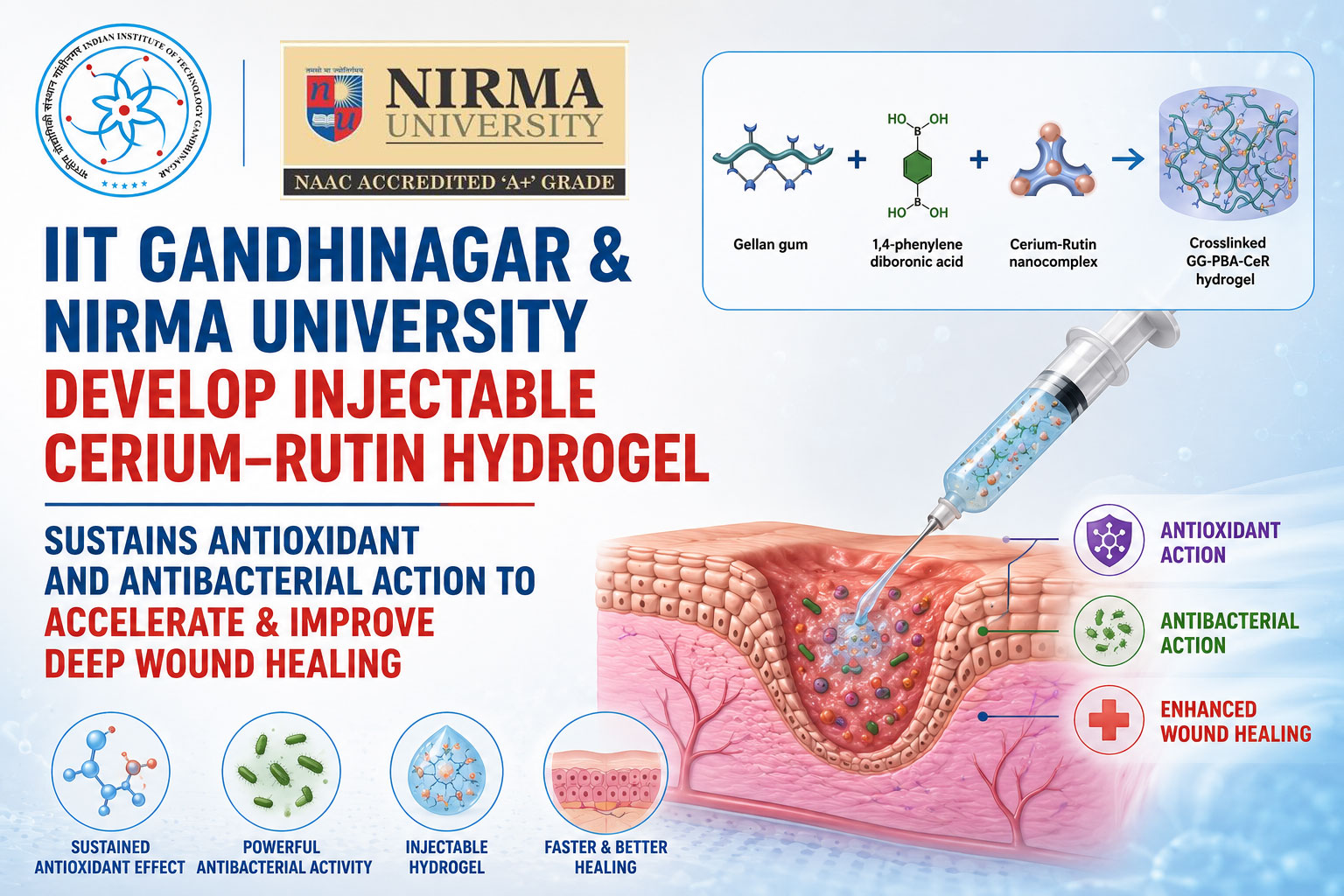
IIT Gandhinagar and Nirma University develop an injectable cerium–rutin hydrogel that sustains antioxidant and antibacterial action to accelerate and improve deep wound healing.
Introduction
Researchers at the Indian Institute of Technology Gandhinagar (IITGN), in collaboration with Nirma University, have developed an antibiotic-free, multifunctional injectable hydrogel that accelerates healing of deep wounds. The new material integrates a first-of-its-kind cerium–rutin nanocomplex into a metal–phenolic network (MPN) to provide sustained antioxidant and antibacterial activity while managing wound exudate. Early laboratory and preclinical results show improved tissue repair, biocompatibility, and controlled release of therapeutic components.
Design principle and materials
The hydrogel relies on an MPN platform, formed by interactions between metal ions and plant-derived polyphenols, which offers stability and modular functionality. The team engineered a cerium–rutin nanocomplex as the key therapeutic unit. Cerium ions mimic endogenous antioxidant enzymes and scavenge reactive oxygen species (ROS), while rutin, a natural flavonoid, contributes antioxidant, antibacterial, and anti-inflammatory effects. Together, the two components also act synergistically to neutralize oxidative stress and limit bacterial growth – two major obstacles in deep wound healing.
How it works
Once injected into a wound, the hydrogel swells and forms a conforming matrix that absorbs exudate and maintains a moist, controlled microenvironment conducive to repair. The MPN structure enables sustained release of the cerium–rutin nanocomplex, providing continuous antioxidant and antibacterial effects rather than a short-lived burst. By lowering ROS levels and suppressing infection risk concurrently, the hydrogel addresses multiple biological barriers that typically delay tissue regeneration.
Laboratory characterisation
The researchers conducted extensive in vitro characterisation to assess physicochemical and functional properties. They measured swelling capacity, release kinetics, and antioxidant/antibacterial activity, and evaluated compatibility with blood and surrounding tissues. The hydrogel demonstrated high swelling capacity – absorbing up to ten times its weight – while retaining structural integrity. Release studies also showed controlled, prolonged delivery of the nanocomplex, matching the design goal of sustained therapeutic action.
Preclinical evaluation
In animal models, the hydrogel accelerated wound closure relative to untreated controls. Histological analyses revealed enhanced granulation tissue formation and reduced markers of oxidative damage and inflammation. The material exhibited hemocompatibility and did not provoke adverse tissue reactions, meeting critical safety criteria for wound-care biomaterials. These preclinical outcomes also supported the authors’ claim that an integrated, multifunctional design can outperform single-function dressings in complex wounds.
Clinical promise and next steps
The team led by Prof Mukesh Dhanka at IITGN emphasised that modern wound care must go beyond passive coverage and deliver active, coordinated therapy. While these results are encouraging, the authors acknowledge that further work is necessary before human application. The researchers plan larger-animal studies, clinical translation efforts, and commercial partnerships. They have also pursued patent protection and are seeking industry collaborators for scale-up, regulatory testing, and technology licensing.
Significance and potential impact
This hydrogel offers a promising antibiotic-free strategy to manage deep and difficult-to-heal wounds by combining ROS scavenging, antibacterial action, and exudate management in a single injectable platform. The cerium–rutin nanocomplex is the first reported pairing of its kind for wound repair, highlighting how rational material design can integrate multiple therapeutic mechanisms. If validated in clinical trials, the technology could reduce infection-related complications, shorten recovery times, and lower reliance on systemic antibiotics – an important advantage amid growing antimicrobial resistance concerns.
Team and collaboration
The multidisciplinary project brought together expertise from IITGN and Nirma University. The IITGN team includes Prof Mukesh Dhanka, first author Shreyash Apotikar (MTech), Aniruddha Dan, Sebika Panja, Rishi Suri, Deepa Garg, Hitasha Vithalani, and Efftesum Rahaman. Collaborators from Nirma University include Prof Sriram Seshadri, Aneri Joshi, and Devanshi Gajjar. The paper, titled “Nanocomplex-Integrated Multifunctional Hydrogel for Fast-Tracked Wound Repair Application: A Preclinical Evaluation,” appears in ACS Applied Bio Materials.
Conclusion
By addressing multiple hurdles – oxidative stress, bacterial contamination, and fluid management – within a single injectable hydrogel, the IITGN–Nirma team has advanced a compelling candidate for next-generation wound therapy. Continued preclinical work and industry partnerships will determine whether the cerium–rutin MPN platform can move into larger-animal tests and eventual clinical use, potentially transforming care for complex wounds in human and veterinary medicine.
#Hydrogel #WoundHealing #CeriumRutin #MetalPhenolicNetwork #AntioxidantTherapy #Antibacterial #Biomaterials #IITGandhinagar #NirmaUniversity #RegenerativeMedicine
Disclaimer
The information in this article is based on available public sources and official statements as of the time of publication. While we aim for accuracy, we do not guarantee completeness or correctness. We advise readers to verify key details from official sources before making any decisions. The website (iitiimsamvaad.com) is not liable for any loss or damage arising from the use of this content. The authors are also not responsible for any such loss or damage.