

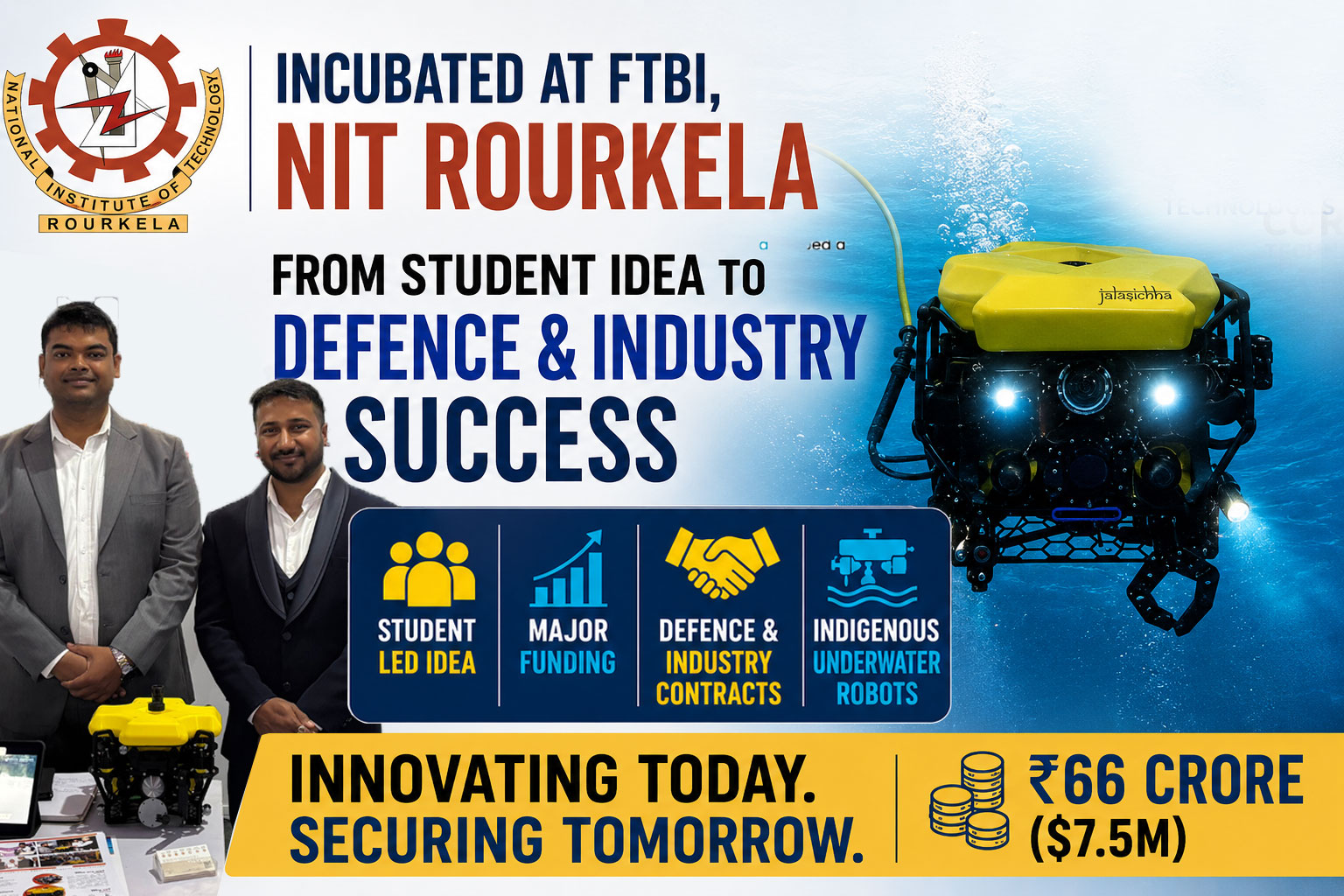
Incubated at FTBI, NIT Rourkela, Coratia Technologies grew from a student-led idea into a defence and industry success with major funding, contracts and indigenous underwater robots.
From idea to impact
Coratia Technologies has emerged as one of the most striking deep-tech success stories from the incubation ecosystem at the Foundation for Technology & Business Incubation (FTBI), NIT Rourkela. Founded in 2021 by NIT Rourkela alumni Debendra Pradhan and Biswajit Swain, the startup began with a focused mission: to develop indigenous underwater robotic systems for India. What started as an idea in an incubation environment has now grown into a company with national relevance, defence applications and strong industrial adoption.
The journey of Coratia Technologies reflects how a well-designed incubation ecosystem can shape a research-backed idea into a commercially viable and strategically important technology venture. With consistent support from FTBI and partner institutions, the startup has moved from early-stage development to large-scale deployment.
Building indigenous underwater systems
At the heart of Coratia’s work lies a pressing national need. India has long depended on imported or externally sourced underwater robotic systems for inspection, surveillance and industrial operations. Coratia stepped in to address that gap by designing indigenous underwater remotely operated vehicles, or ROVs, tailored to Indian requirements.
The company developed two flagship platforms, JALASIMHA and JALADUTA, both of which represent an important step in India’s underwater robotics capability. These systems can support a wide range of operations, including defence tasks, infrastructure inspection and industrial monitoring. By creating these platforms within India, Coratia has strengthened the country’s effort to build strategic technologies at home rather than depend on foreign supply chains.
Major milestones achieved
Coratia Technologies has crossed several major milestones in a short span of time. The startup secured a ₹66 crore contract from the Indian Navy, demonstrating both technical confidence and operational value at the highest level of national defence. It also raised ₹17.4 crore in Pre-Series A funding, which signals strong investor trust in its technology and business potential.
Beyond funding and contracts, the startup has successfully deployed its solutions with the Indian Navy, SAIL, Indian Oil, Indian Railways and Tata Steel. That broad deployment base shows that the technology is not limited to defence use alone. It also has relevance in heavy industry, energy, transport and critical infrastructure, where underwater inspection and robotic support can improve safety, reduce downtime and enhance efficiency.
FTBI’s role in the journey
FTBI, NIT Rourkela, played a central role in helping Coratia move from concept to market-ready innovation. The incubation centre supported the startup through multiple programmes and stages of growth, including the DST NIDHI Entrepreneur-in-Residence programme, the DST NIDHI PRAYAS grant, the MeitY Entrepreneur-in-Residence programme, the Grant Scale-Up Programme and Startup India initiatives.
This support extended well beyond funding. FTBI also provided mentorship, incubation infrastructure, industry connections, investor networking, laboratory access and business development support. That combination of technical guidance and entrepreneurial backing often determines whether a deep-tech startup survives the difficult early years. In Coratia’s case, it clearly helped convert engineering expertise into a scalable venture.
Ecosystem support and collaboration
Coratia’s success also highlights the power of a wider innovation ecosystem. The startup benefited from the support of the Department of Science & Technology, the Ministry of Electronics and Information Technology, Startup India, Mahanadi Coalfields Limited, the Government of Odisha, NIT Rourkela and other stakeholders committed to strengthening India’s innovation landscape.
Such collaboration matters because deep-tech ventures usually face long development cycles, high testing costs and complex market-entry barriers. They need patient capital, access to facilities and institutional confidence before they can succeed. Coratia’s path shows how coordinated support across government, academia and industry can help a startup overcome those barriers and deliver national value.
Defence and Atmanirbhar Bharat
Coratia Technologies also carries strategic significance for India’s broader self-reliance goals. Its underwater robotic systems contribute to defence preparedness, industrial resilience and technological sovereignty. In sectors where precision, reliability and security matter, indigenous solutions offer a major advantage.
The company’s rise fits well with the vision of Atmanirbhar Bharat. It shows that Indian startups can build advanced systems for difficult engineering environments when they receive the right backing. More importantly, it demonstrates that innovation developed in a university incubation centre can move beyond campus walls and make a measurable impact on national capability.
A model for startup growth
The Coratia story offers a strong model for other student-led and research-led startups. It shows that technical skill alone is not enough; startups also need structured support, ecosystem trust and a clear pathway from prototype to deployment. FTBI, NIT Rourkela helped provide that pathway by combining incubation, mentorship and access to opportunity.
As Coratia Technologies continues to grow, its journey will likely inspire more deep-tech entrepreneurs from Indian campuses. It stands as proof that the right mix of talent, institutional support and strategic vision can create startups that serve both markets and national priorities.
Looking ahead
Coratia Technologies is still building, but its trajectory already reflects a rare combination of innovation, execution and impact. From a campus-incubated idea in 2021 to contracts, funding and deployment across defence and industry, the startup has moved quickly and confidently.
FTBI, NIT Rourkela can rightly point to Coratia as a flagship example of what sustained incubation can achieve. The story shows that when universities, government programmes and industry partners work together, they can help create technologies that strengthen India’s innovation ecosystem and its strategic independence.
#CoratiaTechnologies #FtbINITRourkela #DeepTechStartup #UnderwaterRobotics #IndigenousTechnology #IndianNavy #AtmanirbharBharat #StartupIndia #DefenceInnovation #NITRourkela
Disclaimer
The information in this article is based on available public sources and official statements as of the time of publication. While we aim for accuracy, we do not guarantee completeness or correctness. We advise readers to verify key details from official sources before making any decisions. The website (iitiimsamvaad.com) is not liable for any loss or damage arising from the use of this content. The authors are also not responsible for any such loss or damage.