

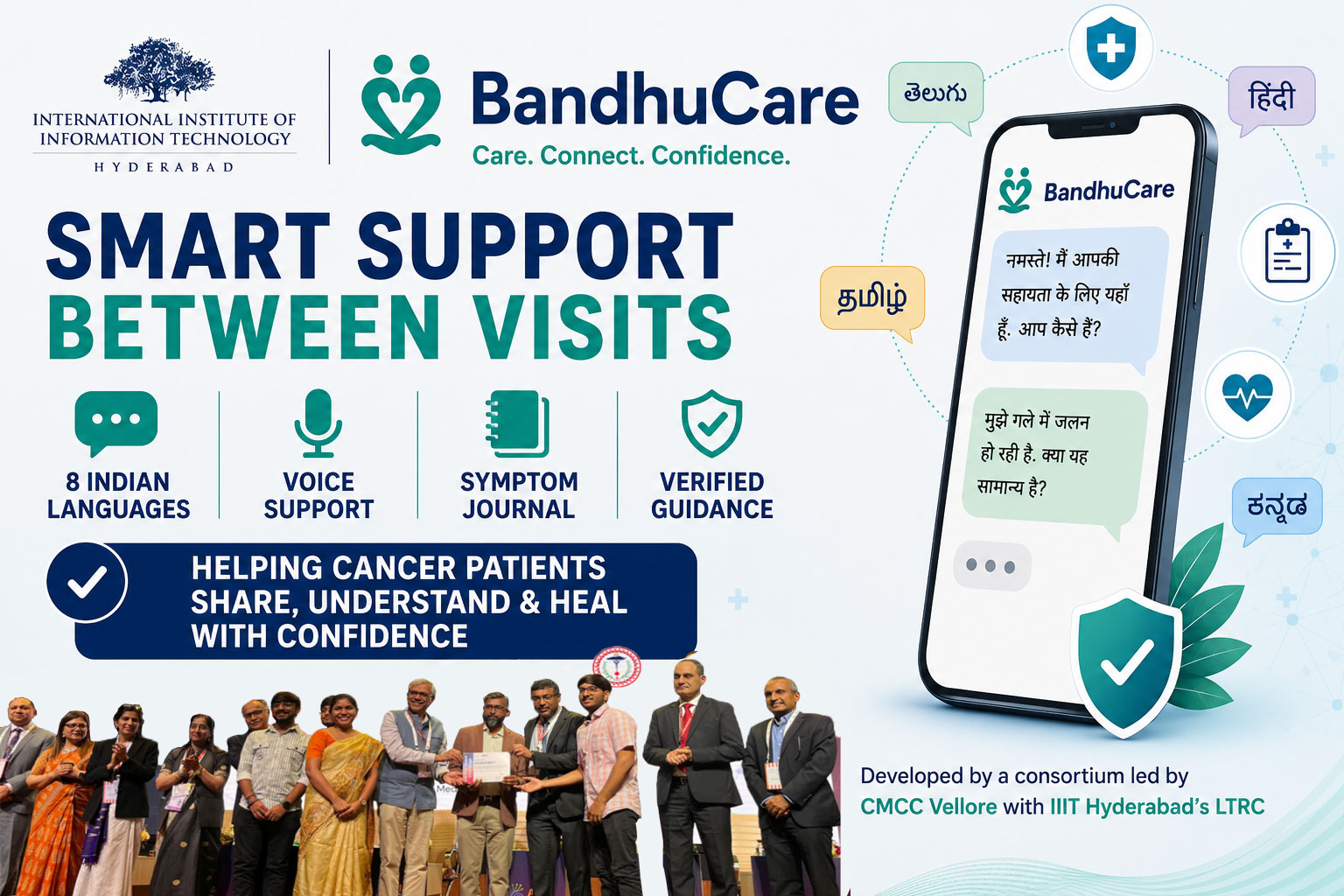
BandhuCare uses eight Indian languages, voice support and a symptom journal to help cancer patients share concerns and receive verified guidance between hospital visits.
Bridging the care gap
Cancer treatment does not end when a patient leaves the clinic. Many questions arise at home, and many symptoms develop between visits, often without a clear record for doctors to review. A new multilingual AI platform called BandhuCare, developed by Christian Medical College (CMC), Vellore, and IIIT Hyderabad, aims to close that information gap by helping patients communicate routine concerns in their own languages and by turning those conversations into useful clinical summaries.
How BandhuCare works
BandhuCare allows patients to speak or type naturally about symptoms such as pain, swallowing difficulty, or dry mouth. The system does not simply store free-flowing conversation; it converts patient input into structured medical information that doctors can review before the next appointment. This design helps clinicians understand what happened between visits instead of depending only on patient memory during a rushed consultation.
The platform also includes a symptom journal. Patients can log daily experiences, which gives doctors a clearer picture of symptom progression, treatment effects, and day-to-day challenges. That feature becomes especially important in cancer care, where small changes in discomfort, appetite, speech, or swallowing can signal larger clinical issues.
Language support for patients
One of the platform’s most important features is language accessibility. BandhuCare currently supports eight Indian languages through text and voice, using language technologies developed at IIIT Hyderabad. This matters because many patients struggle to explain symptoms in English or in a formal medical setting, even when they understand their condition well in their mother tongue.
By allowing patients to use natural speech, the system lowers the barrier between clinical expertise and lived experience. It also reduces the pressure on families to translate complex symptoms or medical questions informally. In a country with deep linguistic diversity, that kind of access can make hospital communication more inclusive and more accurate.
Verified medical guidance
The developers have kept the system tightly controlled. BandhuCare does not diagnose disease or suggest treatment plans. Instead, it answers routine questions, explains commonly experienced symptoms, and guides patients back to their healthcare team whenever a clinical issue needs attention.
Prof. Dipti Misra Sharma of IIIT Hyderabad’s Language Technologies Research Centre said the platform is not built to replace doctors but to support patients with routine information and timely redirection. Dr Hannah Mary Thomas, scientist and lead of the Quantitative Imaging Research and AI Lab at CMC, said the system uses only hospital-approved medical information. She explained that another AI layer checks whether each response truly comes from the approved knowledge base before it reaches the patient.
That safeguard is critical in healthcare. General-purpose chatbots may sound confident even when they are wrong, but BandhuCare tries to stay within a verified medical boundary. This approach reduces the risk of misinformation while still giving patients fast access to trustworthy answers.
Why patients need it
Cancer patients often leave consultations with unresolved doubts. Some forget to ask important questions, while others realize later that new symptoms need attention. Dr Balu Krishna, professor and head of radiation oncology at CMC, pointed out that language barriers can further limit access to reliable information.
BandhuCare is designed to make technology adapt to patients rather than force patients to adapt to technology. That is a meaningful shift in digital health design. Instead of asking patients to master medical terminology or navigate English-only interfaces, the platform meets them where they are, using familiar language and conversational interaction.
Clinical value for doctors
For clinicians, the platform offers more than convenience. A structured symptom journal and organized patient inputs can improve follow-up care, especially when patients report changes that occurred days earlier. Doctors can see patterns more clearly, compare symptoms across visits, and intervene earlier when needed.
That can be especially useful in oncology, where treatment side effects may evolve gradually and where communication gaps can delay supportive care. By creating a digital record of the patient’s everyday experience, BandhuCare helps preserve information that might otherwise be lost. It also gives doctors a more complete basis for making informed decisions during the next consultation.
A model for inclusive AI
BandhuCare represents a practical application of AI in healthcare rather than a flashy experiment. It uses language technology, verified medical content, and structured symptom tracking to support one of the most difficult parts of cancer care: communication. The project shows how AI can improve access when it respects clinical safeguards and linguistic diversity.
Its broader significance extends beyond oncology. Similar systems could eventually support other chronic diseases where patients need repeated guidance, multilingual access, and better continuity between hospital visits. In that sense, BandhuCare points toward a future in which AI strengthens care by improving understanding, not by replacing human judgment.
#BandhuCare #IIITHyderabad #CMCVellore #CancerCare #MultilingualAI #DigitalHealth #PatientSupport #HealthTech #IndianLanguages #ClinicalCommunication
Disclaimer
The information in this article is based on available public sources and official statements as of the time of publication. While we aim for accuracy, we do not guarantee completeness or correctness. We advise readers to verify key details from official sources before making any decisions. The website (iitiimsamvaad.com) is not liable for any loss or damage arising from the use of this content. The authors are also not responsible for any such loss or damage.