

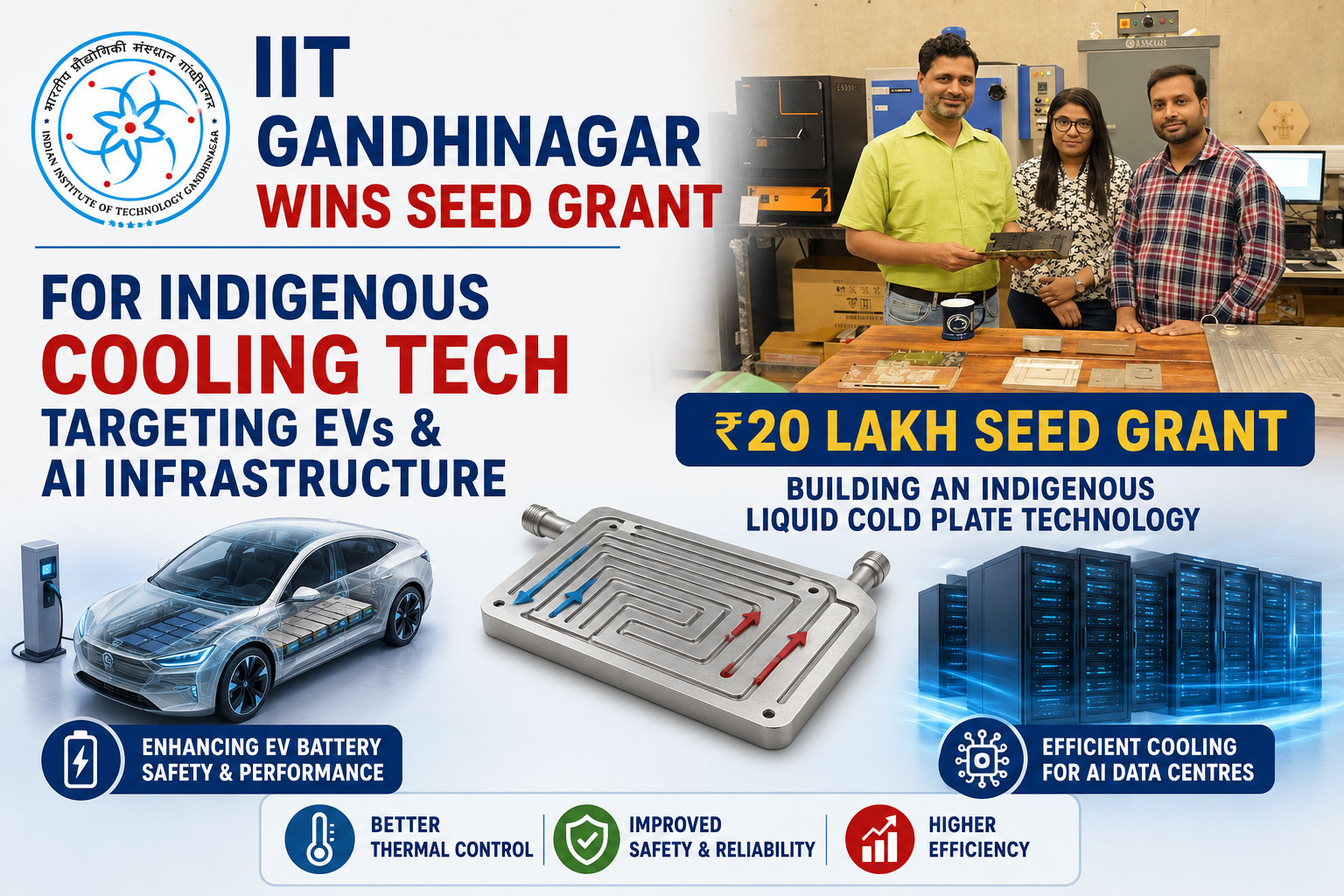
IIT Gandhinagar secures a ₹20 lakh seed grant for an indigenous liquid cold plate technology that could improve EV battery safety and cool AI data centres.
Indigenous cooling breakthrough
Researchers at the Indian Institute of Technology Gandhinagar (IIT-GN) have won a ₹20 lakh seed grant to develop an indigenous cooling technology that could serve electric vehicles, AI-driven data centres, railways, power electronics, defence, aerospace and other high-heat applications. The project, presented at MATRIx 2026, aims to reduce India’s dependence on imported thermal management systems while offering a scalable and affordable alternative.
Why cooling matters
The team designed the technology to tackle two urgent challenges: thermal management in fast-growing AI infrastructure and battery safety in electric vehicles. As data centres expand, cooling has become a primary constraint, while EV battery systems require reliable heat removal to avoid performance loss and safety risks. The researchers argue that advanced liquid cold plates can address both demands more efficiently than many existing solutions.
How the plate works
Liquid cold plates are metal components with internal channels that carry coolant to remove heat from electronic systems. IIT-GN’s innovation, called Advanced Chill Tech, uses a manufacturing method based on friction stir channeling, which forms integrated channels inside a single metal plate without melting the material. This solid-state approach avoids the multi-part assembly used in many conventional plates and aims to improve reliability, manufacturability and thermal performance.
Why it stands out
Most commercial liquid cold plates rely on vacuum brazing, a process that joins multiple metal parts at high temperatures. According to the team, brazing is capital-intensive, energy-intensive and prone to hidden defects or leaks. Amit Arora said brazing success rates are only about 40 to 60 per cent, and any leak in a cold plate creates an electrical and thermal hazard. The friction stir channeling route seeks to reduce those risks by creating the cooling paths within one continuous plate.
Prototype maturity
The researchers say the technology has reached Technology Readiness Level 7, with prototypes already validated in an operational environment. They also report that the largest prototype can withstand pressures above 35 bars and has passed fatigue and tensile testing. The team has filed an Indian patent application titled “A Friction Stir Channeled Cooling Plate” with industry partner Epsilon Engineering Pvt Ltd.
From lab to market
The project was led by Amit Arora, associate professor in IIT-GN’s Department of Materials Engineering, along with doctoral students Prachi Sharma and Rizwan Qureshi. The team has also published related work in the Journal of Materials Engineering and Performance, Machines and the Journal of Manufacturing Processes. Rizwan Qureshi said the seed grant will help bridge the gap between laboratory research and market deployment by supporting larger-scale testing, intellectual property development, product refinement and commercialisation.
Wider impact
If the technology scales successfully, it could strengthen India’s thermal-management ecosystem for EVs, AI systems and industrial electronics. It also aligns with the growing demand for domestic manufacturing in strategic sectors that need safe, efficient and durable cooling hardware. By combining patent-backed engineering with a solid-state manufacturing method, IIT-GN’s approach could help set a new benchmark for indigenous thermal solutions.
#IITGandhinagar #AdvancedChillTech #LiquidColdPlate #FrictionStirChanneling #EVBatterySafety #AICooling #DataCentreCooling #ThermalManagement #MatriX2026 #IndigenousTechnology
Disclaimer
The information in this article is based on available public sources and official statements as of the time of publication. While we aim for accuracy, we do not guarantee completeness or correctness. We advise readers to verify key details from official sources before making any decisions. The website (iitiimsamvaad.com) is not liable for any loss or damage arising from the use of this content. The authors are also not responsible for any such loss or damage.