

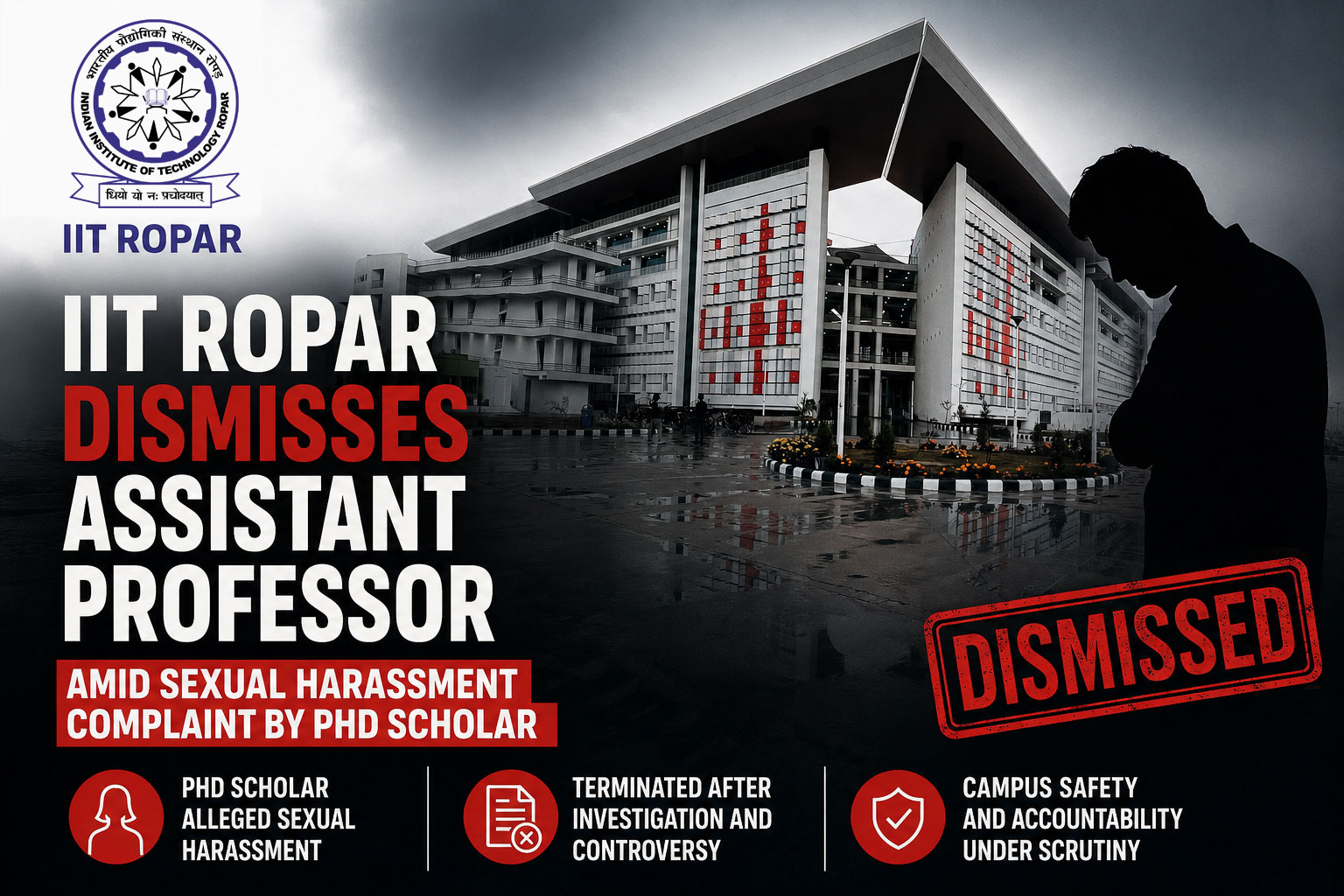
IIT Ropar has dismissed an assistant professor after a PhD student accused him of sexual harassment, prompting renewed scrutiny of campus safety and institutional accountability.
Termination after weeks of controversy
The Indian Institute of Technology (IIT) Ropar has dismissed an assistant professor following a sexual harassment complaint filed by a PhD scholar. The institute issued a termination notice citing unsatisfactory conduct during the probationary period and directed the faculty member to complete all due formalities within seven days. The decision ends a weeks-long controversy that drew sharp criticism from students, academics and the wider public.
The termination notice lists July 24, 2026 as the effective date of dismissal. It also instructs Dr Lakhan Bainsla, the accused faculty member, to complete all “No Dues” procedures within a week. Although the notice does not explicitly name the harassment case as the reason for termination, the action follows a high-profile investigation and mounting pressure over the institute’s handling of the matter.
Allegations that triggered the case
The case began early in 2026 when a female PhD candidate from the Physics Department reported serious misconduct by her academic supervisor. She alleged that the faculty member subjected her to mental torture, harassed her and misused his academic authority to manipulate her position. She also claimed that his actions damaged her academic progress and created an unsafe environment for her research work.
According to the student, the supervisor’s behaviour extended beyond normal academic guidance and crossed into personal and professional intimidation. She said she became dissatisfied with the institution’s initial response and decided to speak publicly about her experience. That decision brought the case into the open and intensified scrutiny of IIT Ropar’s internal processes.
Institutional response and investigation
After the complaint surfaced, the Internal Complaints Committee (ICC) of IIT Ropar initiated an investigation into the allegations. The institute placed the faculty member on enforced paid leave and barred him from entering the campus or participating in academic activities. The matter was also reported to the local police, signalling that the institute treated the complaint as a serious legal and administrative issue.
The ICC’s involvement marked a critical step in the process. The committee is responsible for examining complaints of sexual harassment and recommending appropriate action. Its investigation formed the basis for the institute’s subsequent decisions, including the termination of the faculty member.
Public criticism and pressure
The case sparked intense public debate about how higher education institutions protect students from harassment. Many in the academic community expressed concern over the student’s experience and questioned whether the system had done enough to support her. Critics argued that the complaint had taken too long to reach a decisive outcome and that the institute’s initial response appeared inadequate.
That criticism gained momentum as details of the case circulated on social media and academic forums. Some observers pointed out that PhD students often face structural vulnerability because their academic progress depends heavily on their supervisors. That dependence can make it harder for them to report misconduct or seek help without fear of retaliation.
High Court intervention and restoration of PhD seat
The Punjab and Haryana High Court intervened after the PhD scholar resigned under what she described as “compelling circumstances” linked to alleged harassment. Justice Kuldeep Tiwari held that her resignation was not voluntary and could be withdrawn. The court set aside IIT Ropar’s order dated November 22, 2025, which had accepted the resignation on the same day it was tendered, and directed the institute to allow the scholar to resume her PhD programme forthwith.
The court relied on a 2022 Supreme Court ruling on resignations by judicial officers and a 2025 Allahabad High Court judgment to hold that a resignation submitted under compulsion is not voluntary. It also directed the institute to sympathetically consider all circumstances and create an atmosphere that enables the scholar to resettle and complete her studies. At the same time, the bench made clear that if she breaches her undertaking not to file further complaints, the institute remains free to take disciplinary action.
Context of the resignation
The scholar had submitted her resignation after alleging that her complaint remained unaddressed and that she faced continued harassment and mental distress. Reports say she even sought medical attention at PGI due to the impact of the alleged conduct. The court noted that the resignation letter itself indicated that it arose from alleged mistreatment and was not a normal, voluntary exit. It also pulled up the institute’s lawyers for continuing to oppose her return even after she gave an affidavit promising to stop complaining.
Institutional accountability after the judgment
The High Court’s order places a clear responsibility on IIT Ropar to ensure that the scholar can continue her research without retaliation or obstruction. It also reinforces the principle that institutions must handle harassment complaints with fairness, sensitivity and speed. The termination of the assistant professor, combined with the court’s restoration of the scholar’s seat, marks a decisive phase in the case, though the ICC process and any police inquiry may still run their course.
The judgment will likely influence how other institutions deal with resignations filed amid harassment allegations. It signals that courts will scrutinise whether such exits are truly voluntary and whether institutions have upheld their duty of care. For IIT Ropar, the order now requires practical follow-through: smooth reintegration of the scholar, protection of her academic rights and a demonstrably safe environment for research.
Termination and its implications
The termination of Dr Bainsla marks a significant moment in the case. While the institute framed the dismissal in terms of unsatisfactory conduct during probation, the timing and context clearly link the decision to the harassment complaint. The institute now faces the task of ensuring that the PhD scholar receives full support as she continues her research and that the campus environment becomes safer for all students.
The case also raises broader questions about accountability in elite institutions. IITs occupy a central place in India’s higher education system, and their handling of harassment cases carries symbolic weight. A strong response can reinforce trust in the system, while a weak one can erode confidence among students and researchers.
Campus safety and institutional accountability
The IIT Ropar case has intensified calls for stronger safeguards against sexual harassment in academic institutions. It has renewed attention on the need for clear reporting mechanisms, timely investigations and meaningful consequences for offenders. It has also highlighted the importance of protecting complainants from academic or professional retaliation.
For IIT Ropar, the dismissal may serve as a turning point. The institute must now demonstrate that it can handle such cases with transparency, sensitivity and speed. That includes ensuring that the PhD scholar can pursue her work without further disruption and that other students feel confident that complaints will be taken seriously.
A test for the system
The termination does not end the conversation about campus safety. It opens a new phase in which the institute must show that its actions match its stated commitment to a safe and respectful workplace. The case will likely remain a reference point for future discussions on how Indian universities deal with sexual harassment and power imbalances in academia.
For the academic community, the incident underlines the need for robust institutional cultures that prioritise student welfare over reputation management. It also reminds universities that trust depends on how they respond when things go wrong, not just on how they present themselves when things go well.
IITRopar #SexualHarassment #PhDScholar #CampusSafety #ICC #AcademicMisconduct #HigherEducation #InstitutionalAccountability #StudentSafety #WorkplaceHarassment
Disclaimer
The information in this article is based on available public sources and official statements as of the time of publication. While we aim for accuracy, we do not guarantee completeness or correctness. We advise readers to verify key details from official sources before making any decisions. The website (iitiimsamvaad.com) is not liable for any loss or damage arising from the use of this content. The authors are also not responsible for any such loss or damage.