

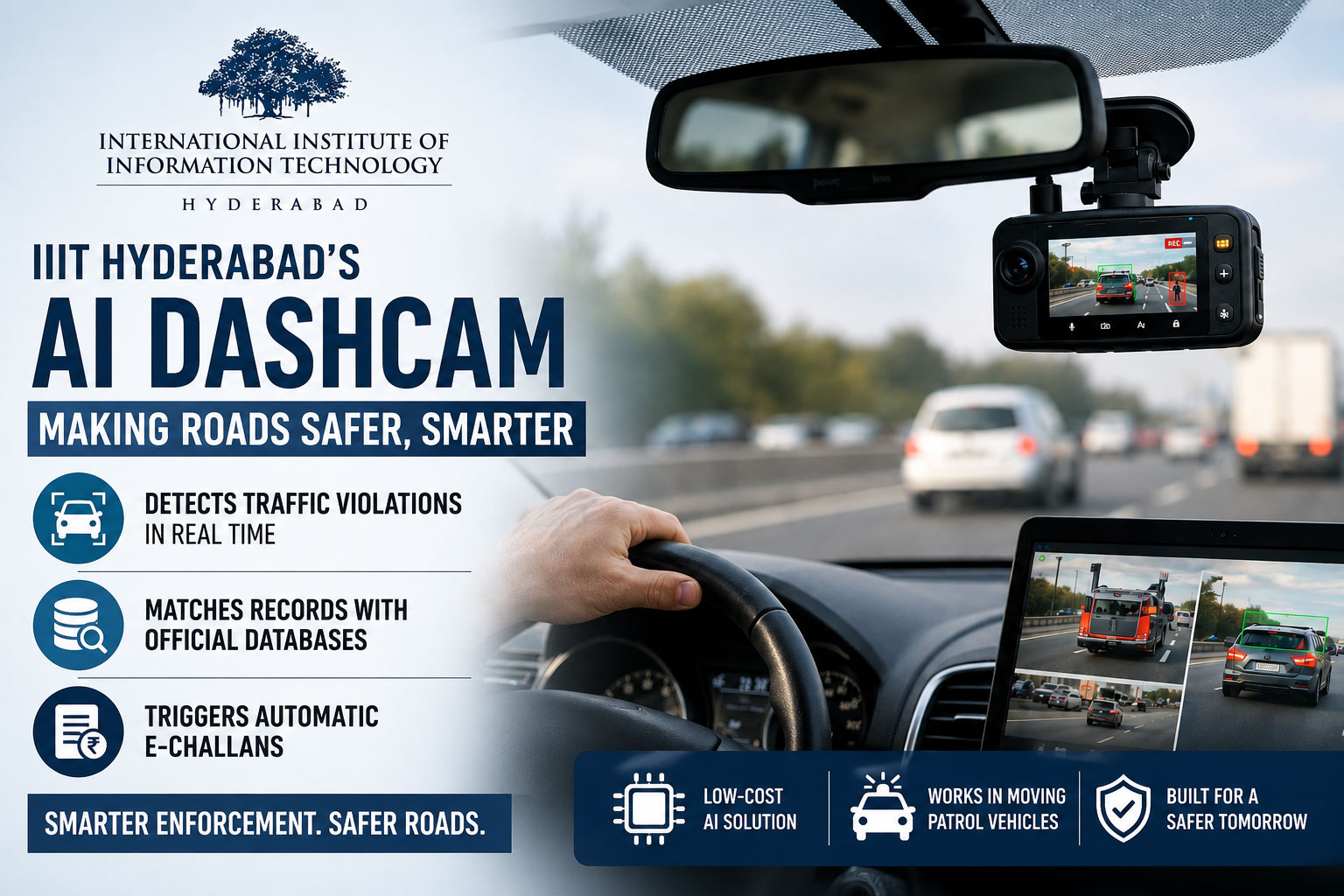
IIIT Hyderabad’s low-cost AI dashcam can detect traffic violations from moving patrol vehicles, match records with official databases and trigger automatic e-challans.
Smarter traffic enforcement
Researchers at IIIT Hyderabad have developed an AI-powered dashcam system that can detect traffic violations while patrol vehicles are on the move. The compact device aims to help police catch offenders in real time, even on roads without fixed surveillance cameras. By combining computer vision with automated database checks, the system could make traffic enforcement faster, broader and more consistent.
The new dashcam targets a familiar problem in Indian cities: many violations happen outside junctions covered by cameras. Riders without helmets, for example, often slip through gaps in enforcement once they move away from monitored intersections. IIIT Hyderabad’s system tries to close that gap by turning every patrol vehicle into a mobile enforcement platform.
How the system works
The dashcam sits on the windshield of a traffic police vehicle and scans nearby vehicles while the patrol car moves through city roads. It uses AI and specialised software to identify traffic offences and capture the registration numbers of violators. The system then compares those details with databases maintained by the Hyderabad Traffic Police and the Transport Department.
Once the software verifies a violation, it forwards the information to the traffic police e-challan system. That system generates the challan automatically and sends the fine details to the vehicle owner’s registered mobile number. This process reduces the need for manual paperwork and speeds up enforcement.
The project specifically highlights helmetless riding as one of the violations the system can detect. But its broader value lies in the fact that it works on the move, rather than relying only on fixed roadside cameras. That mobility gives police a better chance of spotting rule breakers across a wider area.
Pilot on patrol vehicles
To test the technology, IIIT Hyderabad researchers installed the dashcams on the windshields of four Innova patrol vehicles operating in four different traffic police station limits across Hyderabad. The pilot project ran for six months and reportedly produced encouraging results. That trial gave the team a chance to study how the system performed in real traffic conditions rather than in a controlled lab environment.
The pilot also helped the researchers refine the system based on feedback from the traffic police. That practical input matters because enforcement tools must work reliably in busy, unpredictable urban settings. A system that performs well in live traffic can offer far more value than one that only works in demonstration mode.
Low-cost design
One of the most notable features of the dashcam is its affordability. According to Prithvi Jonnada of the Applied AI Research Centre, each unit costs only Rs 8,000 to Rs 10,000 to manufacture. That low cost makes the technology far more accessible for large-scale deployment across police fleets.
Cost matters because traffic enforcement systems often fail to scale when they require expensive infrastructure. A low-cost mobile device gives police departments a more flexible option. Instead of depending only on fixed cameras at busy junctions, they can extend enforcement into neighbourhood roads, smaller streets and other locations where violations may otherwise go unchecked.
Two-wheeler camera pilots
The team did not stop with patrol cars. Based on police feedback, the researchers also fitted three AI cameras on two-wheelers as part of a separate pilot project. That adaptation suggests the system can operate in more than one type of enforcement vehicle.
Two-wheelers can reach narrow lanes or areas where larger patrol vehicles may not have easy access. That makes them useful in places where traffic movement is congested or where violations happen in less visible corners of the road network. By placing AI cameras on smaller vehicles, the project expands the reach of mobile enforcement even further.
Why it matters
If deployed widely, the AI dashcam could significantly strengthen traffic policing. It would allow authorities to identify violations in real time, issue challans more quickly and improve compliance with traffic rules. It could also reduce dependence on manual spotting, which is often inconsistent and limited by human attention.
The system may also improve road safety. Better enforcement can discourage risky behaviour such as riding without helmets, which remains a major cause of injury in road accidents. When offenders know they can be detected anywhere, not just at camera-equipped intersections, compliance tends to improve.
The project also reflects a broader trend in public safety technology. Cities increasingly need tools that are mobile, automated and affordable. IIIT Hyderabad’s dashcam fits that need by combining local deployment with AI-based detection and direct linkage to enforcement systems.
A practical AI application
Many AI projects aim to showcase technical sophistication. This one focuses on a practical civic problem and offers a straightforward solution. It does not ask police to overhaul the system; it gives them a small device that can improve the existing workflow.
That makes the project especially promising. It shows how AI can support public administration when researchers design it around real operational needs. With further deployment and refinement, the dashcam could become a useful addition to urban traffic enforcement across India.
#IIITHyderabad #AIDashcam #TrafficEnforcement #EChallan #RoadSafety #SmartPolicing #ComputerVision #HelmetViolation #TrafficPolice #UrbanMobility
Disclaimer
The information in this article is based on available public sources and official statements as of the time of publication. While we aim for accuracy, we do not guarantee completeness or correctness. We advise readers to verify key details from official sources before making any decisions. The website (iitiimsamvaad.com) is not liable for any loss or damage arising from the use of this content. The authors are also not responsible for any such loss or damage.