

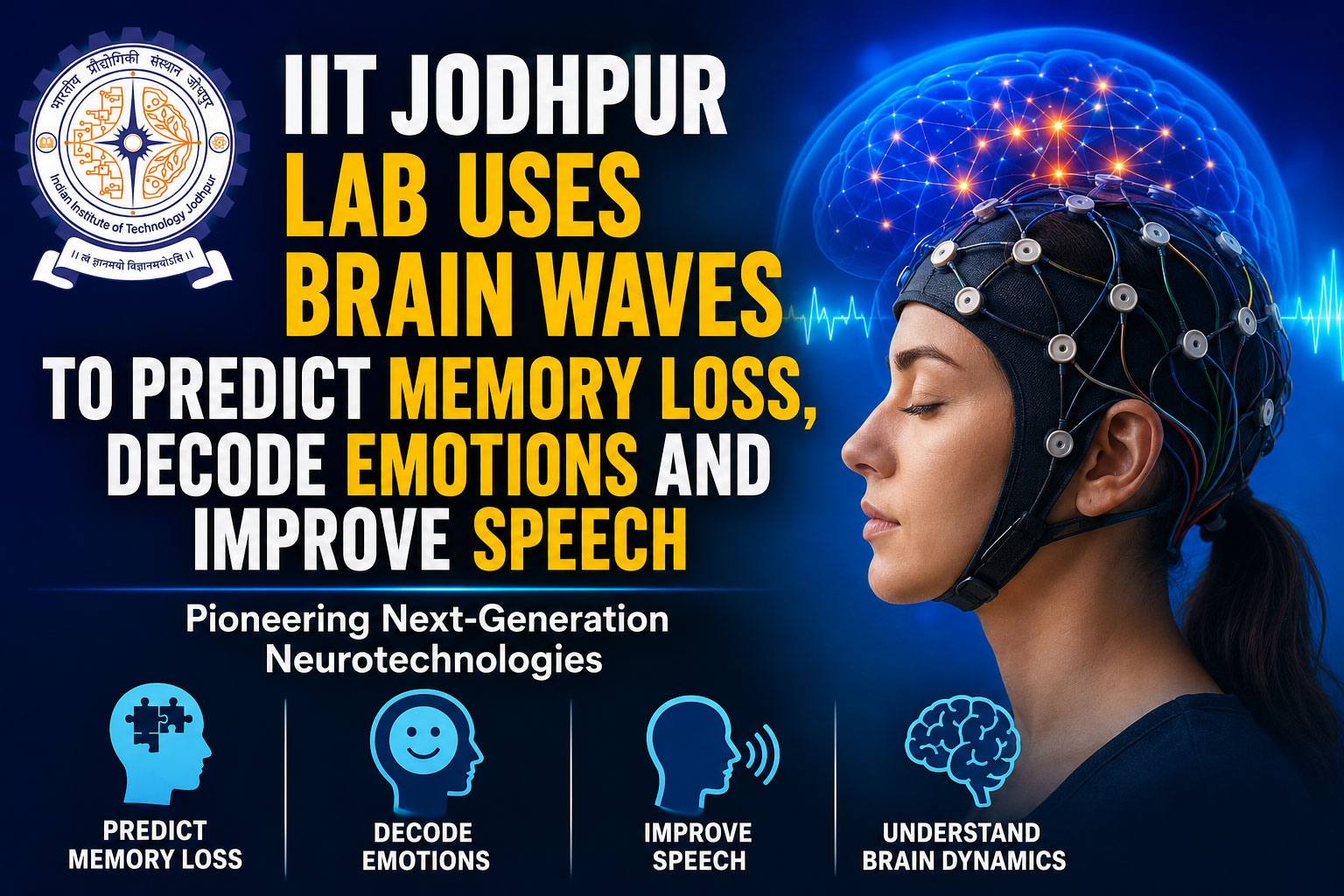
IIT Jodhpur’s Cognitive Brain Dynamics Lab studies brain waves to understand memory, emotion, speech and attention, paving the way for next-generation neurotechnologies.
Decoding the brain in real-world settings
Researchers at the Cognitive Brain Dynamics Lab (CBDL) at IIT Jodhpur are working to answer some of the most fundamental questions about human cognition. They ask what happens inside the brain when people struggle to hear in a noisy room, how emotions shift under uncertainty, why some individuals maintain sharp memory in old age, and how the brain instantly redirects attention to sudden danger. Led by Dr Dipanjan Roy, Professor in the School of Artificial Intelligence and Data Science, the lab combines neuroscience, artificial intelligence, advanced brain imaging, computational modelling and signal processing to study attention, memory, emotion, speech perception and cognitive resilience.
The lab pursues a simple but profound goal: understanding how the human brain adapts to a constantly changing world. By analysing brain oscillations, often called “brain waves”, the team uncovers how the brain processes information, responds to distractions, manages emotions and remains resilient in the face of challenges. The work, supported by multiple nationally funded projects, aims to contribute to future healthcare technologies, brain-inspired AI and interventions for neurological and mental health disorders.
Teaching the brain to hear in noise
One of the lab’s most exciting breakthroughs focuses on how the brain integrates information from multiple senses while understanding speech. In everyday life, people often rely not only on what they hear but also on visual cues such as lip movements to comprehend speech, especially in noisy environments. The researchers have demonstrated how subtle electrical stimulation of the brain can influence the way auditory and visual information are integrated.
By studying brain oscillations, the team has shown that specific neural frequencies can alter speech perception and even create speech-related perceptual illusions. These findings open new possibilities for developing advanced assistive technologies for individuals with speech and hearing disorders. They may also contribute to the next generation of auditory prosthetics that work with the brain’s natural rhythms rather than against them.
Unlocking memory and healthy aging
As populations across the world age, understanding how memory changes over time has become a major scientific and societal challenge. Researchers at IIT Jodhpur are investigating how different forms of attention influence working memory, the brain’s ability to temporarily store and manipulate information. Using electroencephalography (EEG), magnetoencephalography (MEG) and sophisticated computational methods, the team studies how aging affects memory performance and attentional control.
Their findings are helping scientists identify neural signatures associated with healthy aging and cognitive decline. The research has important implications for early detection and intervention in age-related neurological conditions such as Mild Cognitive Impairment (MCI) and Frontotemporal Dementia. That offers hope for more effective diagnostic tools and therapeutic strategies in the future.
Understanding real-world emotions
Mental health disorders such as depression, anxiety and obsessive-compulsive disorder affect millions of people worldwide. Yet understanding emotions in real-life situations remains one of neuroscience’s greatest challenges. To address this, the Cognitive Brain Dynamics Lab is employing advanced functional Magnetic Resonance Imaging (fMRI) techniques and naturalistic experimental settings that closely resemble real-world experiences. By studying how individuals process emotionally charged and uncertain situations, researchers are identifying neurocognitive markers associated with common mental health disorders across different age groups.
Supported through national mission-mode projects, this research aims to build a scientific foundation for future technologies capable of improving diagnosis, monitoring and treatment of mental health conditions. The ultimate goal is to contribute to better emotional well-being and quality of life for people living with these disorders.
How the brain reacts to sudden distractions
Imagine crossing a busy street and suddenly noticing a speeding vehicle approaching. The brain’s ability to rapidly redirect attention toward unexpected events is essential for survival. Researchers at IIT Jodhpur have identified specific brain networks and neural oscillations involved in this process. Their work reveals how the brain distinguishes between important and irrelevant distractions and how attention is reoriented under different real-world conditions.
The findings could have far-reaching applications in understanding neurodevelopmental and attention-related disorders, including Attention Deficit Hyperactivity Disorder (ADHD). They may also support the development of future interventions designed to improve attentional control and cognitive performance in both clinical and everyday settings.
Building brain-inspired healthcare
The research being conducted at IIT Jodhpur goes beyond understanding the brain; it seeks to translate scientific discoveries into real-world impact. From improving communication technologies and supporting healthy aging to addressing mental health challenges and neurological disorders, the outcomes of these studies have the potential to influence healthcare, education, assistive technologies and artificial intelligence. Dr Dipanjan Roy said the lab aims to uncover fundamental principles of brain function that can eventually translate into technologies and interventions for improving mental health, cognitive well-being and quality of life.
The knowledge generated through this research can contribute to addressing some of society’s most pressing challenges, including age-related cognitive decline, mental health disorders and communication impairments. By combining neuroscience with AI and advanced neuroimaging, the Cognitive Brain Dynamics Lab is helping to build the future of brain-inspired healthcare and next-generation neurotechnologies.
#IITJodhpur #BrainWaves #Neuroscience #MemoryLoss #EmotionDecoding #SpeechPerception #CognitiveHealth #MentalHealth #HealthyAging #Neurotechnology
Disclaimer
The information in this article is based on available public sources and official statements as of the time of publication. While we aim for accuracy, we do not guarantee completeness or correctness. We advise readers to verify key details from official sources before making any decisions. The website (iitiimsamvaad.com) is not liable for any loss or damage arising from the use of this content. The authors are also not responsible for any such loss or damage.