

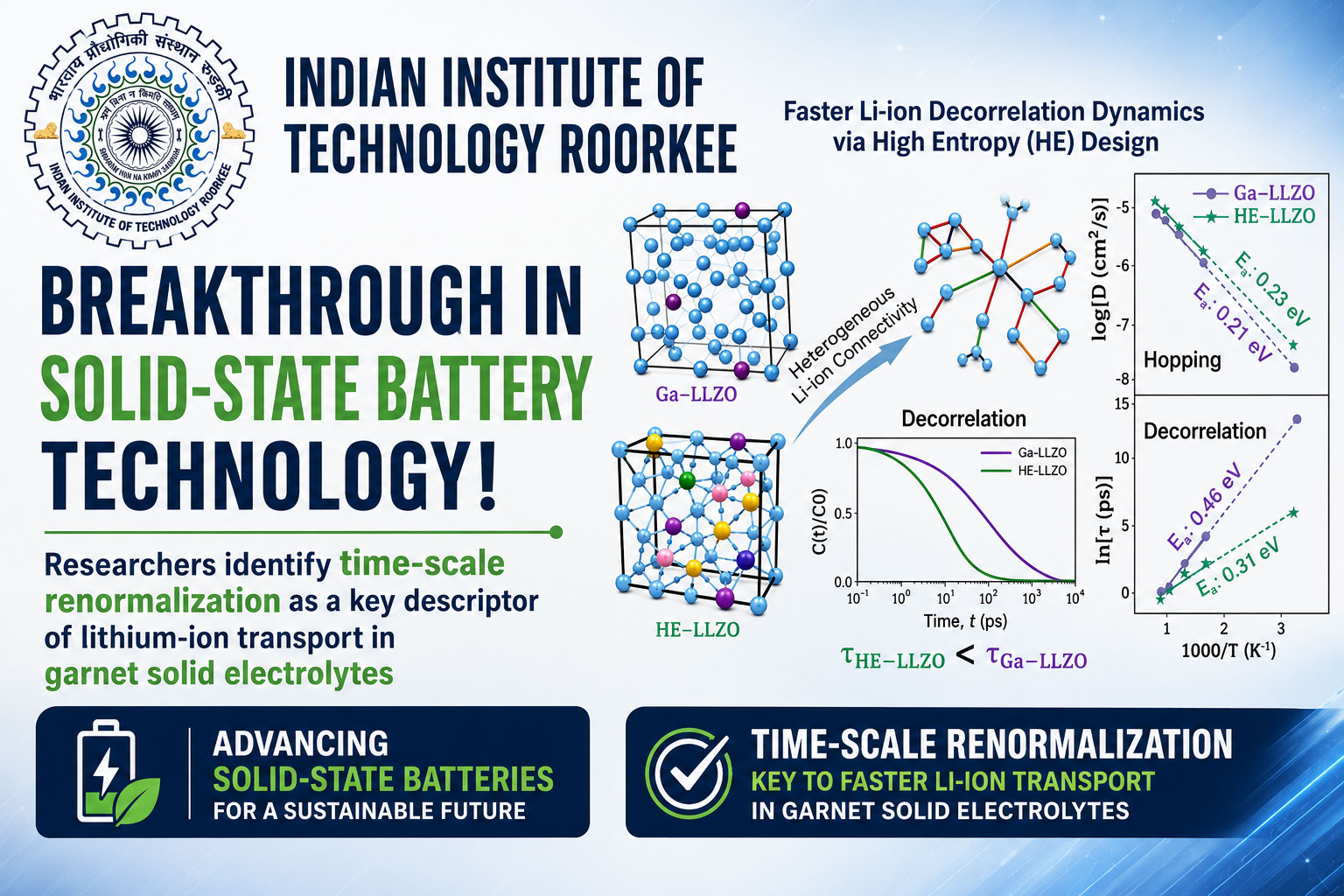
IIT Roorkee researchers identify time-scale renormalization as a key descriptor of lithium-ion transport in garnet solid electrolytes for better solid-state batteries.
A new framework for ion transport
Researchers at the Indian Institute of Technology Roorkee (IIT Roorkee) have published a fundamental study that advances scientific understanding of how lithium ions move through solid materials. The work, led by Prof Swastika Banerjee from the Department of Chemistry, appears in the Journal of the American Chemical Society (JACS). Titled “Time-Scale Renormalization of Correlation Decay Governs Li-Ion Transport in Garnet Solid Electrolytes,” the study establishes time-scale renormalization of ionic configurations as a new framework for understanding fast lithium-ion transport in solid electrolytes.
Solid-state batteries are widely regarded as promising alternatives to conventional lithium-ion batteries because of their potential advantages in safety, energy density and operational stability. Yet understanding the fundamental mechanisms that govern ion transport in solid materials remains a major scientific challenge. The IIT Roorkee study addresses that gap by linking ion mobility to the evolution of ionic configurations over different timescales.
Why solid-state batteries matter
Conventional lithium-ion batteries rely on liquid electrolytes, which can leak, catch fire or degrade over time. Solid-state batteries replace those liquids with solid electrolytes, offering better thermal stability and the potential for higher energy density. That makes them attractive for electric vehicles, portable electronics and grid-scale energy storage. However, many solid electrolytes still conduct ions more slowly than liquids, limiting their practical performance.
Garnet-based solid electrolytes represent an important class of materials in this field. They combine reasonable ionic conductivity with chemical stability against lithium metal. But scientists still struggle to predict which compositions and structures will deliver the fastest ion transport. The IIT Roorkee work seeks to change that by offering a new way to think about ion dynamics at the microscopic level.
Time-scale renormalization as a key descriptor
The study demonstrates that lithium-ion transport is closely linked to the evolution of ionic configurations over different timescales. The researchers show that the key is not only how far lithium ions move, but also how quickly they lose memory of their correlated local environments. By identifying time-scale renormalization as an important descriptor of ion dynamics, they provide a new lens for analysing ion transport in garnet solid electrolytes.
In simple terms, ions do not move in isolation. Their motion depends on how neighbouring ions arrange and rearrange around them. If those local configurations change slowly, ions remain trapped in correlated patterns and move less efficiently. If the configurations relax quickly, ions can hop more freely. The study quantifies this behaviour and shows that time-scale renormalization captures the essential physics behind fast ion transport.
Implications for materials design
Prof Swastika Banerjee said a long-standing challenge in solid-state battery research has been understanding how to design materials that can transport ions more efficiently. She explained that the team explored the microscopic processes that govern lithium-ion transport and found that the speed at which correlated environments decay matters as much as the distance ions travel. By framing this as time-scale renormalization, the work gives researchers a new perspective for designing advanced solid electrolytes.
That perspective can guide future experiments and simulations. Instead of focusing only on static properties such as crystal structure or defect concentration, scientists can now consider how ionic configurations evolve over time. That may help them identify compositions that promote rapid relaxation of local environments and, consequently, faster ion transport. Over time, this could lead to solid electrolytes that charge faster, operate more safely and deliver higher energy density.
Contribution to materials science and energy research
The findings contribute to the broader scientific understanding of ion transport phenomena. They may provide useful guidance for future research on advanced ion-conducting materials and solid-state energy storage systems. By advancing understanding of ion transport mechanisms in solid materials, the study makes an important contribution to materials science and energy research.
Prof Kamal Kishore Pant, Director of IIT Roorkee, said fundamental scientific research forms the foundation for future technological advancements. He noted that the study contributes important insights into ion transport phenomena that may inform future developments in advanced energy storage materials. He added that the work reflects IIT Roorkee’s continued emphasis on high-quality research addressing emerging global challenges and supporting sustainable technological innovation.
From fundamental insight to future batteries
The study does not immediately produce a new battery. Instead, it offers a conceptual tool that researchers can use to screen and design better solid electrolytes. That fits a common pattern in materials science: fundamental insights often precede practical breakthroughs by years. Yet without such insights, progress remains trial-and-error. The IIT Roorkee work reduces that uncertainty by clarifying what controls ion mobility at the microscopic level.
As the global push for cleaner energy intensifies, solid-state batteries occupy a central place in many roadmaps. Electric vehicles, renewable energy integration and portable electronics all depend on better storage technologies. By improving the scientific basis for solid electrolyte design, the study supports that larger goal. It helps move the field from empirical observations toward predictive materials engineering.
A step toward safer, faster-charging batteries
The researchers hope their work will ultimately contribute to safer, faster-charging and more energy-efficient solid-state batteries. If future materials can combine high ionic conductivity with mechanical and chemical stability, they could transform energy storage. That would mean longer-range electric vehicles, more reliable grid storage and reduced dependence on fossil fuels. The IIT Roorkee study does not solve all those challenges, but it clarifies one critical piece of the puzzle.
By linking ion transport to time-scale renormalization, the team has opened a new avenue for research. Other groups can now test whether this descriptor applies to different classes of solid electrolytes, such as sulfides, phosphates or polymers. They can also explore how doping, strain or interface engineering affects time-scale renormalization. Over time, that collective effort may yield the next generation of solid-state batteries.
#IITRoorkee #LithiumIonTransport #SolidStateBatteries #GarnetElectrolytes #TimeScaleRenormalization #EnergyStorage #MaterialsScience #JACS #IonConductivity #SustainableEnergy
Disclaimer
The information in this article is based on available public sources and official statements as of the time of publication. While we aim for accuracy, we do not guarantee completeness or correctness. We advise readers to verify key details from official sources before making any decisions. The website (iitiimsamvaad.com) is not liable for any loss or damage arising from the use of this content. The authors are also not responsible for any such loss or damage.