

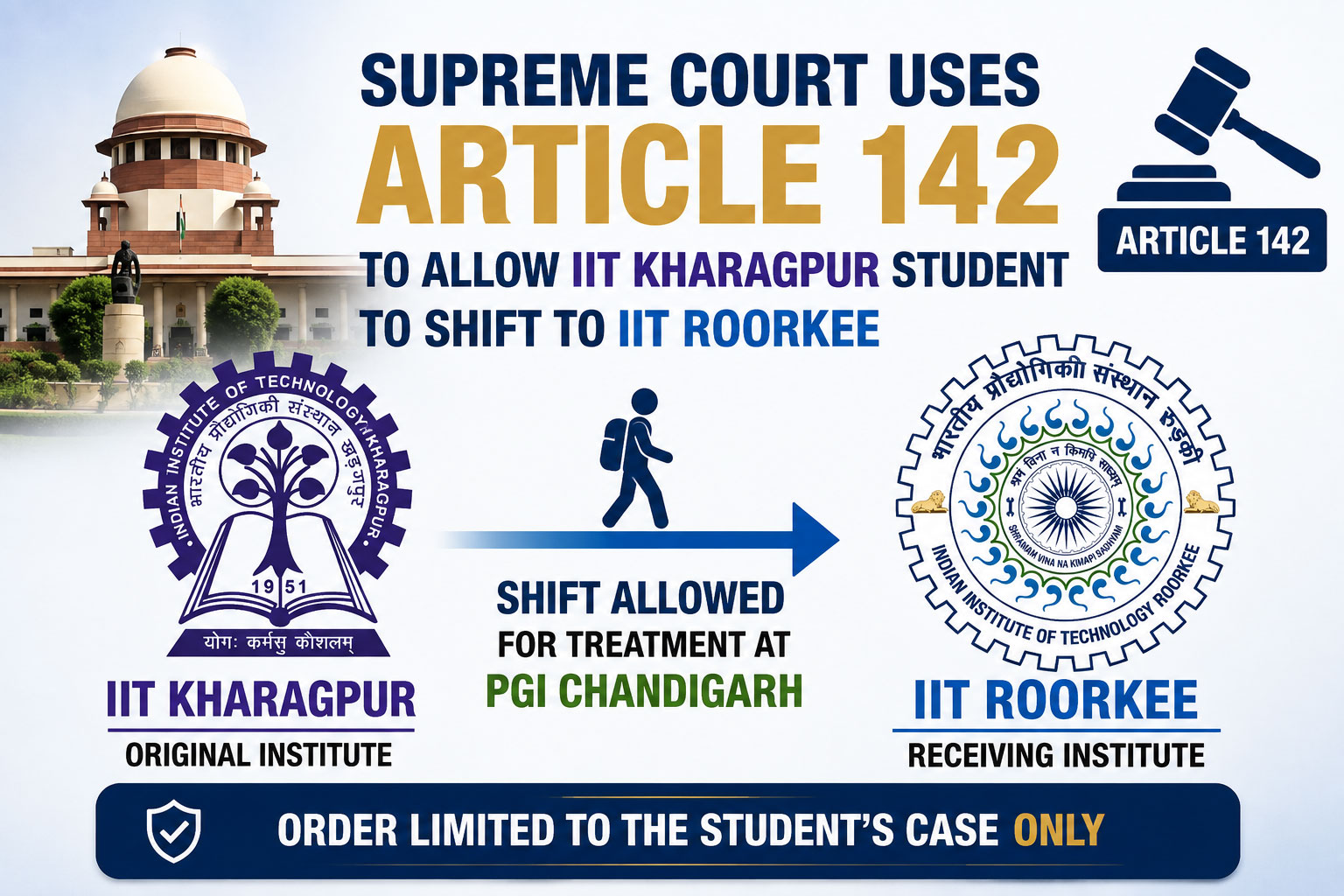
The Supreme Court used Article 142 to allow an IIT Kharagpur student to shift to IIT Roorkee for treatment at PGI Chandigarh, while limiting the order to his case.
A rare inter-IIT transfer
In a rare intervention, the Supreme Court allowed a B.Arch student of IIT Kharagpur to transfer to IIT Roorkee on serious mental health grounds. The student is undergoing treatment at PGI Chandigarh and requires continuous specialist supervision. A Bench comprising Justice B.V. Nagarathna and Justice R. Mahadevan directed IIT Kharagpur to issue the necessary transfer or migration certificate, along with all original documents, to IIT Roorkee within a week. The Court also directed IIT Roorkee to admit the petitioner to the first year of its B.Arch programme, subject to applicable admission and fee requirements.
The case has drawn attention because inter-IIT transfers on medical grounds remain uncommon. Most IITs operate with separate rules and limited portability across campuses. That makes the Supreme Court’s order significant, both for the student and for how institutions handle mental health crises in the future.
Medical grounds and the student’s plea
During the hearing, Senior Advocate Shobha Gupta, appearing for the petitioner, relied on medical records from PGI Chandigarh and an evaluation conducted by AIIMS. She submitted that the student has been diagnosed with recurrent depressive disorder and requires continuous medication and treatment under specialist supervision. She argued that remaining at IIT Kharagpur would make it difficult for him to access consistent care and support.
Earlier, on July 15, the Supreme Court had directed the Director of AIIMS to constitute a Medical Board to assess the student’s mental health condition. At the same time, it directed IIT Roorkee to keep one seat vacant until the matter was decided. Those interim directions came while hearing the writ petition filed by the IIT Kharagpur student seeking migration on account of depression and the need for specialised therapy, which he claimed was not available in Kharagpur.
IIT Roorkee’s opposition and the legal hurdle
Opposing the plea, counsel appearing for IIT Roorkee argued that the AIIMS report did not specifically recommend a transfer between IITs. While acknowledging the student’s mental health condition, the institute submitted that the transfer regulations placed before the Court were applicable only to IIT Kharagpur and did not bind other IITs. It further stated that IIT Roorkee did not have any regulation permitting such transfers.
The Bench observed that every IIT functions independently through its own Senate and cannot be governed by another institute’s regulations. “Each IIT independently has a Senate. These rules are for IIT Kharagpur, not IIT Delhi. What about IIT Roorkee then?” the Bench remarked. That observation highlighted a structural gap: no uniform framework exists for inter-IIT migration on medical or humanitarian grounds.
Article 142 and the scope of the order
Responding to the submissions, the Bench observed that the matter would have to be considered under Article 142 of the Constitution, which empowers it to pass orders necessary for doing complete justice. Using this power, the Court allowed the transfer while clarifying that the relief was confined to the student’s medical circumstances. It said the direction was being issued only because of the petitioner’s medical condition and the requirement of ongoing treatment at PGI Chandigarh, which made it impracticable for him to continue studying at IIT Kharagpur.
During the proceedings, IIT Roorkee informed the Court that if the transfer was allowed, the petitioner would have to begin the B.Arch programme from the first year since academic continuity through transfer was not possible. The petitioner’s counsel accepted the condition. The institute also requested that the Court confine any relief granted in the matter to the facts of the present case and not treat it as a precedent for future transfer requests. The Court recorded that submission.
Mental health scrutiny at IIT Kharagpur
The issue of student mental health at IIT Kharagpur has also come under the Supreme Court’s scrutiny in the past. In July 2025, while hearing another matter, a Bench of Justices J.B. Pardiwala and R. Mahadevan questioned the institute over student suicides and asked what measures the institute had taken to address the issue. Counsel for IIT Kharagpur then informed the Court that the institute had constituted a 10-member committee and that a counselling centre was functioning to identify and support students facing mental health concerns.
That earlier exchange shows that the Court has been watching how premier institutions respond to mental health crises. The latest order adds another layer to that oversight by linking medical need with academic continuity and institutional responsibility.
What the judgment means for future cases
The Supreme Court made it clear that its order does not create a general right to transfer between IITs. It stressed that the direction applied only because of the petitioner’s specific medical condition and treatment requirements at PGI Chandigarh. By recording IIT Roorkee’s request, the Court ensured that the order would not automatically bind other institutes in future cases. That approach balances compassion for the individual with the need to preserve institutional autonomy and regulatory consistency.
At the same time, the judgment highlights a policy gap. With each IIT operating under its own Senate and rules, students facing severe mental health issues may find no clear pathway for migration. The Court’s use of Article 142 fills that gap in this case, but it also signals that lawmakers may need to create a more structured framework for similar situations in the future.
Institutional responsibilities and student welfare
The case puts a spotlight on how institutions support students in crisis. It shows that medical documentation, counselling reports and treatment plans can become central to academic decisions. It also shows that courts may step in when institutional mechanisms appear inadequate or when students face genuine hardship. For IITs, the order reinforces the need for robust mental health infrastructure, clear protocols for medical leaves and transfers, and coordination between campuses when students require specialised care.
For students, the judgment offers limited but important relief. It confirms that extreme medical circumstances can justify extraordinary academic measures. At the same time, it reminds them that such relief depends on strong medical evidence and may come with conditions, such as restarting a programme from the first year.
A precedent in principle, not in law
The Supreme Court’s order does not set a binding precedent for future inter-IIT transfers. Yet it creates a reference point for how courts may approach similar cases. It shows that courts can use Article 142 to address urgent humanitarian needs when existing rules fall short. It also shows that courts will expect institutions to act responsibly when student health and safety are at stake.
As IIT Kharagpur, IIT Roorkee and other campuses refine their mental health policies, this case will likely remain a touchstone. It underscores that academic regulations must accommodate genuine medical emergencies without compromising institutional integrity. In that sense, the judgment is less about creating a new rule and more about insisting on complete justice in exceptional circumstances.
#IITKharagpur #IITRoorkee #SupremeCourt #StudentMentalHealth #Article142 #PGIChandigarh #InterIITTransfer #Depression #HigherEducation #MentalHealthPolicy
Disclaimer
The information in this article is based on available public sources and official statements as of the time of publication. While we aim for accuracy, we do not guarantee completeness or correctness. We advise readers to verify key details from official sources before making any decisions. The website (iitiimsamvaad.com) is not liable for any loss or damage arising from the use of this content. The authors are also not responsible for any such loss or damage.