

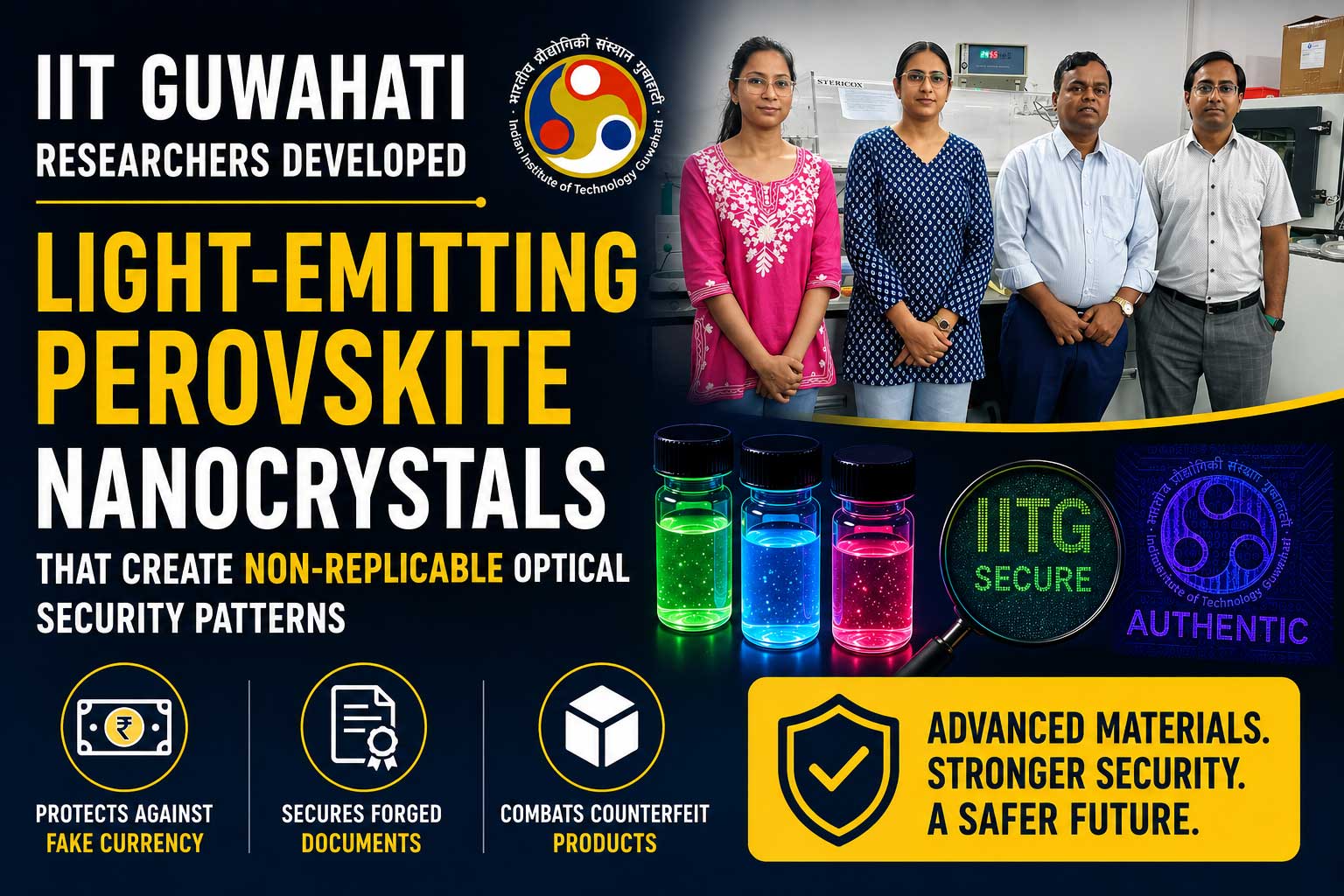
IIT Guwahati researchers have developed light‑emitting perovskite nanocrystals that create non‑replicable optical security patterns to protect against fake currency, forged documents, and counterfeit products.
New Light‑Based Security Against Counterfeits
Researchers at the Indian Institute of Technology (IIT) Guwahati have developed an advanced light‑emitting perovskite nanomaterial that can significantly strengthen protection against fake currency, forged documents, and counterfeit products. The team created nanocrystals that generate light‑based security patterns, which cannot be replicated using conventional printing or imaging techniques.
The findings appear in the prestigious journal Advanced Optical Materials in a paper co‑authored by Prof. Saikat Bhaumik, Assistant Professor, along with Prof. P. K. Giri, Professor, and their research scholars Latika Juneja and Garima Choudhary from the Department of Physics at IIT Guwahati.
Counterfeiting as a Global Threat
Counterfeiting has become a major global concern affecting industries ranging from pharmaceuticals and electronics to banking and identity documentation. Modern technologies now enable offenders to copy conventional security measures such as barcodes, QR codes, holograms, and watermark labels with high accuracy.
These challenges pose serious risks to national security by enabling financial fraud, illegal activities, and security breaches. The growing ease of counterfeiting has also created an urgent demand for smart, difficult‑to‑reverse‑engineer anticounterfeiting systems that go beyond traditional visual or digital markers.
Perovskite Nanocrystals with Unique Optical Properties
To address this challenge, Prof. Bhaumik, Prof. Giri, and their research team developed light‑emitting perovskite nanocrystals, a class of crystalline materials known for their exceptional optical and electronic properties. These nanocrystals measure in the nanometer range – about a hundred thousand times smaller than the width of a single human hair – and can produce very pure and intense colours with extremely narrow emission ranges.
This property enables accurate optical signatures and broader colour tunability compared with traditional fluorescent materials. Such characteristics make the nanocrystals highly suitable for secure authentication technologies that require precise, hard‑to‑mimic visual and spectral markers.
Solving Stability Challenges with a Double‑Layer Coating
One major challenge with perovskite materials is their sensitivity to moisture, heat, and environmental conditions, which causes them to degrade easily. To overcome this limitation, the research team developed a double‑layer coating around the nanocrystals. This coating makes the material heat‑ and chemical‑resistant while preserving its light‑emitting properties, ensuring long‑term stability in real‑world conditions.
The coated nanocrystals also maintain their optical performance even under stress, making them viable for practical security applications in currency, documents, and product packaging exposed to varying environments.
Direct Laser Writing for Complex Security Patterns
Using a direct laser writing technique, the team created tiny security patterns from these perovskite nanocrystals. The multi‑layer coating allowed the nanocrystals to form these patterns without conventional lithographic masks, enabling resolutions of 10–40 micrometers. This high resolution supports very complex patterns and the encoding of detailed information within a small area.
These microscale patterns can be integrated into banknotes, identity cards, pharmaceutical packaging, and high‑value electronic components. When illuminated with specific light sources, the patterns reveal unique optical signatures that are extremely difficult to forge using standard printing or imaging methods.
Potential Impact on Security and Authentication
The development offers a powerful new tool for combating counterfeiting across multiple sectors. For national security agencies, it also provides a robust mechanism to protect currency and official documents. For industries, it enables secure authentication of products and components, reducing losses from fraud and protecting brand reputation.
By combining advanced nanomaterials, protective coatings, and precision laser patterning, IIT Guwahati has created a next‑generation anticounterfeiting technology that addresses both stability and replication challenges. As counterfeiters adopt more sophisticated tools, such light‑based, nanomaterial‑driven security systems will play a critical role in safeguarding economic and national security.
Disclaimer
The information in this article is based on available public sources and official statements as of the time of publication. While we aim for accuracy, we do not guarantee completeness or correctness. We advise readers to verify key details from official sources before making any decisions. The website (iitiimsamvaad.com) is not liable for any loss or damage arising from the use of this content. The authors are also not responsible for any such loss or damage.