
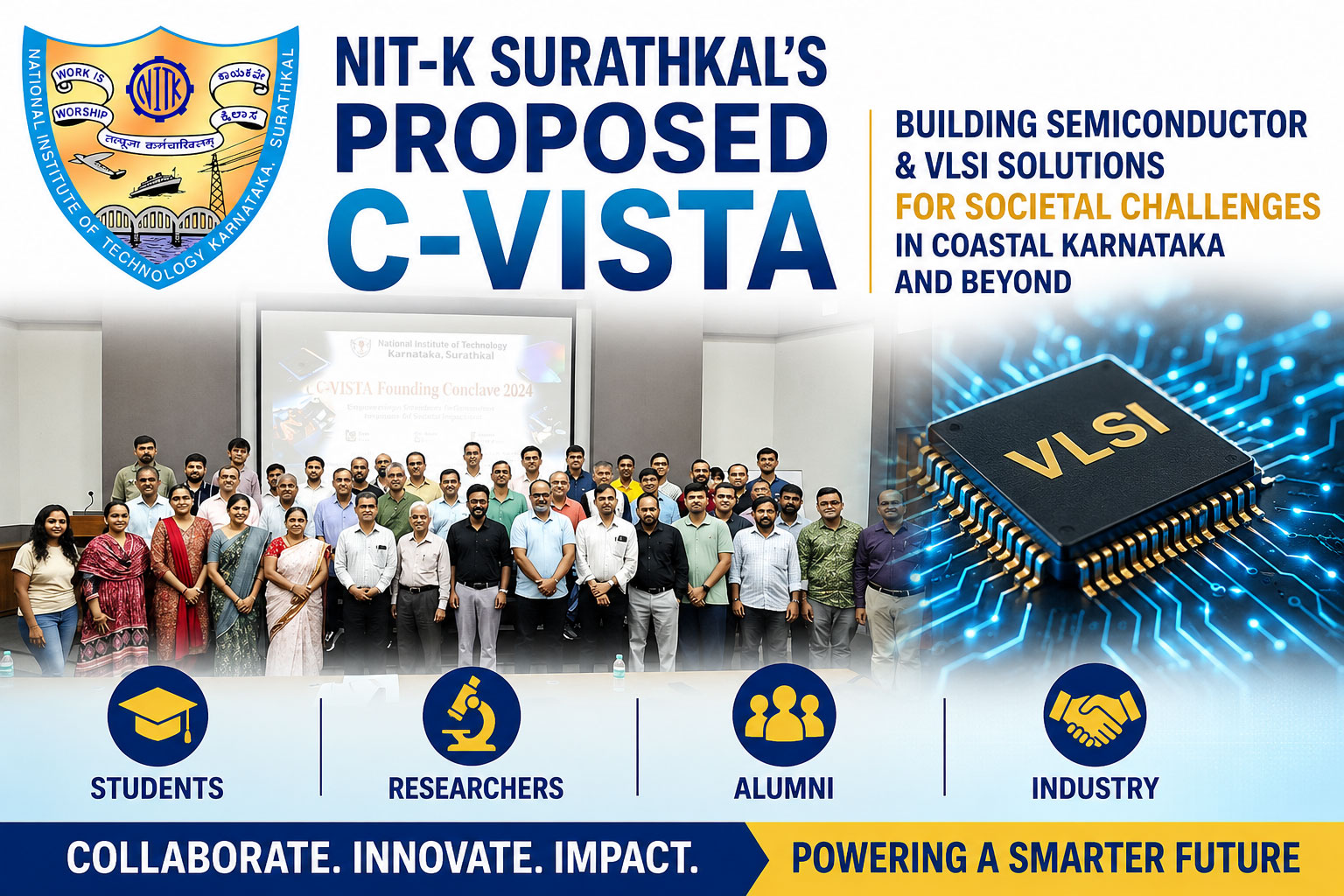
NIT-K Surathkal’s proposed C-VISTA will connect students, researchers, alumni and industry to build semiconductor and VLSI solutions for societal challenges in coastal Karnataka and beyond.
Building a semiconductor innovation hub
The National Institute of Technology Karnataka (NIT-K), Surathkal, has proposed the Centre of Excellence for VLSI Innovation for Systems, Technology, and Applications, or C-VISTA, to strengthen semiconductor research, education and entrepreneurship. The centre aims to position NIT-K as a hub for Very Large-Scale Integration (VLSI) innovation and create a platform where students, faculty members, alumni and industry practitioners can work together on real-world problems.
NIT-K Director B. Ravi said C-VISTA could help the institute identify campus-level challenges and develop semiconductor- and VLSI-based solutions with wider societal applications. He made the remarks while inaugurating the two-day founding conclave of the proposed centre on the institute campus.
The initiative reflects India’s growing focus on building domestic capabilities across the semiconductor value chain. While chip fabrication requires large investments and specialised infrastructure, VLSI design, embedded systems, sensors and application-specific electronics offer important opportunities for Indian institutions, startups and engineering talent.
From campus problems to public solutions
C-VISTA will encourage teams to identify problems within the NIT-K campus and use them as starting points for technology development. These challenges could include energy management, water monitoring, smart mobility, campus security, healthcare delivery and climate resilience. Students and researchers can use sensors, microcontrollers, custom chips and intelligent systems to design solutions that later find applications beyond the campus.
This approach gives students practical experience in the complete innovation cycle. They can define a problem, develop a system architecture, design hardware and software, build prototypes and test their performance in real conditions. Industry partners can then help them improve manufacturability, reliability, cost and market readiness.
The model also supports entrepreneurship. A successful campus prototype can become the foundation for a startup, a licensing opportunity or a research collaboration. C-VISTA will therefore connect academic learning with product development and commercialisation.
Conclave brings the ecosystem together
The founding conclave brought together representatives from industry, academia, government and NIT-K’s alumni network. The participants discussed semiconductor innovation, talent development, research priorities and ways to strengthen industry collaboration in coastal Karnataka.
Navin Bishnoi, a 1998-batch alumnus of NIT-K, vice-president and India country manager at Marvell Technology and chairperson of the India Electronics and Semiconductor Association, delivered a masterclass on the semiconductor value chain. He outlined opportunities for India in chip design, systems innovation, talent development and ecosystem building.
Rohit Bhat, founder of the Silicon Beach Programme, and Padmanand Warrier, a 1981-batch NIT-K alumnus and founder of Warrier H.E.A.R.T. Hub for Sustainable AI, also contributed to the conclave. Subhash C. Yaragal, Deputy Director; Udaya Bhat, Dean of Research and Innovation; and Prasanna Belur, Dean of Alumni and Corporate Relations, participated in the discussions.
Industry and academic participation
The conclave included representatives from KarMic Design Pvt. Ltd., EKA Mobility, Karnataka Digital Economy Mission, Sierra Pinnacle, Anmaya Technologies Pvt. Ltd., Silicon Beach Programme, Leanwatts India Pvt. Ltd. and TiE Mangaluru. NIT-K faculty members, research scholars and undergraduate students also took part.
Industry practitioners Samarth Modi, Girish Desai, Gopal Krishna Nayak and Ashish Guttedar led sessions on technology development and market requirements. Their participation gave students an opportunity to understand how companies evaluate semiconductor products, recruit skilled engineers and convert research ideas into deployable systems.
The presence of mobility, energy, design, startup and policy organisations also widened the scope of the discussions. It showed that semiconductor and VLSI technologies can support multiple sectors rather than operate as isolated electronics specialisations.
Three application-focused verticals
The conclave explored three founding application areas for C-VISTA: biomedical devices and healthcare; climate and disaster resilience; and drones, electric vehicles and robotics. These areas reflect the growing importance of locally designed electronics in addressing Indian challenges.
Healthcare systems can use compact sensors, wearable devices and low-power diagnostic platforms to monitor patients and support point-of-care services. Climate and disaster-resilience applications can use sensor networks and real-time data to monitor floods, landslides, heat and coastal risks.
Drones, electric vehicles and robotics require efficient control systems, power electronics, navigation technologies and embedded intelligence. Local design capabilities can help reduce dependence on imported components and enable engineers to customise products for Indian operating conditions.
Breakout sessions converted these discussions into action items. The participants agreed on a 90-day execution roadmap, the appointment of faculty and industry champions for each focus area, and timelines for launching programmes and forming student cohorts.
Strengthening talent and research
C-VISTA will create opportunities for students to work with engineers, researchers and entrepreneurs. Such interaction can strengthen skills in chip design, semiconductor systems, embedded programming, testing, verification and product development. It can also encourage students from different disciplines to collaborate on complete systems.
For faculty members, the centre can support interdisciplinary research and externally funded projects. Semiconductor development often requires expertise in electronics, computer science, mechanical engineering, materials, physics and data science. C-VISTA can bring these groups together and help them pursue larger research programmes.
The proposed centre can also strengthen NIT-K’s engagement with government agencies and industry. The institute already has experience in VLSI-related research and sponsored projects, while its coastal Karnataka location places it close to a growing network of technology companies, startups and innovation initiatives.
A platform for India’s deep-tech ambitions
C-VISTA comes at a time when India is expanding its semiconductor ecosystem through investments in design, manufacturing, packaging, research and talent development. Academic institutions will play a crucial role in supplying skilled professionals and generating the intellectual property needed by the industry.
By combining education, research, industry collaboration and entrepreneurship, C-VISTA can help NIT-K contribute to that national effort. Its focus on societal applications will also ensure that semiconductor innovation responds to practical needs in healthcare, mobility, disaster management, energy and public infrastructure.
If NIT-K implements the proposed roadmap effectively, C-VISTA could become a model for application-driven semiconductor education and research. It can help students move from classroom concepts to working prototypes, while giving industry partners access to new ideas and trained talent.
#NITKSurathkal #CVISTA #SemiconductorInnovation #VLSI #ChipDesign #DeepTech #ElectronicsResearch #IndustryAcademiaCollaboration #Robotics #AtmanirbharBharat
Disclaimer
The information in this article is based on available public sources and official statements as of the time of publication. While we aim for accuracy, we do not guarantee completeness or correctness. We advise readers to verify key details from official sources before making any decisions. The website (iitiimsamvaad.com) is not liable for any loss or damage arising from the use of this content. The authors are also not responsible for any such loss or damage.