

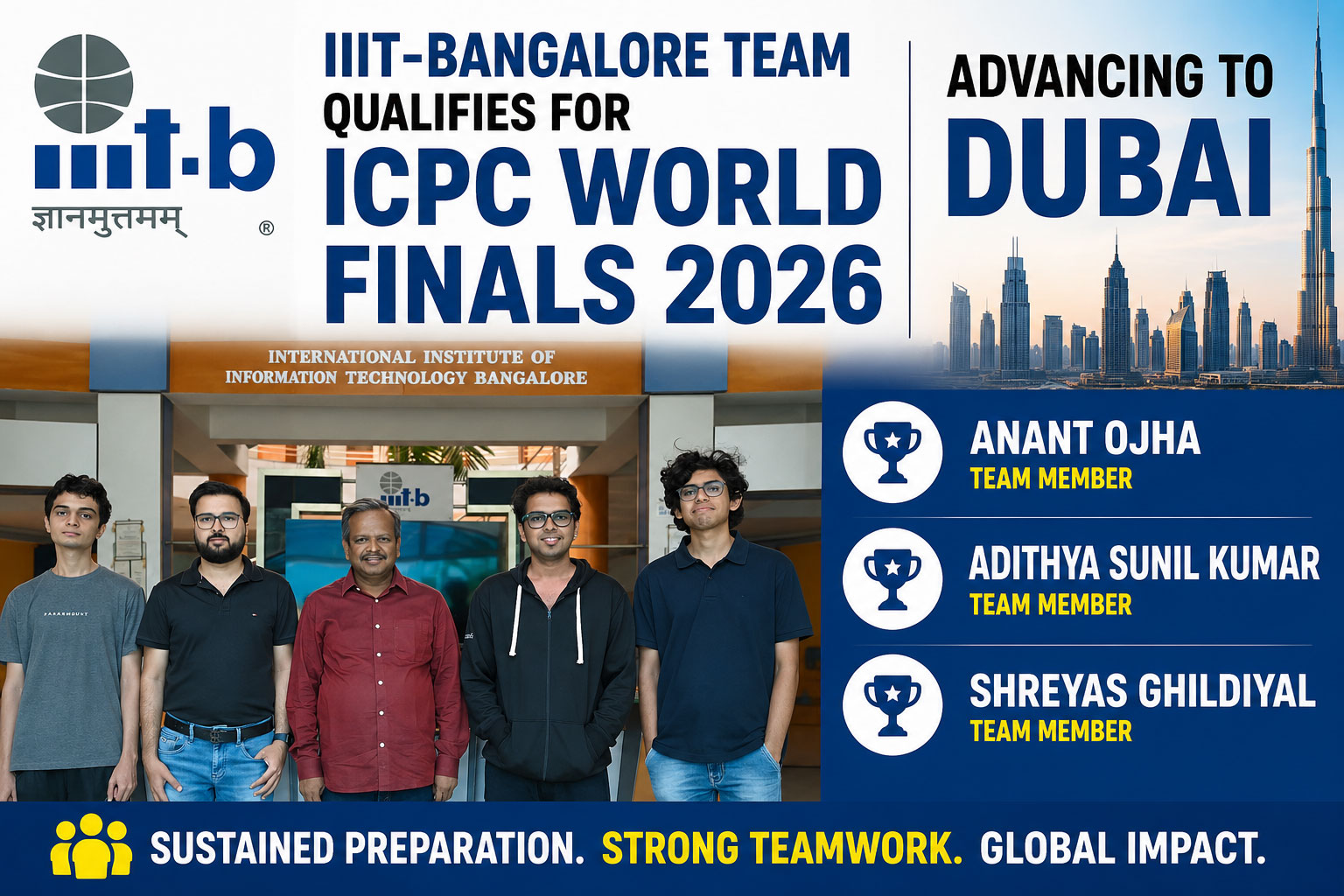
IIIT-Bangalore’s team qualifies for ICPC World Finals 2026, with Anant Ojha, Adithya Sunil Kumar and Shreyas Ghildiyal advancing to Dubai through sustained preparation and teamwork.
A third global qualification
A three-member team from the International Institute of Information Technology Bangalore (IIIT-Bangalore) has qualified for the International Collegiate Programming Contest (ICPC) World Finals 2026. The achievement marks the institute’s third qualification for the global programming competition and highlights its sustained strength in competitive programming.
The team comprises Anant Ojha, Adithya Sunil Kumar and Shreyas Ghildiyal. Prof. Muralidhara V. N. and Vivek Yadav mentored the students throughout their preparation. The team will compete against university programmers from across the world at the World Finals, scheduled to take place in Dubai, United Arab Emirates, from November 15 to 20, 2026. The Dubai Chamber of Digital Economy will host the event.
For the students, the qualification offers an opportunity to represent IIIT-Bangalore and India at one of the most prestigious university programming contests. It also places them among the world’s strongest young problem-solvers in algorithms, data structures and computational thinking.
What makes ICPC challenging?
The ICPC brings together university students who compete in teams of three. Each team works collaboratively to solve complex algorithmic and real-world programming problems using a single computer within a fixed time limit. The format tests more than coding speed. It requires teams to analyse problems quickly, divide tasks effectively, design efficient algorithms and implement solutions accurately under pressure.
Team members must also decide which problems to attempt and how to allocate their limited time. A technically correct solution may still fail if the team cannot optimise its approach or identify hidden edge cases. Communication therefore plays an important role. Students must explain ideas clearly, review one another’s code and respond quickly when an attempted solution produces an incorrect result.
The contest assesses programming expertise, analytical thinking, problem-solving ability and teamwork. These skills also support careers in software engineering, artificial intelligence, cybersecurity, data science, systems design and research.
A large global competition
The 2026 ICPC competition recorded participation from 60,948 students forming 35,480 teams. They represented 3,148 academic institutions across 103 countries. Regional contests took place through 251 competitions at 1,312 contest sites, with support from 12,558 coaches and 1,879 volunteers. A total of 70,611 participants took part in the regional contests.
These figures illustrate the scale of the qualification achieved by the IIIT-Bangalore team. Universities from several continents participate in the ICPC, and only a small group of teams reaches the World Finals. The selection process requires students to perform consistently through regional stages against highly trained competitors.
The Dubai finals will also carry special significance because they form part of the 50th annual ICPC World Championship. The event will bring together a global community focused on problem-solving, teamwork and algorithmic excellence.
Building on earlier success
IIIT-Bangalore previously qualified for the ICPC World Finals in 2017 and 2018. Its earlier qualifying teams included Aditya Paliwal, Simran Dokania and Shyam K. B. The 2026 qualification therefore represents the institute’s third appearance at the global finals.
The latest achievement shows that the institute has developed a competitive programming culture that extends beyond individual student performances. Regular training, mentorship and peer learning help students build skills over several years. Experienced participants can also guide junior students and create a cycle of knowledge-sharing within the institute.
The team’s success reflects that broader ecosystem. The students did not rely only on classroom instruction. They followed a sustained preparation schedule, practised difficult problems and learned to work efficiently as a unit.
Role of mentorship and preparation
Prof. Muralidhara V. N. said strong foundations in data structures and algorithms remain essential for competitions such as the ICPC. He also identified sustained practice, teamwork, perseverance and the ability to perform under pressure as important factors in competitive programming.
He described the qualification as a result of the team’s disciplined preparation and commitment. Competitive programming allows students to extend classroom learning into advanced problem-solving, where they must apply theoretical concepts to unfamiliar and time-sensitive challenges.
Vivek Yadav, Technology Officer and Adjunct Faculty at IIIT-Bangalore, has a long association with the ICPC. His involvement began in 2012, when he was a student at the institute and belonged to its first team to qualify for the regional contest. During that period, he also conducted competitive programming sessions for junior students.
Yadav later continued to mentor students and support their interest in programming and problem-solving. He attributed the institute’s third qualification to the team’s hard work, teamwork and regular practice.
Preparing for the Dubai finals
The team will now focus on preparing for the World Finals in Dubai. The students will need to strengthen their algorithmic speed, practise contest simulations and improve coordination under strict time limits. They will also study problem-solving patterns that commonly appear in international competitions while developing strategies for selecting and prioritising problems.
Competing at the global level will expose the students to different programming styles and allow them to learn from teams representing leading universities. Regardless of the final ranking, the experience will strengthen their technical confidence and provide valuable insight into international standards in computer science education.
A milestone for IIIT-Bangalore
The qualification reinforces IIIT-Bangalore’s reputation for research-led technology education and advanced computing talent. It also demonstrates how focused mentorship and a strong student culture can produce results in highly competitive global contests.
As Anant Ojha, Adithya Sunil Kumar and Shreyas Ghildiyal prepare for Dubai, they will carry forward the legacy of IIIT-Bangalore’s earlier finalist teams. Their journey shows that competitive programming is not simply a contest of speed; it is a test of knowledge, creativity, resilience and collaboration.
IIITBangalore #ICPC2026 #ICPCWorldFinals #CompetitiveProgramming #Algorithms #DataStructures #ComputerScience #ProgrammingContest #StudentAchievement #DubaiFinals
Disclaimer
The information in this article is based on available public sources and official statements as of the time of publication. While we aim for accuracy, we do not guarantee completeness or correctness. We advise readers to verify key details from official sources before making any decisions. The website (iitiimsamvaad.com) is not liable for any loss or damage arising from the use of this content. The authors are also not responsible for any such loss or damage.