

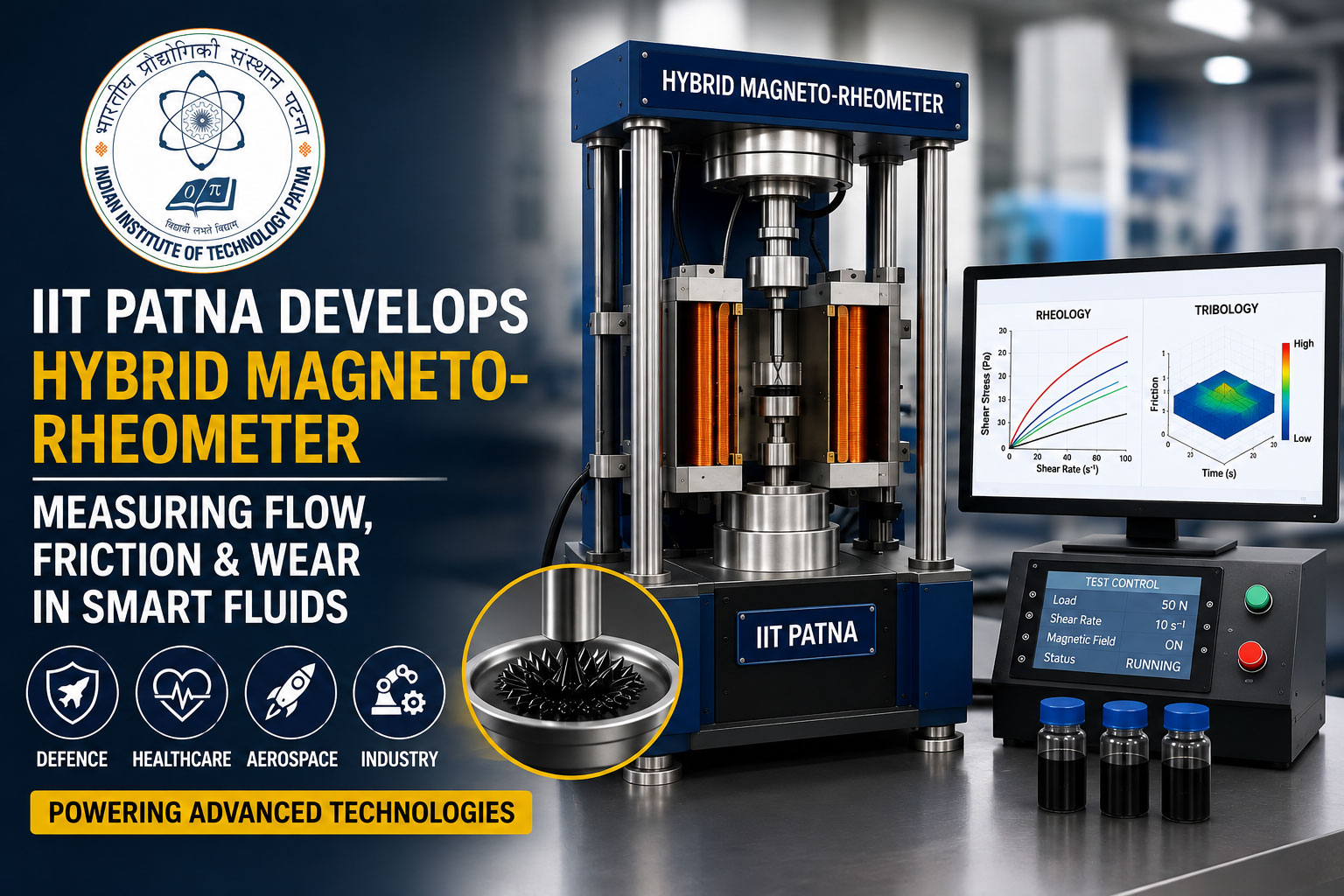
IIT Patna researchers develop a hybrid magneto-rheometer that measures flow, friction and wear in smart fluids, supporting advanced technologies across healthcare, aerospace and defence.
A new tool for smart fluids
Scientists at the Indian Institute of Technology Patna have developed an innovative hybrid magneto-rheometer that could advance research on magnetorheological (MR) fluids. Supported by the Department of Science and Technology (DST), the instrument offers a new method to evaluate how these smart fluids behave under realistic operating conditions. The research team published its findings in Rheologica Acta, highlighting the role of advanced testing technologies in developing adaptive and energy-efficient systems.
Led by Prof Chiranjit Sarkar, the IIT Patna team prepared nano iron powder-based MR fluids and designed a custom-built instrument to measure their rheological and tribological properties. The device can test the fluids under combined compression and shear, both in the presence and absence of a magnetic field. This capability addresses an important gap in conventional testing methods.
How magnetorheological fluids work
MR fluids contain magnetic particles suspended in a carrier liquid. Under normal conditions, the particles remain relatively dispersed and the fluid flows easily. When researchers apply a magnetic field, the particles align and form chain-like structures, causing the fluid’s viscosity to increase rapidly. When the field disappears, the fluid returns to a more fluid state.
This reversible change allows engineers to control the transmission of force through an external electrical signal. Systems can therefore adjust their resistance, stiffness or damping almost instantly. That makes MR fluids useful in brakes, clutches, shock absorbers, vibration-control systems, dampers and actuators. They can also support medical devices and rehabilitation technologies that require controlled movement or resistance.dst.gov+1
The challenge of real-world conditions
Researchers have studied MR fluids for several years, but their behaviour under actual working conditions remains difficult to understand. Devices often expose these fluids to more than one type of force at a time. For example, a damper may compress the fluid while another component causes it to slide or shear. Friction, wear and deformation can then influence performance simultaneously.
Many existing rheometers primarily measure how a fluid flows or deforms under shear. Tribometers, in contrast, examine friction and wear. Researchers often need separate instruments to study these properties. That arrangement can make it difficult to understand how the same fluid behaves when compression, shear and magnetic stimulation act together.
The IIT Patna team designed its hybrid magneto-rheometer to overcome that limitation. The instrument combines rheological and tribological measurements in a single testing platform, allowing scientists to study flow, deformation, friction and wear under mixed-mode conditions.
Measuring compression and shear together
The newly developed instrument generates a constant, high-strength magnetic field across the MR fluid sample while using comparatively low electrical current. The researchers can then apply compression and shear forces to an iron-based MR fluid and compare its behaviour with and without magnetic stimulation.
This arrangement provides a more realistic picture of how the fluid will perform inside an engineering device. Scientists can examine how the magnetic field changes viscosity, how the fluid responds to normal loads and how friction affects its movement. They can also observe whether repeated operation produces wear or changes the material’s performance.
The resulting data can help researchers optimise the concentration, size and distribution of magnetic particles in MR fluids. It can also guide the design of devices that use these fluids under demanding mechanical conditions.
Supporting high-performance applications
The hybrid magneto-rheometer could support the development of improved brakes, clutches, dampers and vibration-control systems. In vehicles, MR-based components can respond to changing road or load conditions and provide adaptive control. In aerospace and defence, they could help manage vibration, shock and structural movement in systems that operate under variable conditions.
Healthcare offers another important application area. Researchers can use MR fluids in assistive devices, prosthetic systems and rehabilitation equipment that adjust resistance according to a patient’s movement. The ability to control such systems precisely can improve comfort and performance while reducing mechanical complexity.
By enabling more detailed material characterisation, the IIT Patna instrument can help engineers design these technologies with greater reliability. The device may also reduce the need to test components only after they reach the prototype stage.
Beyond MR fluids
The instrument’s usefulness extends beyond magnetorheological materials. The researchers expect it to benefit studies of a wide range of viscoelastic materials used in polymers, pharmaceuticals, food processing, cosmetics and petrochemicals. These materials often display both fluid-like and solid-like behaviour, so scientists need precise information about their flow and deformation characteristics.
A single instrument that analyses multiple properties under controlled conditions can make materials research more efficient. It can help laboratories compare formulations, study performance under different loads and identify how a material changes during repeated use.
From testing technology to innovation
The IIT Patna development demonstrates how improvements in measurement tools can accelerate progress in materials science. Engineers cannot optimise a smart fluid unless they understand how it responds to magnetic fields and mechanical forces. By combining rheological and tribological analysis, the hybrid magneto-rheometer provides a more complete picture of MR fluid performance.
The research also reflects IIT Patna’s work in magnetorheological fluids, rheology, tribology, non-Newtonian flow and biomedical-device design. Prof Sarkar’s research group has pursued these areas through DST-supported projects and related studies on smart fluids and devices.scholar.google+1
Enabling next-generation adaptive systems
The new hybrid magneto-rheometer could help researchers develop safer, more efficient and more responsive technologies. Its ability to test MR fluids under compression and shear gives scientists access to information that conventional methods may miss.
As industries seek adaptive systems that consume less energy and respond quickly to changing conditions, smart fluids will continue to attract attention. The IIT Patna instrument can support that transition by giving researchers and industry a reliable platform to design, compare and improve high-performance magnetorheological materials.
#IITPatna #MagnetorheologicalFluids #HybridMagnetoRheometer #SmartMaterials #Rheology #Tribology #AdvancedMaterials #MedicalDevices #AerospaceTechnology #DefenceTechnology
Disclaimer
The information in this article is based on available public sources and official statements as of the time of publication. While we aim for accuracy, we do not guarantee completeness or correctness. We advise readers to verify key details from official sources before making any decisions. The website (iitiimsamvaad.com) is not liable for any loss or damage arising from the use of this content. The authors are also not responsible for any such loss or damage.