
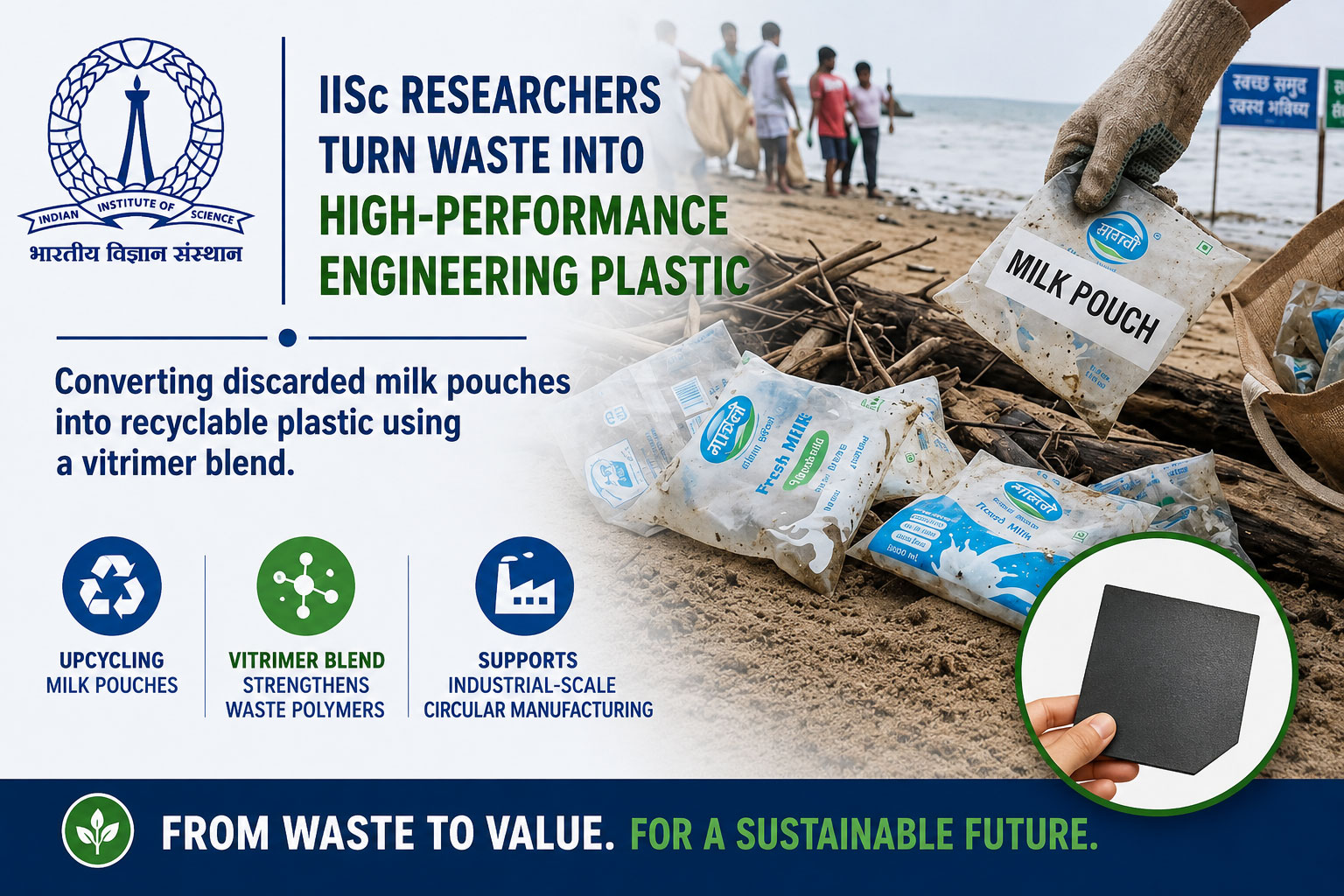
IISc researchers convert discarded milk pouches into recyclable engineering plastic using a vitrimer blend that strengthens waste polymers and supports circular manufacturing at industrial scale.
Turning a difficult waste stream into value
Scientists at the Indian Institute of Science (IISc), Bengaluru, have developed and patented a technology that converts discarded milk pouches into high-performance engineering plastic. The material can undergo multiple recycling cycles without losing its strength, addressing one of the major limitations of conventional plastic recycling.
India discards an estimated 100–120 million plastic milk pouches every day, according to a 2025 report by Chintan Environmental Research and Action Group. That amounts to approximately 36.5–43.8 billion pouches each year. Although manufacturers make these pouches from recyclable polyethylene (PE), collection and processing challenges often send them to landfills, waterbodies or open environments.
The IISc technology could help transform this low-value waste into durable material for industrial products. It also supports a circular-economy model by keeping plastic in use for longer rather than treating it as disposable waste.
Why milk pouches are difficult to recycle
Milk pouches typically contain flexible polyethylene films. Waste collectors and recyclers often find these films difficult to separate, clean and process because they become contaminated with food residues and wet waste. Their relatively low economic value further reduces the incentive to collect them.
Even after collection, conventional mechanical recycling can weaken polyethylene. Repeated heating and reprocessing break down polymer chains and reduce the material’s tensile strength and durability. As a result, recycled plastic often finds use only in lower-value applications and may eventually become waste after a limited number of cycles.
The IISc team designed its process to overcome both problems. Instead of recycling polyethylene alone, the researchers combined it with a specially engineered polypropylene (PP) vitrimer made from post-consumer recycled PP. This PP commonly comes from discarded shampoo bottles, oil containers and similar rigid packaging.
How the vitrimer improves the material
The research team, led by Prof Suryasarathi Bose of the Department of Materials Engineering, included Bhashkar Bohra and Debashrita Kundu. The researchers developed a vitrimer that performs two functions in the blend. It reinforces the recycled polyethylene and acts as a compatibiliser, helping two otherwise incompatible waste plastics combine into a stable material.
A vitrimer contains dynamic covalent bonds that can rearrange under suitable conditions. This structure allows the material to retain the strength associated with a cross-linked network while also allowing reprocessing at elevated temperatures. Researchers can therefore reshape and recycle the material without destroying its mechanical performance.
The team first prepares the recycled polypropylene for vitrimer formation and then blends it with recycled polyethylene obtained from milk-pouch waste. The resulting hybrid system creates a more uniform and mechanically robust material. The researchers characterised the blend through mechanical testing, rheological analysis, gel-content measurements and microscopy.
Higher strength and repeated recycling
The optimised blend nearly doubled the tensile strength of conventionally recycled polyethylene. More importantly, it retained its mechanical properties after three consecutive recycling cycles. That performance distinguishes the material from conventional recycled plastics, which often lose strength with every round of processing.
The researchers processed the material through Fused Granulate Fabrication, or FGF, 3D printing. This approach uses polymer granules to manufacture large or complex components. The team demonstrated the feasibility of producing functional products, including a prototype park bench, from the upcycled material.
The ability to convert the blend into 3D-printing feedstock expands its possible applications. Manufacturers can create components with customised shapes, reduce material waste and produce large parts without relying solely on conventional moulding. The material could therefore support both recycling and advanced manufacturing.
Potential industrial applications
Prof Bose said the technology does not depend on the source or brand of the milk pouch. Recyclers can use milk pouches from different manufacturers, provided they collect and process the material appropriately. He added that the final product can undergo 3D printing and could replace materials currently used in products such as road dividers, bus shelters and logistics containers.
These applications require strength, durability and resistance to repeated use. A recycled polymer that maintains its performance can help reduce the demand for virgin plastic and lower the environmental burden associated with manufacturing new materials.
The material could also support construction-related products, industrial components and public-infrastructure applications. However, manufacturers will need to conduct additional testing for weather resistance, fire safety, impact performance and long-term durability before adopting it at scale.
Segregation remains essential
The new chemistry cannot solve every challenge in plastic waste management. Prof Bose stressed the importance of segregating plastic packaging from wet waste and biomedical waste. Contamination can reduce the quality of recycled products, increase processing costs and compromise the consistency of the final material.
Effective collection systems, source segregation and organised recycling networks will therefore determine how widely the technology can operate. Municipal bodies, dairies, waste-management companies and manufacturers must coordinate to create a reliable supply of clean plastic waste.
Advancing the circular economy
The IISc innovation shows how material science can improve the value of difficult waste streams. Instead of downcycling milk pouches into weaker products, the vitrimer-based process upgrades them into engineering-grade material that can retain its properties through repeated recycling.
The research, published in Nature’s materials science portfolio, provides a foundation for developing high-value manufacturing from mixed polyolefin waste. Its broader significance lies in moving plastic recycling from a one-way process towards a closed-loop system.
If industry partners successfully scale the process, the technology could reduce plastic pollution, conserve raw materials and support domestic manufacturing. It demonstrates that discarded packaging can become a resource when researchers combine polymer chemistry with innovative processing and responsible waste management.
#IIScBengaluru #PlasticRecycling #MilkPouchWaste #Vitrimer #EngineeringPlastic #CircularEconomy #Polyethylene #Polypropylene #3DPrinting #SustainableManufacturing
Disclaimer
The information in this article is based on available public sources and official statements as of the time of publication. While we aim for accuracy, we do not guarantee completeness or correctness. We advise readers to verify key details from official sources before making any decisions. The website (iitiimsamvaad.com) is not liable for any loss or damage arising from the use of this content. The authors are also not responsible for any such loss or damage.